Showing posts with label New York Giants. Show all posts

Monday, February 10, 2014

#451 Jimmy Constable


NOTE: I'm now down to less than twenty cards to post in this set which I've come to love so much. After Mr. Constable here I have another pink card, a black framed one, one last All Star card and a superstar Hall of Famer among those remaining. I will be checking to make sure that I haven't missed one but if not I should be wrapped up by Opening Day. 

It took Jim "Sheriff" Constable five and a half years to make it to the majors after signing with the New York Giants in 1951. He was a minor league workhorse as a starter in the Giants chain winning as many as 19 games in a year. He got a call by the Giants in mid-season of 1956 and was knocked around in two of three appearances and returned to the minors.

The Tennessee native was again with the Giants in August of 1957 with better results. He split a pair of decisions and had a 2.87 ERA in 28 innings out of the bullpen. During the 1958 campaign he was waived by the Giants in June, was picked up by the Indians who waived him in July when he was signed by the Senators.

It was following that 1958 season while pitching winter ball in Cuba that Constable suffered what is described as a 'mental breakdown' that eventually caused him to be out of the game for three years. His Baseball Reference Bullpen page quotes him in Steve Bitker's book The Original San Francisco Giants:


Constable said, "My father was manic depressive. It is inherited. It was through the heavy stress I was under in Cuba after the whole year I had, being with three different teams, then down there with Castro taking over and people disappearing, I had quite a breakdown."
After his layoff and recovery Constable was signed by the Braves in 1962. After pitching for their AAA club in Toronto (his other numbers are better than his 9-14 record) he was given a shot in September to return to the majors. He was given a start for the Braves against the Pirates on September 22 and rewarded the team with a five hit complete game shutout.

That wasn't good enough for the Braves to keep him around though and he was waived and claimed by his original team, the now-San Francisco Giants, who used him mostly in the minors for two years. He got a few innings with the Giants in 1963 but was out of baseball for good after that.

Upon retiring Constable returned to East Tennessee, and he worked as a control analyst at Magnavox for 15 years. He then returned to college for an education degree and taught in the the Washington County, Tennessee schools. Second consecutive featured player who turned to teaching after baseball. 

Jim Constable died in 2002. A few weeks later the local paper had a feature on him. They sort of skirt the metal illness issues he suffered by referring to 'health problems' and his 'nervous condition'. He is pictured here posing in Yankee Stadium and framed in pink. Based on his timeline he was out of baseball when this card was issued. His next (and only other Topps card) came out in 1963 when he had returned.  

Here is the '63:


And I found this signed postcard for sale on eBay. He looks like a kid, doesn't he? 


Wednesday, January 15, 2014

#404 Hank Sauer


At the age of 42 in 1959 Hank Sauer was the third oldest player to have a card in the set. Only Enos Slaughter and Murray Dickson had a year on the guy whose nickname was 'Honker'. While he's shown with his last team, the Giants, Sauer's glory days came with the Chicago Cubs with whom he played from 1949 through 1956.

Sauer's pro baseball career began way back in 1937 when he signed with the Yankees after the western Pennsylvania native had spent a couple of years working in a New Deal Civilian Conservation Corps job to help support his family. He spent three years playing in the Yankee's system and displaying a powerful bat before he was drafted away by the Reds. Over the next seven years Sauer played mostly in the minors for Cincinnati while getting three major league trials of various lengths and putting in a year of military service. His minor league exploits led to his being elected to the Minor League Baseball Hall of Fame.

He took over the left-field job for the Reds in 1948 and proceeded to blast 35 homers while hitting .260 and driving in 97 runs. But a slow start to 1949, combined with a propensity to strike out caused the Reds to trade Sauer to the Cubs in June. He made the most of the change in scenery and in less than 100 games he had 27 homers, 83 RBI and a .291 average. His hitting captured the hearts of Cub fans and they would shower him with pouches of his favorite chewing tobacco during games.

His hitting had improved when he switched to a heavy 40 ounce bat and it never let up during a five season stretch on Chicago's North Side. Dubbed the 'Mayor of Wrigley Field' Sauer hit over thirty homers in each of the next five seasons except one. In 1952 he led the NL in home runs with 37 and RBI with 121. He won the NL MVP Award for that production.

His numbers plummeted in 1955 and he had lost his starting job when the Cubs traded him to the Cards. He played well in a reserve role in St. Louis but was released due to what Sauer claims was his being a bad influence on Stan Musial. Sauer discusses this in his SABR bio:

Sauer, playing as a reserve in 1956, batted 151 times, but he averaged .298 with five home runs and 24 RBIs, despite being hit in the face with a bat during one of the team’s practice sessions. Also, he and his roommate stayed out until after midnight two or three nights a week, which, Hank recollected, Musial enjoyed.
The Cardinals’ management, however, did not favor late-night carousing. Sauer observed, “In September of ‘56, the manager [Fred Hutchinson] came up and said, ‘Hank, we’ve got to let you go.’ I said, ‘Let me go! I’m having a pretty damn good year. Why are you letting me go?’
“He said, ‘Yeah, you’re having a good year, but your roommate is having a lousy year. He’s only hitting .315.’ I said, ‘What the hell’s the matter with .315?’ He said, ‘Musial is not a .315 hitter. He’s a .330 hitter. You’re on your way!’ So I was the one who had to go.”
Sauer revived his career with the Giants in 1957 and earned Comeback of the Year honors but in '58 he was back to a reserve role and in '59 he played sparingly before becoming a coach at mid-season. That ended his playing days. He remained with the Giants in various capacities for 35 years. He died at the age of 84 in 2001 while playing golf.

That's Seals Stadium behind Sauer with it's distinctive red railings. The 'Honker' looks every bit of his 42 years, doesn't he?

Sauer's brother Ed played the outfield for three NL teams in the 1940s. His son Hank Jr. played three years in the lower minors in the 1970s. There are several articles about his days in Chicago on the Chicago Tribune web site. And here is his obit in that paper.

Sunday, January 5, 2014

#368 Don Mueller


Don Mueller is pictured on this card as a member of the White Sox but he spent the bulk of his very successful career with the New York Giants. In eight full and two partial seasons with the Giants Mueller earned a reputation for timely hitting and the ability to put the ball into play.  He was given the nickname 'Mandrake the Magician' for his batting prowess. He also was know for almost never drawing a walk. In fact he struck out only 137 times and drew 156 walks in over 4400 plate appearances with New York.

Mueller signed with the Giants in 1944 and played part-time for their minor league club in Jersey City, New Jersey while mainly doing his duty as a member of the U.S. Merchant Marines. In 1948 and '49 he was a full time ballplayer and hit well enough to get extended looks by the Giants in both of those seasons.

He took over an outfield post with the Giants in 1950 and played for eight seasons compiling a .298 average for them. He went 7 for 18 in the 1954 World Series against the Indians as he helped his club win the title. That was the year he led the league with 212 hits and made the first of his two straight NL All Star squads.

Mueller played a part in the third and deciding 1951 playoff game against the Dodgers. The Hardball Times recaps the details. Dodger fans should look away at this point:

Oct. 3, 1951: It might be the most famous game in baseball history and Mueller helps kick off its most famous inning. The Giants and Dodgers split the first two games of the playoff, and in this winner-take-all contest, Brooklyn takes a 4-1 lead into the bottom of the ninth inning. After Alvin Dark leads off with an infield single, Mueller comes to the plate. So far Mueller is 1-for-12 in the series, but he laces a single out to bring the tying run to the plate.
When Lockman doubles a few minutes later, Mueller breaks his ankle sliding into third. Thus pinch runner Clint Hartung scores a little bit later when Bobby Thomson homers to win the pennant for the Giants. Mueller will not, obviously, play in the World Series, which the Giants lose in six games to the Yankees.
Mueller's numbers declined over the course of his final seasons with the Giants and he was sold to the White Sox prior to 1958 and therefore missed playing for the Giants in San Francisco. He played part time in 1958 but was ailing and got just four at-bats in '59 before he was released by Chicago in May.

Mueller, the son of Pirates outfielder Walter Mueller, raised cattle on his family farm, did some scouting for the Giants and worked in insurance after his playing days. His son Mark played minor league ball.

Wednesday, October 16, 2013

#475 Jack Harshman


San Diego native Jack Harshman began his baseball 'life' as a power hitting, free swinging first baseman for the San Diego Padres of the PCL in 1945. After a year or so of playing on the west coast and a short Navy stint Harshman was obtained by the New York Giants in 1947 and he slugged his way through the Giants' chain for several years. He had modest success in his brief shots in the majors and finally his minor league team owner suggested that Harshman, who pitched batting practice to his teammates regularly, might try pitching full time as a way to return to the majors.

He became a full time pitcher in 1953 and went 23-7 for Class AA Nashville. Despite those lofty numbers the Giants sold him to the White Sox that fall and Harshman began a second life as a major league starting pitcher. In his first season as a major league starter, 1954, Harshman struck out 16 Red Sox in one game and pitched a 16 inning complete game 1-0 shut-out against the Tigers. It is estimated that Harshman threw 245 pitches in that one. 

He went 48-34 in 4 seasons with the Sox and then was traded to the Orioles for 1958. His 12-15 record doesn't compare to his 2.85 ERA that year. A rocky start in 1959 earned him a trade to the Red Sox in June and a waiver ride to the Indians in July. He pitched sparingly for Cleveland in 1960 and had a few minor league appearances in '61 before he retired. 

He never lost his power at the plate. He twice had six homer seasons and that number was good for fifth best among all players on the 1958 Orioles. Among his 76 major league hits are 21 homers! That's quite a ratio. 

Harshman is truly a fascinating guy. Lots to read about in his personal life and professional career. As always there is his SABR bio and then there is a multi-part blog series that I found pretty interesting. You can get to through this site

Here is a 'teaser' from one installment, a quote from the Saturday Evening Post:


Jack Harshman could hit the ball a mile, but his batting average was anemic. Then, aided by the uninhibited girl he married, he turned into a surprisingly crafty pitcher.
"Uninhibited" didn't have the same connotation back then. In this case, it's because she gives advice and shares opinions about his pitching performances.
 There may never have been a baseball wife quite like Frances DeVee Oldman Harshman. She is pert, pretty -- and candidly ambitious for Jack. Her terse, matter-of-fact husband refuses to blow his own horn, but this uninhibited little blonde has been doing it for him ever since they were married in 1950.

Finally, check out this great picture of Harshman as a Giants 1B prospect:


Sunday, October 6, 2013

#307 Curt Barclay


After signing with the Giants in 1952 out of the University of Oregon Curt Barclay finished that season with a nine game taste of pro baseball before he spent 1953 in the military. Returning to the States in '54 Barclay ascended the Giants' farm system with three impressive seasons.

He made the Giants staff in 1957 and was the #3 starter, finished second on the team in wins (9) and had the best ERA among the starting staff. He moved with the club to San Francisco but injured his shoulder early in the '58 campaign and spent most of that year and the next trying to work his way back up to the Giants from their AAA club. After his injury he managed to appear in just seven games for the Giants. His last big league appearance was a rocky 1/3 of an inning that he had in April of '59. He finished out his career with 12 games of minor league ball in 1960.

After his playing days Barclay worked for a lumber manufacturer. He died at the age of 53 in 1985. During his days at Oregon he played alongside Earl Averill on the ball field and was a starter on the basketball team that featured 'Jungle Jim' Loscutoff who played on seven Celtic NBA title teams. 

Wednesday, September 11, 2013

#377 Johnny Antonelli


Johnny Antonelli was signed by the Milwaukee Braves as a 'Bonus baby' in 1948 after he wowed scouts with a no hitter in a Rochester, N.Y. semi-pro all star game before 8000 people. As such the Braves had to keep him on the major league roster through 1950. He was used sparingly and then spent two years in the service. Antonelli claims the military was where he learned to pitch. He is one of a handful of players who never played a day in the minors.
That's apparently true as when he returned in 1953 he went 12-12 with a 3.18 ERA for the Braves. The Braves gave up on him and traded the lefty to the Giants in a deal that paid huge dividends on Coogan's Bluff.
Antonelli turned into the Giants' ace and he went 21-7 with a league leading ERA as the club went to the World Series. In that Series Antonelli earned his ring as he pitched and won Game Two and returned in Game Four with a save out of the bullpen in the Series finale.
For the next five seasons, through the Giants' move to San Francisco, Antonelli pitched about as well as anyone in the league. He had made five NL All Star squads when, in 1960, everything went south. He pitched poorly, squabbled with management and the press, complained about Candlestick Park, was boo'd at home and lost his starting spot.
In 1961 he found himself in Cleveland and then Milwaukee (ironically both teams that had played key parts in his career). He was out of the game after that season. But Antonelli had invested his baseball salaries wisely and made millions with Firestone franchise stores.
Antonelli wrote his memoirs recently and the book was released last year. It has some nice reviews on Amazon. SABR has an informative bio, of course.

Wednesday, July 17, 2013

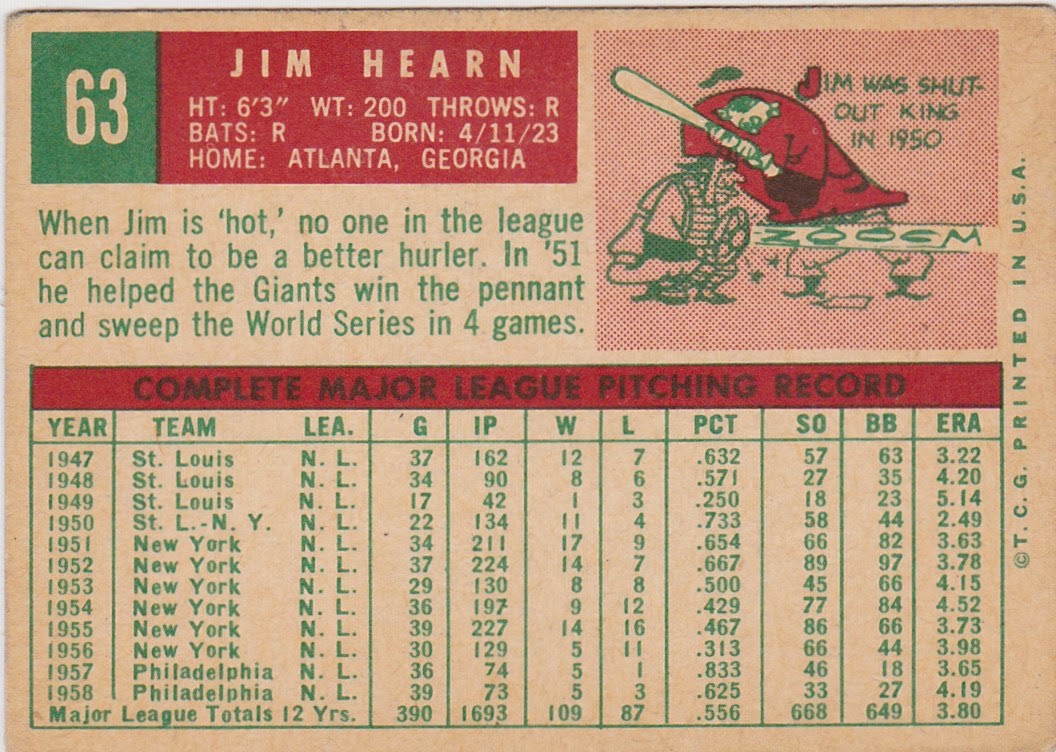
#63 Jim Hearn


In 1959 pitcher Jim Hearn was at the end of his baseball trail. He pitched in 6 games, didn't win any and was released by the Phillies in May, a few months after this Series One card was released. But he'd had a pretty nice career previously, winning 108 games with a solid 3.81 ERA and getting himself a World Series ring with the 1954 Giants.

In 1942 the Cards signed Hearn, a native of Atlanta, out of Georgia Tech and he had a good season of Class B baseball before he was off to the military for three years during WWII.

When he returned in '46 he got in another year in the minors and debuted with the Cardinals in 1947. He went 12-7 that season, slid just a bit in '48, split the '49 campaign between the Cards and the minors and found himself waived to the Giants in July 1950.

He returned to his rookie form with the Giants, went 11-3 the rest of that '50 season, pitched five shutouts and won the NL ERA crown. Not a bad year for a guy who was essentially a late inning mop-up man for the first three+ months of the season.

In 1951 the Giants relied on Hearn as a #3 starter behind 20 game winners Sal Maglie and Larry Jansen. Hearn won 17 games and went on to win his only start in the Series that year against the eventual champion Yankees.  

Hern remained a part of the Giants' rotation through 1956 and won 14 games in '52 and '55. In the Giants 4 game sweep of the Indians in that year's World Series Hearn, by now the clubs' fourth starter, didn't see the field.

Despite a nice ERA he went 5-11 for New York in 1956 and was traded to the Phillies that October. He spent two seasons pitching out of the Phils' bullpen and then, as noted, was released in 1959. He was charged with a loss, the final decision of his career months after his release due to a May game being suspended. He was 'on the hook' for that game and when it was completed in July he took the loss.

Hearn hit two inside-the-park home runs in his career. One came in a game in July of 1955 in which he also hit fence-clearing homer. Pretty remarkable to have two 'leg' homers given that here have been only a total of eight hit by pitchers since 1954. 

Hearn's card features a view that you don't see often (or ever?) in this set. Behind him looms the far left field/center field grandstands of Connie Mack Stadium. Over Hearn's left shoulder is the scoreboard which is topped by the Ballantine Beer sign. 

"Make that three ring sign, Ask the man for Ballantine"


Monday, June 17, 2013

#141 Joe Shipley, The Sporting News Rookie Stars


Welcome to "Joe Week" here at '59 Topps.

Well if Joe Shipley's former teammate Felipe Alou is to be believed:
....Giants manager Felipe Alou said Giants pitcher Joe Shipley once heaved a fastball that went over the screen at Seals Stadium and clobbered a fan. "I heard he was ordered to hit somebody," says Alou. Mission accomplished. (Legend has it that as a minor-leaguer Shipley hit a batter who was in the on-deck circle.)
In 1953 Tennessee native Shipley was acquired by the New York Giants from Vidalia, an independent pro team in the Georgia State League. Shipley had gone 1-9 with a 6.99 ERA and had issued over eight walks per nine innings with the two clubs he pitched for that first season as a pro. But the Giants must have seen potential.

He fought his way up the Giants' minor league ladder while showing some promise mixed in with bouts of wildness. He made one appearance with the now San Francisco Giants in July of 1958 and took a pounding. In 1959 he pitched with the big club into June making ten trips to the hill including one start. He had no decisions but the Giants lost every one of those games. That's a pretty weird stat. 

He made 15 relief appearances with the 1960 Giants, again with no decisions while the Giants went 1-14 in those games. I'm not Dick Tracy but I'm seeing a pattern here. Shipley was released prior to the 1962 season and moved through a couple of organizations before he got one final shot from the White Sox. In three games in July of 1963 he pitched a total of 4.2 innings, gave up 9 hits, seven runs and six walks. He took a loss and that was his only career decision.

The card back blurb notes that if Shipley can ..."control his wildness and cut the corners he'll be a fine major leaguer." 

Shipley pitched in the minors for a few more years and then went on to coach baseball at East Tennessee State from 1966 to 1975. His best record there came in 1972 when his club went 12-7. That's Joe in uniform at ETSU below. And below that is his 1960 Topps cards. Two cards for a guy with one decision in his career. 


Monday, June 3, 2013

#89 Billy Gardner


Billy Gardner began playing professional baseball when he signed with the New York Giants as an 18-year-old infielder in 1945. He banged around their chain and spent a year in the military before he finally debuted in 1954. In April of 1956 he was purchased by the Orioles and stepped into the role of starting second-baseman that year.

In 1957 Gardner blossomed and had the best season of his career, batting .262 while playing every game and leading the league in plate appearances and tying for the lead in doubles. He was voted as the Orioles' MVP and in what had become their first .500 season. While in Baltimore Gardner was known as an 'average Joe' who could be found after most home games enjoying steamed crabs at the popular Obrycki's. 

Gardner, who was known as 'Shotgun' for his powerful arm spent two more seasons as a regular in Baltimore and then was dealt to the Senators where he continued his regular 2nd base duties. Moving with the team to Minnesota, Gardner was lucky enough to be traded to the powerhouse Yankees in June of that year and as a result he picked up a World Series ring. He pinch hit for Luis Arroyo with two down in the bottom of the ninth in Game Two and lined out to short to end the Reds 6-2 win. But his days as an everyday player were over.

He was traded again, now to the Red Sox, in 1962 and played in Boston for one more season before turning his sights to coaching and managing on both the minor and major league levels. As a manager in the Boston organization he was even able to pick up a few at bats as late as 1971 meaning he had a playing career that spanned three American wars.

Gardner managed the Twins from 1981 though part of 1985 with his best season being a third place finish in the AL West and a .500 record. He took over for the ill Dick Howser with the Royals in 1986 but was replaced late in the year. His son, Billy Jr., continues to be a minor league manager.

The Baltimore Sun had a nice article/interview with Gardner in 2011. He currently lives in his home state of Connecticut and seems to be as 'scrappy' as ever..

It's a pretty ordinary card, yellow frame with a Yankee Stadium shot, but Gardner is an Oriole so that's a big plus.

Saturday, June 1, 2013

#216 Andre Rodgers


Andre Rodgers was the first Bahamian to play in the major leagues. The story goes that he was a talented cricket player and paid his way to a New York Giants' try out camp in 1954. Lacking polish and baseball experience Rodgers set about 'learning' the game as he played his way up the teams' chain. As a shortstop he had impressive minor league stats, especially for a guy who hadn't played any baseball prior to his signing. The Giants noticed and he debuted in 1957.

He got month+ 'looks' in '57 and '58 and made an impact in 1959 when he played in 71 games and hit 250 while sharing the shortstop job with Eddie Bressoud. After a 1960 season in which his progress seemed to stall he was traded to the Braves and then on to the Cubs on the eve of the 1961 season.

Another year of platooning gave way to a full time shortstop job with the Cubs in 1962 as he replaced Ernie Banks who was moved to first base. He had his best seasons in Chicago hitting .278 in '62 and 12 homers in 1964. He held that job for three seasons and was traded to Pittsburgh where his output and playing time dwindled. After spending 1968 back in AAA he played one partial season in Japan before retiring.

Rodgers, who passed away nine years ago in his hometown of Nassau, had two brothers who played minor league baseball. One was killed in a car wreck just as his career was starting.


Wednesday, May 22, 2013

#443 Daryl Spencer


After coming out of Wichita State hard hitting infielder Daryl Spencer spent a year in independent ball before being acquired by the New York Giants in 1950. After a 'cup of coffee' in 1952 he broke into the Giants everyday lineup in 1953 and slugged 20 homers with 56 RBI. His .208 average was a career low although his career average was only .244 in 10 seasons.

After that rookie year Spencer spent two seasons in the military and led his army team to an armed services baseball title. Back in the bigs in 1956 he spent the next four seasons as a Giants' starting middle infielder. He was a solid if unspectacular player and was dealt to the Cardinals for 1960 and he played there for a season and a quarter as their shortstop. Then it was on to the Dodgers and Reds in a platoon role.

After he retired from the majors he spent another seven seasons in Japan where he played on four pennant winner with the Hankyu Braves. He slugged 74 homers over his first two seasons there. His aggressive style, especially on the base paths was a revelation to the Japanese and he was a very popular player there. He retired at one point, returned to Wichita to open a restaurant but was drawn back to Japan and served as a player coach before retiring for good after the 1972 season.

After returning to the States for good he managed in amateur ball and worked for Wichita's AA club.

This is a nice clean card with an action pose. I like it a lot for that reason. I'd guess it was taken at Seals Stadium because there were many in the set that were shot there. Plus, Spencer has on the Giants' home uni.

Informative interview done while Spencer was still in Japan can be found here. And as usual his SABR page is the go-to spot for his backstory.

Found this card image on the web. Spencer on a Japanese card.


Monday, April 22, 2013

#28 Red Worthington


I never remember 'Red' Worthington as 'Red'. He was 'Al' Worthington. But then again I don't remember his pitching for the Giants, only the Twins, so don't go by me.

Anyway, Worthington signed with the Chicago Cubs out of the University of Alabama in 1951. He had led the Crimson Tide to an SEC title and a College World Series berth. After an unremarkable year in the Cubs system he was dealt off to the Giants prior to the 1952 season.

He made his major league debut in July of 1953. Boy, did he ever! Worthington became the first major leaguer to open his career with back-to-back shutouts. He beat the Phils (at home) and the Dodgers (in Flatbush) on July 6 & 11 by identical 6-0 scores. He went on to lose his next eight decisions that year before finishing up with a couple of strong starts to land at 4-8 for the season.

He pitched mostly in the minors for a couple of years before returning as a starter in 1956. He began transitioning into a reliever in 1957. He had a career high 11 wins in 1958 and pitched well in '59 but found himself bounced from the Giants to the Red Sox, White Sox and Reds before finding a plsce with the 1964 Twins and taking over the closer role there.

Between '64 and his retirement at the age of forty following the 1969 season Worthington saved 88 games for the Twins with 37 wins and a 2.62 ERA. Following his playing days he went on the coach the Twins in 1972 under his manager from his Giants days, Bill Rigney. He then spent 13 years as the head coach at Liberty University. His book was published in 2004. In 2011 the Birmingham native was inducted into the Alabama Sports Hall of Fame.

There is just enough red in the background of that picture to ID the scene as Seals Stadium. These seafoam green cards have grown on me since i began blogging this set. This one is in great shape other than the slight yellowing of the cardboard.

Btw... there was another Red Worthington, an outfielder for the Braves and Cards in the early 30s. That Red and Al were not related.

Saturday, April 20, 2013

#19 Ed Bressoud


Eddie Bressoud had a long baseball career. Signed by the Giants in 1950 he played three years in their farm system, gave two years to military service and returned to play a couple more seasons in the minors. He debuted with the Giants, still based in New York, in June of 1956. He opened the '57 season back on the farm but returned to the big club in July of that year.

As the team moved west Bressoud gained more playing time at shortstop, playing in over a hundred games in both 1959 and 1960. In 1961 his slick fielding was no longer enough to hold off other competitors for the starting slot and he was relegated back to the bench in place of Jose Pagan.

The Houston Colt '45s took Bressoud as their first expansion pick and them dealt him to the Red Sox. While he missed by a year the chance to play on the Giants' 1962 NL Champs club, he did enjoy his best big league seasons with the Red Sox. He had double digit homers and his best batting averages in three seasons in Fenway. He made the AL All Star squad in 1964 but didn't get into the game, a fact that he was always bitter about. By 1966 however he had been traded to the Mets and then to the Cards for 1967. He got a Series ring and a couple of at bats in the '67 Series against his old Red Sox club.

He managed a year in the minors before becoming a teacher and coach at DeAnza Community College in California. Bressoud has said that despite his success in Boston and that title in St. Louis, he always considered himself as a member of the Giants.

I'm guessing that Bressoud (btw...Baseball Reference gives the pronunciation as 'bruh-sue', with a silent 'D' which means I have had it wrong for 40 50 years) posed for this picture while a member of the New York Giants which would explain the hatless pose chosen. But that could be the Los Angeles Coliseum so, who knows.

Thursday, February 21, 2013

#378 Gail Harris


First baseman Gail Harris played all or part of six big league seasons, half with the New York Giants and half with the Detroit Tigers. After a five year climb through their minor league chain he had modest success with the Giants but is the answer to the question, "Who hit the last homer for the New York Giants?"

Harris' best season came the year this picture was taken, 1958. He had nearly 500 at bats and punched out 20 homers and 83 RBI to go with a .273 average. His numbers fell off the earth the next year (9-39-.221) with 100 less at bats and in 1960 he played in only a handful of games for Detroit before being traded to the Dodgers in May. He spent the rest of 1960 and all of 1961 in the minors and then called it a career.

He then turned to the business world and had a long career with Nationwide Insurance in his native Virginia.

Oh, BTW.... googling 'Gail Harris' led to this (ahem) 'actress'. Just sayin' <-NSFW!!!

The stuff one finds!


Saturday, January 12, 2013

#309 Sal Maglie


Sal Maglie is one of the most interesting guys I've come cross in blogging the '59 set. Out of Niagra Falls Maglie signed with the New York Giants in 1938. He spent five uneventful seasons in the Giants chain and at one point left the game and worked at a defense plant in New York. (He had been rejected for military service for a sinus condition). He then returned to baseball, pitched in the Giants chain and debuted in 1945. When the '45 season was over Maglie jumped to the Mexican League after having issues with Manager Mel Ott. That earned him a five year ban from the majors.

During his five years away.... well there is no way I can capture the color of Maglie's career in a blog post. And there is no point in re-inventing the wheel. I refer you to the exceptional SABR bio which is found here and is highly recommended.

The short version is that Maglie became a highly successful pitcher for the Giants and Dodgers and garnered more major league time with the Indians, Yankees and Cards. He's one of about a dozen players to have been with all three original New York franchises. He had been released in April of 1959 and therefore was out of the game by the time this card was issued by Topps.

He finished with 119 wins, a 3.15 ERA, an ERA title, a wins title and World Series title and one of the coolest nicknames in baseball history, 'The Barber'.

There is a You Tube video of a 1956 appearance Maglie made on the old "What's My Line?" TV show. It was broadcast live on the evening of October 7, 1956. That was the same day as the fourth game of the World Series.  The NEXT DAY Maglie pitched and lost in one of the most celebrated World Series games ever played, Don Larsen's perfect game. On the panel is Yankee Phil Rizzuto who was wrapping up his career. The video is here. It runs immediately upon opening the page so I didn't embed it. Here's a still shot.


Other Maglie notes:

Sal Maglie Stadium is home to minor league and collegiate baseball in Niagara Falls, New York. The original Sal Maglie Stadium is profiled here.

He had pitched his own no-hitter just two weeks prior to the Larsen perfecto.

He served two stretches as Red Sox pitching coach and saw his last uniform duty as the pitching coach for the Seattle Pilots.

His post playing career life was a roller coaster of triumph and tragedy and again I refer you to the SABR bio or this book available on Amazon.

edit: Amazon link cleaned and replaced. Dunno what was up with that

Friday, December 7, 2012

#502 Al Dark


Alvin Dark played for 14 seasons in the majors beginning in 1946 and ending with his retirement as a player in 1960. His whole playing career was a a National Leaguer. Along the way he played every spot on the diamond except behind the plate. He even pitched a inning in 1953.

Coming up with the Boston Braves he was the NL's Rookie of the year in 1948 and finished third in the MVP balloting. That season he batted .322 and was 4th in the league in that category. He played for the Braves in the Series that year. Heady stuff for a rookie. After his average slipped to the .270s in 1949 the Braves dealt him to the Giants where he continued his outstanding play in the field and at the plate. He made three All Star games with the Giants.

After six seasons with the Giants, and having helped them win a World Series title in 1954, Dark was traded to the Cardinals early in the 1956 season and he stayed there for a year and a half before being moved on to the Cubs during the '58 season. He split the 1960 season between the Phils and Braves and it was the first year in 13 seasons that he wasn't a full time player.

After retirement as a player he began a long and largely successful career as a manager starting with the Giants with whom he went to the Series in 1962. After stints with the Kansas City A's and Indians he managed the Oakland A's to the 1974 World Championship.

Dark had been a highly successful three sport college athlete at LSU and had served in the Marines in WWII. His SABR entry contains some interesting stories of his days prior to MLB fame.

Dark appears in Cubs' road gear on this pink framed '59 card. He joined the Cubs during the previous season. It appears to have been taken in Seals Stadium in San Francisco as were several other Cub cards I've shown. A little research shows that the photo was taken on one of the three trips the Cubs took out west after the trade was made.

Monday, November 12, 2012

#529 George Bamberger


George Bamberger had over 200 minor league wins in a career that stretched from 1946 to 1963. Along the way he made a handful of major league appearances, seven games with the Giants in 1951/52 and three more in 1959 with the Orioles, the year this card was issued. Those games in 1959 were in April and as noted on the back of his card he was sent down in May. He never made it back to the big leagues as a player.

But he did spend a lot of time in big league dugouts. He started coaching in the minors in the early 60s even as his active playing career was winding down. He became the Orioles' minor league pitching instructor and the was named as pitching coach of the O's under Earl Weaver in 1968. He kept that job through some very glorious years for the Birds. The Orioles had four Cy Young winners and 18 twenty game winners during his time there.

In 1978 he left the Orioles and took the managerial job with the Milwaukee Brewers. That season he won the majors Manager of the Year award while guiding the Brewers to a 93-69 third place finish, He had another good year in '79 but suffered a heart attack in the spring of 1980 and resigned after that season.

He managed the Mets in 1982 and part of '83 and returned to Milwaukee as skipper in 1985/86. In each of those seasons his clubs were below .500. 'Bambi' died in 2004. Former Orioles and Mets GM Frank Cashen called him the best pitching coach he ever seen. From that NY Times obit:

''He was the best pitching coach I ever saw,'' Frank Cashen, the former general manager of the Orioles and the Mets, said in a telephone interview yesterday.
He recalled that Bamberger gave his pitchers plenty of work.
''He believed in a four-man rotation,'' Cashen said. ''His theory was, the arm was a muscle, and the more you used it, the better off you were, as long as you didn't abuse it.''
Cashen remembered that Orioles Manager Earl Weaver ''was very flamboyant and not afraid to take pitchers to task vocally,'' but that ''George was very quiet; he was their friend.''

I like this high number card for a number of reasons, not the least of which are appreciation for what he did as the Orioles pitching coach and the fact that the back is printed, as are all '59 high numbers, in black and red on cream colored cardboard. Plus it's in really nice shape. The palm tree gives away the fact that this was a spring training shot.

Friday, May 11, 2012

#243 Marv Grissom


Marv Grissom looks like the state senator representing the western district of Nebraska, don't you think? Or maybe a parish priest. I can't decide. 

After a couple of minor league looks and a four year stint in the service during WWII Grissom finally debuted briefly as a 28 year old rookie with the New York Giants in 1946. He disappeared back to the minors soon after that and traveled through the Tigers organization before establishing himself with the White Sox in 1952. That year he started 24 games, won 12 of them and posted a respectable 3.74 ERA. But he was traded to the Red Sox prior to 1953. They waived him and he was claimed by the Giants in July of that year.

He spent that year and the next five as a bullpen stalwart for the Giants in New York and, in 1958, San Francisco. 1954 was his best season. He won 10 games and saved 19. He was an All Star that year and won a World Series ring by helping the Giants defeat the Indians.

Grissom won Game One of that Series, entering immediately after the famous Willie Mays catch of  Vic Wertz' shot to deep center. He finished out that game allowing a hit and three walks in 2.2 innings.

Grissom was traded to the Cardinals following the 1958 season and pitched briefly for them. He had injured his back in the spring and never got healthy. He retired in June of that year.

Following his career he served several clubs as a pitching coach. Over three stints he coached the Angels hurlers for 15 seasons. Marv's brother Lee pitched for four clubs in the 30s and 40s. Their nephew Jim Davis pitched for three clubs in the 50s. 

A nice interview of Marv Grissom appears on the web here and an obit here. This webpage makes the statement that Grissom was recommended to the Giants by Johnny Mize who played against him on service teams during their time in the Pacific. And Grissom has stated the same thing. Baseball Reference shows he was signed by the Giants in 1941. I don't know the significance of the fact that Grissom was a Giants farmhand before his service play. Or if it's just a coincidence. Or that it matters. 

Another pink border card. I don't know what the players felt about them when they got the freebies from Topps but I like them. There is a crease in the lower right corner that my scan hides pretty well. Marv is pictured in his Giants gear here.

Sunday, April 10, 2011

#464 Mays' Catch Makes Series History


This may not be the best catch in baseball history, even Willie Mays said he made better ones himself, but it's surely the most famous. As the back of the card states Willie made this nab on a ball hit by Vic Wertz in Game One of the 1954 World Series between the Giants and Indians. He snared it with his back to the plate, wheeled and threw to the infield forcing Al Rosen to return to first. The Giants won the game in 10 innings and swept the Series.

What has added to the fame of the catch is the fact that it was televised in a era when TV was still a bit away from being the universal presence that it is nowadays. Watching the Series on the tube was an opportunity that was hard to pass up. Thus Willie's effort was seen by many. 


The best catch I've ever seen live was made by Roberto Clemente at Shea Stadium on September 20, 1969. With two out in the sixth inning Bob Moose seemed about to lose a no hit bid on a drive to the deep right field corner by Wayne Garrett. But Clemente ran/flew/dove and somehow speared the ball before if hit the warning track. It was the most athletic play I've ever seen. And yes, Bob Moose went on to finish his no hitter, the only one I've ever witnessed in person.

Friday, March 18, 2011

#297 Jackie Brandt


No, it's not a bad scan.... my Jackie Brandt card is pretty beat up. Surface scuffs, soft corners, blemishes, a small tear and a crease or two. To say nothing of Topps' horrible attempt to project the Giants 'SF' logo onto Brandt's cap.

I sure that this photo was taken during his time as a New York Giant. in 1956. Brandt spent time in the service, missing the '57 and most of the '58 seasons. In the meantime the Giants moved out to the West Coast. Topps airbrushed many of the New York Giants' caps in 1958, adding this rather strange 'SF' logo that only vaguely resembles the actual one. They ended up using this on Brandt's '59 card as shown. Fugley.

Brandt's career ran from his debut with the Cardinals in 1956 through a stint on the '67 Astros. He made stops along the way with the Giants as mentioned in New York and San Francisco in Baltimore and Philadelphia. His best seasons came as an Oriole from 1960 through '65. 

He held down a regular outfield job with the pre-Frank Robinson O's and in fact was indirectly involved in Robby acquisition. He was dealt to the Phils in December of 1965 for Jack Baldschun who himself was part of the package the O's sent to the Reds 4 days later.

Notes on Jackie Brandt:
  • He played 3rd base in the first game I ever saw in the Astrodome
  • He was the 'cover boy' for Sports Illustrated's 1961 Baseball Issue.
  • There is a long and far ranging interview with Jackie here. But if you can get through it or make heads or tails of much of it your reading comprehension is a lot better than mine.