Showing posts with label Chicago White Sox. Show all posts

Saturday, March 8, 2014

#537 Rodolfo Arias


If you're going to play only one season of major league baseball you might as well make it a season that ends up with a World Series, right? And so it was with lefty pitcher Rodolfo 'Rudy' Arias. A Cuban native he had pitched in his home country for several years before signing with the Chicago White Sox in 1953 as a 22 year old.

Interestingly he had been approached by Joe Cambria, the Senators' 'super scout' who had reeled in so many Cuban stars for the Nats in the 50s. But Arias, on the advice of a Cuban baseball executive, put off signing with Cambria. He had hopes of drawing interest on a baseball trip his Cuban team was about to take to the States. And he was right. Based on his play the White Sox made a much larger offer than Cambria routinely did.

Beginning with his first season in the minors in '53 Arias pitched nearly year-round as he traveled back to Cuba to play in the winter leagues there. His first minor league season was his best but he continued to climb the Sox' ladder despite less than gaudy stats until he made the club in the spring of 1959.

That year he appeared in 34 games with the White Sox, all in relief. He totaled 44 innings and posted a 4.09 ERA to go with a 2-0 record. He made his last appearance of the season late in August but was on the Sox' post-season roster when they played the Dodgers in the World Series. Arias did not get into a Series game.

He was back in the minors in 1960 and moved through several organizations, never resurfacing in the big leagues. He last pitched in Mexico in 1966 after he had 'retired' for several seasons due to an arm ailment. After retiring for good Arias worked in the Miami area in construction and security. His interesting life and career are told best on his SABR bio page.

His oldest son, also named Rudy, was a catcher in the Mariners organization and remains in baseball today serving as the Orioles bullpen catcher.

Free bonus... image of a Cuban baseball card of Rudy Arias. This is the place that sells them.


Just a few cards to go,

to be exact.

Sunday, February 16, 2014

#493 Jim Landis


California native Jim Landis was a five time Gold Glove winner  for the White Sox and as a member of the '59 Go-Go Sox he helped that club win the American League pennant. He began his baseball career by signing with Chicago in 1952 and played two seasons of minor league ball before spending two years in the military.

Landis returned to baseball in 1956 and hit well enough to earn a spot in the Sox' outfield in 1957. He seemed over-matched by big league pitching and was sent to the minors for five weeks in late summer. In '58 he blossomed and hit .277 with 15 homers and was the everyday center fielder.

His '59 season was good enough to garner some MVP votes and in the Series against the Dodgers he hit .292 and made some crucial defensive plays in a losing effort. In 1960 he began his string of Gold Glove seasons and in 1962 he played in the All Star game. He was in the top three in many defensive categories among A.L. outfielders between 1958 and 1963.

But his offensive numbers had been sliding since his 22/85/.283 season in 1960 and he was traded to Kansas City for 1965 where his hitting had a slight uptick. But after a year there the A's dealt him to the Indians and he spent the '66 season watching his stats slide again. His last season in the game was 1967 which he split between the Astros, Tigers and Red Sox. His stay with Boston was only about a week and he wasn't able to stay around to possible play in the '67 Series with them.

He was in the sign business after retiring. SABR is as always the best place to read up on Landis' career and Baseball Almanac has an interesting interview with him. Jim's son Craig Landis played minor league baseball and is currently a player agent

Sunday, January 5, 2014

#368 Don Mueller


Don Mueller is pictured on this card as a member of the White Sox but he spent the bulk of his very successful career with the New York Giants. In eight full and two partial seasons with the Giants Mueller earned a reputation for timely hitting and the ability to put the ball into play.  He was given the nickname 'Mandrake the Magician' for his batting prowess. He also was know for almost never drawing a walk. In fact he struck out only 137 times and drew 156 walks in over 4400 plate appearances with New York.

Mueller signed with the Giants in 1944 and played part-time for their minor league club in Jersey City, New Jersey while mainly doing his duty as a member of the U.S. Merchant Marines. In 1948 and '49 he was a full time ballplayer and hit well enough to get extended looks by the Giants in both of those seasons.

He took over an outfield post with the Giants in 1950 and played for eight seasons compiling a .298 average for them. He went 7 for 18 in the 1954 World Series against the Indians as he helped his club win the title. That was the year he led the league with 212 hits and made the first of his two straight NL All Star squads.

Mueller played a part in the third and deciding 1951 playoff game against the Dodgers. The Hardball Times recaps the details. Dodger fans should look away at this point:

Oct. 3, 1951: It might be the most famous game in baseball history and Mueller helps kick off its most famous inning. The Giants and Dodgers split the first two games of the playoff, and in this winner-take-all contest, Brooklyn takes a 4-1 lead into the bottom of the ninth inning. After Alvin Dark leads off with an infield single, Mueller comes to the plate. So far Mueller is 1-for-12 in the series, but he laces a single out to bring the tying run to the plate.
When Lockman doubles a few minutes later, Mueller breaks his ankle sliding into third. Thus pinch runner Clint Hartung scores a little bit later when Bobby Thomson homers to win the pennant for the Giants. Mueller will not, obviously, play in the World Series, which the Giants lose in six games to the Yankees.
Mueller's numbers declined over the course of his final seasons with the Giants and he was sold to the White Sox prior to 1958 and therefore missed playing for the Giants in San Francisco. He played part time in 1958 but was ailing and got just four at-bats in '59 before he was released by Chicago in May.

Mueller, the son of Pirates outfielder Walter Mueller, raised cattle on his family farm, did some scouting for the Giants and worked in insurance after his playing days. His son Mark played minor league ball.

Friday, January 3, 2014

#386 Jim Delsing


When this card was issued in 1959 outfielder Jim Delsing had played 806 of his 822 major league games, he hadn't been in the majors for two years, he was still a year away from returning to the bigs (briefly) and he had never taken the field in a Washington cap (and never would).

Also in his rearview was a unique moment that arose in August of 1951 when, as a member of the St. Louis Browns, he was called upon to pinch-run for Eddie Gaedel the 'little person' that owner Bill Veeck had his club use as a pinch-hitter. Delsing describes the whoe situation in his SABR bio thusly:
"Mr. Veeck owned St. Louis back in 1951, and he was always doing some promoting. This happened at a Sunday double-header on August 19, and between games they brought out a great big, huge cake. Out of the cake popped Eddie Gaedel, wearing a St. Louis Browns uniform, with 1/8 on the back. He gets out of the cake and walks over to the dugout. We knew nothing about it. We took a look at the lineup. I had a couple of hits in the first game, so I thought I would sure be playing." 
"I went up to Zack Taylor, who was manager, and he said, Cool it. You'll be all right.' Taylor had Frank Saucier leading off. When it came time for Saucier to bat, Taylor called him back, and told Gaedel to bat for Saucier. We all thought it was a joke, because Mr. Veeck used to do all kinds of promotions. Gaedel walked up to the plate, and the umpire said, You can't bat.' But Mr. Veeck had this all worked out. Gaedel reached in his pocket and pulled out a major league contract. So they had to let him hit. Bob Cain was the Tiger pitcher, and Bob Swift was the catcher. Gaedel had a strike zone that was about an inch and a half! He walked on four pitches, and Zack Taylor said to me, Now go run for Gaedel.' Then I knew what he was talking about, why I wasn't playing the second game."

That's Gaedel in the center of this picture and Delsing is #18 leaning against the pole to the left.


Delsing had begun his pro career in 1942 with a year of independent ball in his native Wisconsin. He was signed by the Cubs and played a minor league season in their chain before serving Uncle Sam for two years. Returning from the service Delsing found his contract had been obtained by the White Sox and he played for nearly three full seasons in the upper reaches of that team's system. He hit well enough to earn looks with the Sox at the beginning and end of the 1948 season.

He was traded to the Yankees prior to 1949 and was called up for a September look during which he hit .350 and impressed his teammates enough that they voted him a small World Series share despite his not being active for it.

He hit well to start the 1950 season for the Yanks but was traded to the Browns in June as part of a seven player deal. He was a regular in the Browns outfield putting up pedestrian numbers and was traded again, this time to the Tigers in August of 1952.

Three plus seasons as an everyday player for the Tigers was highlighted by his best season, 1953, when he hit .288 with 11 homers and 61 RBI. Subsequent seasons brought diminishing numbers and in May of '56 he was again traded, this time back to the White Sox. Over the next three years Delsing moved around the minors via a dizzying string of trades and purchases that saw him being the property of the Tigers (again), the minor league Houston franchise, the Senators (for a few months of the off-season between the 1958 and 1959 seasons) and finally the Kansas City Athletics where in 1960 he re-emerged in the majors for the last five weeks of the season. that was his last in uniform.

After baseball Delsing worked for the archdiocese of St. Louis for thirty years. He has a son who is a pro golfer and a grandson who played Major League Soccer.

For more of Jim Delsing and his interesting career (and he has some cool stories to tell) see his SABR bio or this interview done a few years back with the Missouri History Museum's magazine.

As noted Delsing never suited up for the Senators in a regular season game and his shot features a drawn "W" logo on his cap. I get the vague impression the this pic shows the left-centerfield area of Yankee Stadium in the background.

Tuesday, December 24, 2013

#341 Tom Qualters


Tom Qualters had one of the best nicknames I've come across among the '59 set subjects. His Phillies teammates in 1953/54 called him 'Money Bags'. That came from the fact that Qualters, signed to a $40,000 'Bonus Baby' contract as a high school phenom, was a member of the Phils roster for both of those seasons and pitched a total of one third of an inning. Left him plenty of time to count his cash I suppose.

That old rule required players signed for more than $4,000 to remain in the majors on the signing club's roster for two years or risk losing them to waivers. Qualters was signed out of McKeesport, Pa. and made his debut on September 13 of that '53 season in a blowout loss to the Cardinals. He got an out but allowed six earned runs on 5 hits including a homer, a walk, a wild pitch and to ice the cake, he hit a guy. His ERA for the day/season was 162.00 which is not reflected on his '59 Topps card's stat line.

He was sent to the minors in 1955 and remained there for most of the next three seasons putting up pretty respectable numbers. He was recalled to the Phils in September of 1957 and was treated roughly in seven outings. After one game as a Phil in '58 he was sold to the White Sox. He pitched decently the rest of the way in the A.L. pitching in 26 games but was back in the minors in 1959 and he kicked around several organizations' system before retiring after 1962. His major league totals read 0 wins, 0 losses, 5.64 earned run average.

After baseball Qualters worked as an enforcement officer for the Pennsylvania Fishing and Game Department. His grandson Shawn Stiffler is head baseball coach at VCU. Another grandson, Ian Stiffler was drafted this season by the Braves and pitched in the Gulf Coast rookie league.

According to both Baseball Reference and Wikipedia Tom Qualters, shown on this card in Yankee Stadium, holds the distinction of being the only pitcher to appear on a Topps baseball card four times without ever recording a decision!

Wednesday, October 16, 2013

#475 Jack Harshman


San Diego native Jack Harshman began his baseball 'life' as a power hitting, free swinging first baseman for the San Diego Padres of the PCL in 1945. After a year or so of playing on the west coast and a short Navy stint Harshman was obtained by the New York Giants in 1947 and he slugged his way through the Giants' chain for several years. He had modest success in his brief shots in the majors and finally his minor league team owner suggested that Harshman, who pitched batting practice to his teammates regularly, might try pitching full time as a way to return to the majors.

He became a full time pitcher in 1953 and went 23-7 for Class AA Nashville. Despite those lofty numbers the Giants sold him to the White Sox that fall and Harshman began a second life as a major league starting pitcher. In his first season as a major league starter, 1954, Harshman struck out 16 Red Sox in one game and pitched a 16 inning complete game 1-0 shut-out against the Tigers. It is estimated that Harshman threw 245 pitches in that one. 

He went 48-34 in 4 seasons with the Sox and then was traded to the Orioles for 1958. His 12-15 record doesn't compare to his 2.85 ERA that year. A rocky start in 1959 earned him a trade to the Red Sox in June and a waiver ride to the Indians in July. He pitched sparingly for Cleveland in 1960 and had a few minor league appearances in '61 before he retired. 

He never lost his power at the plate. He twice had six homer seasons and that number was good for fifth best among all players on the 1958 Orioles. Among his 76 major league hits are 21 homers! That's quite a ratio. 

Harshman is truly a fascinating guy. Lots to read about in his personal life and professional career. As always there is his SABR bio and then there is a multi-part blog series that I found pretty interesting. You can get to through this site

Here is a 'teaser' from one installment, a quote from the Saturday Evening Post:


Jack Harshman could hit the ball a mile, but his batting average was anemic. Then, aided by the uninhibited girl he married, he turned into a surprisingly crafty pitcher.
"Uninhibited" didn't have the same connotation back then. In this case, it's because she gives advice and shares opinions about his pitching performances.
 There may never have been a baseball wife quite like Frances DeVee Oldman Harshman. She is pert, pretty -- and candidly ambitious for Jack. Her terse, matter-of-fact husband refuses to blow his own horn, but this uninhibited little blonde has been doing it for him ever since they were married in 1950.

Finally, check out this great picture of Harshman as a Giants 1B prospect:


Tuesday, October 8, 2013

#328 Lou Skizas


As soon as you get to Lou Skizas' Baseball Reference page and you see that he was known as "The Nervous Greek" you know that there is an interesting story here. And when you check out the first paragraph of his SABR bio, you know that there most certainly is:

“I was a character in baseball. I saw it as an interim type of career,” Lou Skizas told Bill Gleason. Skizas, known as “The Nervous Greek” during his four-season major-league playing career, was perhaps best known for an unusual ritual that he followed before coming to bat. Before reaching the plate, the right-handed-batting Skizas dropped his bat, covering it with dirt. Then, wiping the bat off by rubbing it between his pants legs, he kissed the end of the bat before reaching into his back pocket at least three times to touch an object that was said to be a good-luck piece. Placing all of his weight on his right leg, Skizas kept his left foot off of the ground until just before the pitch reached the plate. This was the unorthodox style that belonged to the man Casey Stengel once called “the greatest natural-looking hitter I've ever seen.”
Skizas was born in Chicago and raised in a home where only Greek was spoken. He claims to have been labeled as 'retarded' (his words) when he first entered school because he didn't know what his teacher was saying. As a ballplayer in high school he caught the eye of Yankee scouts and was signed in 1949 and while playing in their farm system he developed a close friendship with Mickey Mantle that remained in place all their lives. Skizas spent two seasons in the military along with his five years in the minors before he got a token shot with the Yankees in 1956. He was dealt (as all marginal Yankee players were then) to the Kansas City Athletics in May of '56.

He hit .316 in about 300 at bats that year and held down a regular outfield spot for the club in '57. That winter he was part of a huge 12 player deal that sent him to the Tigers with whom he split the '1958 season between the majors and minors. The White Sox drafted him prior to 1959 but traded him to the Reds early in the season. He was therefore technically a part of the Sox' AL champion club but he was long gone by the fall. He played for three season in the Reds' chain and one more in Detroit's, never again making a major league appearance. He also played in Cuba during the winter of 1959.

He finished with a .270 lifetime average and had 30 homers. After retiring Skizas finished a bachelor's degree he'd been working on for over a decade and then went further by adding a masters and doctorate in biology. He was a college professor in Illinois at Illinois State and the University of Illinois-Champaign along with coaching the schools' baseball teams.

As late as the 1990s he continued to be part of the game as a part-time scout for the Cubs in the Chicago area.

Friday, October 4, 2013

#560 Luis Aparicio The Sporting News All Star


Luis Aparicio makes his third appearance in the 1959 Topps set with this All Star card. It follows his regular issue card and his Keystone Combo special card appearance alongside Nellie Fox.In his career Looie make 8 All Star squads appearing in 10 games. His Hall of Fame career is not reflected in his All Star game numbers as he went 2 for 25 with one stolen base in those 10 games.

No way to tell if this shot was taken at the same time as his regular issue card photo but they were both taken at Yankee Stadium.


Wednesday, October 2, 2013

#154 Ray Herbert


Detroit native Ray Hebert signed with his hometown Tigers in 1949 and after putting up some nice minor league stats he got a taste of the majors in 1950. He spent most of 1951 and all of '52 in the service before returning to Detroit and taking a spot in the Tigers' bullpen.

He had control problems and was beaten up pretty badly over two seasons before he was sold to the Athletics for the 1955 season. Another subpar year led to a couple of seasons back in the minors. He returned to the bigs in 1958 and had better results in a swingman role. The next two years saw Hebert gain a spot in the Athletics' rotation and he won 25 games for some pretty bad KC clubs. He was traded to the White Sox in June of '61 and he career took another turn for the better.

He went 20-9 with a 3.27 ERA in 1962 and he made his only All Star appearance, a game he ended up winning. He won fewer games in 1963 (13) but he led the A.L. with seven shutouts and had a 3.24 ERA. His numbers declined after that and he was out of the majors following 1965 after a couple of seasons with the Phillies.


Friday, August 30, 2013

#73 Ron Jackson


The 6'7" Ron Jackson was a basketball star in high school and continued his hoops prowess at Western Michigan University in his hometown of Kalamazoo MI.

Jackson was also a big enough baseball prospect to be signed as a 'bonus baby' by the Chicago White Sox in 1954. As such he was required to remain on the roster for two seasons and in his first year with the Sox he hit .280 in 40 games. In '55 he again played 40 games but his numbers were disappointing and  beginning in 1956 he was bouncing back and forth between the Sox and the minors through 1959.

Traded to the Red Sox he got into only ten games in '60 and spent most of that year and the next again in the minors. He retired at age 28 to go into the insurance business. He died of pancreatic cancer in 2008.

The Kalamazoo Gazette, Jackson's hometown newspaper, ran a tribute to Jackson after his death. It touches on his character, his two sport career and has memories from his family. It's a nice read.

This is another in a string of nicely preserved cards that I've been posting. Not exactly 'pack fresh', but pretty darn close. And there are those Yankee Stadium pennants again.

Thursday, August 22, 2013

#264 Chico Carrasquel


Shortstop Alfonso 'Chico' Carrasquel, one of the first Venezuelan players to play in the majors, was the first Hispanic player to start in an All Star game. That came in his second season, 1951 when he beat out Phil Rizzuto for the slot.

His rookie season of 1950 saw Carrasquel hit .282 and he was third in the Rookie of the Year voting. That average turned out to be a career high but he hit well enough to keep the White Sox shortstop job where he teamed with Nellie Fox to form a slick DP pairing for six seasons before his 1957 trade to the Indians. A trade prompted, at least in part, to open the job at starting shortstop for fellow Venezuelan Luis Aparicio.

Carrasquel had been signed by the Dodgers out his hometown of Caracas but was unlikely to supplant Pee Wee Reese with the Dodgers so he was sold to the Sox after a year in the Dodger train. In total he made four All Star squads with the Sox and consistently ranked at or near the top of the AL in fielding categories.

After his trade to the Indians Carrasquel played another three seasons as a regular (or close to it). As his numbers declined he played for the A's and finally the Orioles in his final year, 1959. He was signed in the following off season by the White Sox but was released prior to the opener. He signed with the Dodgers and spent the year with their AAA club in Montreal. The White Sox--->Dodgers ending to his career gives it a nice 'Bell Curve' sort of feel.

When his playing days ended he coached and managed in his native country and scouted for the White Sox. He later was their Spanish language broadcaster.

In this short Chicago Tribune interview Carrasquel discusses his career and his carjacking in Valenzuela in 2003. His 2005 New York Times obituary contains tributes from teammates and others that speak to Carrasquel's influence and talent.

I never like Oriole players depicted in anything other than the proud orange and black so here are a handful of Carrasquel photos from 1959, his only season in Charm City.


Saturday, August 10, 2013

#410 Billy Pierce


This is the fourth card featuring White Sox lefty Billy Pierce that I've posted out of this set. And it's the last. First up was a look at the special card ( #156 Ace Hurlers) he shared with Robin Roberts and a little detective work into the background of the picture Topps used. Then came his card in the Baseball Thrills subset (#466 Pierce All Star Starter) and soon after was his '59 Sporting News All Star card (#572 Billy Pierce '59 All Star Selection). This one is obviously his regular card.

While I like any card with the Yankee Stadium background this is far from the best Billy Pierce card issued during his career. He's one of those guys who, like fellow lefty Whitey Ford, was always referred to as 'the crafty...' or 'the stylish..(insert name)'. I don't know what it was about those guys that made them 'stylish', or even what it means exactly. I do know that there are a bunch of really cool pictures of Pierce floating around. I have a Pierce card collection and I'll post some of them on my 5 Tool blog and at the bottom of this post will be a couple of the pics I found.

Pierce, a Detroit native, was a Tigers signee in 1945. He opened the season on the Tiger staff for six weeks but didn't get into a game. Sent to the minors he returned to the big club before the season ended and pitched in Fenway Park in his first game. He was with the team when they won the World Series that season. He was eligible for and received a Series champs ring despite pitching only 10 innings in the majors all year. He was 18 years old.

He was hurt for a good part of '46 and pitched in the minors in 1947 before making the club again in '48 but he was hardly used and his numbers were atrocious. Being traded to the White Sox that winter proved a turning point and he went on to have an exceptional 13 year career for the Sox. He won 186 games for a team that was climbing steadily out of the doldrums during the 50's. They broke trhough to play in the 1959 World Series but lost to the Dodgers. Pierce, a 14 game winner who was injured late in the season, was put in the bullpen for the Series. He allowed just two hits in four innings of work.

After two more winning seasons on the South Side Pierce was traded to the Giants where he finished out his career. He had a sterling 1962 season, winning 16 games and helping the Giants reach the World Series. He started two games and pitched very well but split his two decisions. He finished third in Cy Young voting in the NL that season. Pierce retired after the 1964 season with 211 career wins and an ERA of 3.27 in 18 seasons.

The best Pierce ever did in Hall of Fame voting was less than 2% of the votes back in 1971. I'm not saying he should have made it but 2%? That's just silly. The JAWS ranking of all starting pitchers puts him 96th at the moment. That's ahead of ten Hall of Famers including Chief Bender, Dizzy Dean and far ahead of Catfish Hunter.

Pierce's highlights from Baseball Reference:

Major League Bests
  • Wins: 20 (1956, 1957)
  • ERA: 1.97 (1955)
  • Innings: 276 1/3 (1956)
  • Strikeouts: 192 (1956)
  • WHIP: 1.02 (1964)
  • Saves: 8 (1963)
Notable Achievements
  • 7-time AL All-Star (1953, 1955-1959 & 1961)
  • AL ERA Leader (1955)
  • AL Wins Leader (1957)
  • AL Strikeouts Leader (1953)
  • 3-time AL Complete Games Leader (1956-1958)
  • 15 Wins Seasons: 8 (1951-1953, 1955-1958 & 1962)
  • 20 Wins Seasons: 2 (1956 & 1957)
  • 200 Innings Pitched Seasons: 9 (1950-1953 & 1955-1959)
  • Won a World Series with the Detroit Tigers in 1945 (he did not play in the World Series)
The SABR site has some great nuggets of info in the Pierce bio page and this Chicago news website has a neat story linking Billy Pierce and former Sox perfect game pitcher Mark Buehrle.

And here at a few nice shots of the 'crafty & stylish' lefty found on the 'net:


Wednesday, July 31, 2013

#179 Don Rudolph


Lefty pitcher (and Baltimore native!!) Don Rudolph seems like an average guy. Pitched 17 seasons of professional baseball including a long stretch climbing through the White Sox system. Spent some time in the service. Had a spectacular sophomore minor league season when he went 28-8 in the Georgia State League in 1951.
Got in 6 big league seasons (all or parts of) with the White Sox, Reds, Indians and Senators. Was 18-32 for his big league career. He actually led the AL in fielding percentage at his position in 1963. He's the only White Sox player in the 1959 set to have a green framed card. Died at the age of 37 from injuries sustained in a truck accident.
And he has this intriguing cartoon on the back of his '59 topps:


He was married to a professional dancer. That's kind of unusual. Maybe we should look into this. Turns out he was married to one Miss Patti Waggin. And here is a publicity still of said dancer:


scroll down, please cover the eyes of any impressionable children.


Scroll some more.


Bingo.
Here's the happy couple.


And they are again. She really is quite attractive. Go back and look at the cartoon. It resembles her I think.


Ms. Waggin has a website. You can join her fan club (and Don Rudolph's as well it seems).


And just to prove that SABR covers every angle, below is their take on the courtship of Don and Patti.
One night in 1954, Rudolph made a fateful visit to a nightclub that soon changed his life. Performing that night was Patti Waggin, a popular burlesque dancer. Patti, whose real name was Patricia Artae Brownell, was born into a family of vaudeville performers. After dropping out from Chico State College in California, where she was known as the “Coed With the Educated Torso,” she performed burlesque numbers throughout the country. By the time she met Don, she was well-known in her field, appearing on a list of top 10 strippers in the country. Rudolph said that after sitting through three straight shows that night, it was “love at third sight.” However, when he tried to approach Patti after the last show, he was rebuffed. But Don was a persistent man and when he saw an advertisement for another performance in his hometown of Baltimore, he went to see her again. After another initial rebuff, he was able to charm Patti and buy her a soda. From there, their relationship blossomed and in 1955, they were married.
Who knew there was a list of "Top Ten strippers"? You just can't make this stuff up. There is a Patti Waggin Facebook page which, along with that 'fan' page revolves mostly around the author's penchant for shilling this book.


OK, this may get me suspended from Blogger, but here are a few more pics of the lovely Ms. Waggin.


After this point, you're on your own.

LATE EDIT.....looks like I have lost two 'followers' today. I was at 56 yesterday. Seems Patti Waggin is still casting her spell.

Sunday, July 21, 2013

#453 Les Moss


This is one of my favorite cards in the '59 set. First of all Ohio native Les Moss was an original Baltimore Oriole having come over with the club from St. Louis for the '54 season. He's wearing a uniform I favor, the simple White Sox road gray of the mid/late 50s with the sleeve number. And finally he is posing in the classic catchers' pose, the 'baseball card squat' and has the facade, lights and flags of the original Yankee Stadium displayed behind him.

Moss' professional baseball career was long and varied. He spent all or parts of 13 big league seasons with four AL clubs beginning with the Browns in 1946 and ending with the White Sox in 1958. Never an everyday catcher, Moss has six or so years in which he carried about half the load behind the plate. While never an All Star or dangerous hitter, Moss did have some seasons with double digit homers and respectable batting averages. His primary skill, however, was as a defensive standout and he was known as an exceptional handler of pitchers.

By the time this card was issued Moss was no longer a major leaguer. In fact he had had only two at bats in 1958 despite having been on the White Sox roster all that year. He served as the teams' bullpen and third catcher for the season and got into only two games. In 1959 and 1960 he was transitioning from active player to the coaching and scouting jobs by working in the Sox organization at the major league and AAA level and occasionally playing for the Sox' San Diego farm club.

From that point forward Moss held scouting, coaching and managerial jobs until he finally left the game in 1995. He managed in the majors with the White Sox on two occasions in the late 60s as interim skipper and he took the reigns of the Tigers in 1979. Just when it appeared that Moss, called a 'faithful soldier' by some, was going to get a long deserved shot at a full time managerial gig, Hall of Famer Sparky Anderson came available and the Tigers jumped. Just 53 games into that '79 season, and with Moss directing his club to a one game over .500 record, Detroit, not wanting Anderson to take another available job, kicked Moss to the curb and signed the former Reds' manager.

Moss bounced back by taking a job in the Cubs' organization as a pitching coach/instructor and then in 1982 he joined the Astros as pitching coach and outlasted several managers in Houston. He was very well thought of and respected by the Houston press and the fans. He moved on to the Giants' organization and served as pitching coordinator before finally retiring in 1995.

A long and distinguished career leads to a lot of kudos and Moss, who died in 2012, has a rather interesting SABR bio. It's recommended reading.

Here is Les Moss' '54 Bowman. Part of my Orioles collection.


And here is the 1979 Topps Tigers Team card featuring Les Moss.


Monday, July 15, 2013

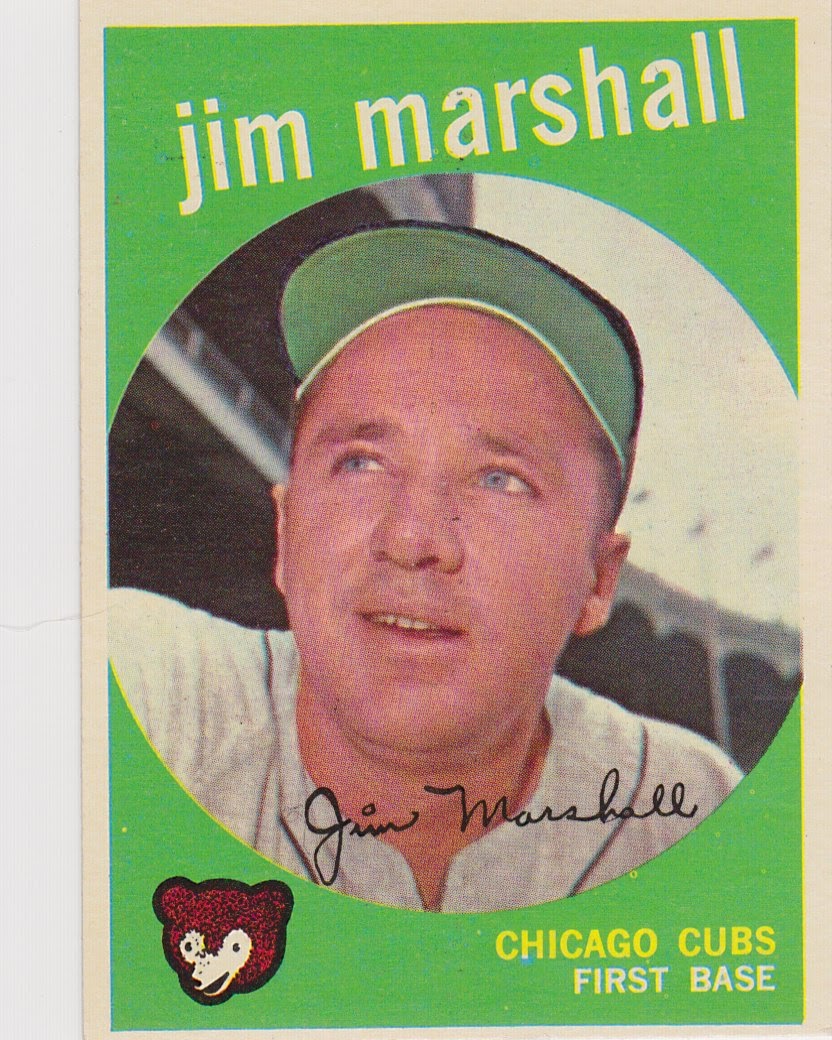
#153 Jim Marshall


I'd venture a guess to say the two closest things to major league baseball without actually being the majors have been the old independent PCL and the Japanese Leagues. Jim Marshall spent quite a bit of time in both of those, and he got in five seasons in our big leagues as well.

Marshall signed with the White Sox in 1950 and for the next eight seasons he put up some big power numbers with the Oakland Oaks of the PCL and various farm clubs in the Sox, Giants and Orioles' chains.

He debuted with the Orioles in 1958, was the regular first baseman for awhile and in August was waived due to his .215 average and went to the Cubs. His averages continued to be low while his power, so good in the minors, dried up against major league pitching. 1959 was his busiest and best big league season. He got into over 100 games with the Cubs and had 11 homers and 40 RBI in nearly 300 at bats.

That off season was a hectic one for Marshall. He was traded to the Red Sox who in turn traded him to the Indians during spring training of 1960. But when Sammy White, the other player traded to the Indians, refused to report Marshall was returned to the Cubs. Four days later, still before the season started, the Red Sox dealt Marshall to the Giants for Al Worthington.

He spent two seasons with the Giants, was sold to the expansion Mets for '62 and then was traded to the Pirates in May. While a member of the Mets he became the first player to homer in consecutive games for that club.

Following his tour with the Bucs he went to Japan and played three seasons over there.Since his playing days he has been a coach on two continents, managed in the big leagues for both the Cubs and A's and is currently in the front office of the Arizona Diamondbacks as Senior Advisor, Pacific Rim Operations. 

That's an Orioles uni Marshall is wearing at Yankee Stadium on this '59 card. Love the facade and flags flying on top of Yankee Stadium. So many memories.

Marshall is the victim of a very shoddy airbrush treatment on his 1961 Topps card. Just look at the cap.