Showing posts with label Connie Mack Stadium. Show all posts

Monday, February 24, 2014

#494 Don Pavletich


Don Pavletich is an interesting guy on an interesting card. He was signed out of Wisconsin by the Reds for a big bonus in 1956. The card-back claims it was a 'reported $40,000' while Pavletich, in this book excerpt on Google which I referenced numerous times for this post, says it was $30,000 but reported as $20,000. Whatever it was it qualified him as a 'bonus baby' and obligated the Reds to keep him on their roster.  

He began his pro career in 1957 when he reported to spring training. He was on the Reds roster as the season opened and pinch hit (he walked for Don Newcombe) in one game. Then at the urging of the Reds he joined the Army in May. The plan was that he could play service ball and get experience without taking up a valuable roster spot and sitting around. He spent the rest of that year and all of 1958 in the military. Interestingly he says that he was discharged three months before the end of his two year hitch on a hardship appeal. The hardship being that he had to be in spring training to pursue his livelihood!

When he returned in 1959 he again played in a single game but this time, instead of heading overseas, he headed for the minors. He had two solid seasons there, played with the Reds in 1962 and was used sparingly. Two seasons split between the Reds and the minors followed and finally, in 1965, he had a full year as a major league platoon catcher and he hit a career high .319. Another good year  (.294 with 12 homers) followed in 1966 but by then a young Johnny Bench was on the Reds' catching horizon and Pavletich's days were numbered in Cincy.

His numbers and playing time took downward trends (he played more first than catcher in '68) and he was traded to the White Sox for 1969. A broken hand limited his playing time and he was dealt to the Red Sox where he played on a limited basis for two years. After an off season trade to the Brewers in the winter of '71/'72 he was released that March. He did not return to the majors and worked as a mortgage loan officer after baseball. 

That card is pretty unique in this set. Pavletich poses in catching gear with a red cap and in what appears to me to be Connie Mack Stadium. The windows and posts in the stands seem to make it so. Check this picture of the old ballpark and see if you agree. 


But when was it taken? He was with the Reds early in 1957 and they played in Philadelphia early in April so that's a possibility. He was in Europe in the Army during 1958. They also played there early in 1959, maybe early enough to have his photo snapped in time to be included in this set. But knowing Topps that just doesn't seem likely. 

But that cap. Assuming it's not 'colored' by an artist and really is red than that becomes an interesting clue. The Reds wore that cap in 1956 before going to the white crown version in 1957. It may be that Pavletich, after signing in '56, was brought to Philadelphia for a look at the club or to iron out details. The Reds were there in mid-September. And Pavletich himself spoke of signing in '56 but not reporting until '57 Or they team may have had him come for the actual contract signing and some publicity pics. That sort of this isn't unusual even today with big dollar prospects. 

I'll never know but tracking down stuff like this keeps me interested in this set even 500+ posts into it.

Thursday, December 12, 2013

#269 Jack Meyer


Jack Meyer was a hard throwing right-hander who was originally pursued by the Yankees but decided to attend Wake Forest University instead. I couldn't find his name among a list of letter winners on their baseball site but those type of things are often incomplete. In any case in 1951 Meyer was signed by the Phils and put together some impressive seasons as a starter as he rose through their system.

The Phils put him on their big league roster in 1955 and used him out of the bullpen for the most part. He rewarded them with a league high 16 saves and finished second to Bill Virdon of the Cardinals in the Rookie of the Year balloting.

Meyer would never again approach those first year numbers. He picked up only five more saves over the rest of his career as the Phils made him into a middle reliever. He was 24-34 over the course of six seasons in Philadelphia before back problems forced him out of baseball at the age of 29 after one 1961 appearance.

He died at the age of 34 of a heart ailment in 1967. His son, also called 'Jack' was well know in the sport of surfing and related industries in the Northwest. He too died of heart problems. He was only 53 when he passed away in 2007.

Meyer follows Seth Morehead as the second consecutive Phillies pitcher to be shown here on the '59 Topps Blog in a Connie Mack Stadium photo. Looking closely at the two cards shows that they were almost undoubtedly photographed on the same day. The banner on the upper deck railing to the right of each of them is identical.

Tuesday, December 10, 2013

#253 Seth Morehead


On the last day of the 1957 season lefty Seth Morehead became the answer to two trivia questions: "Who was the last pitcher to face the Brooklyn Dodgers?" and "Who was the last pitcher to face Roy Campanella?"

In that game on September 29th, Morehead's first career start and first win, he hurled a tidy four hitter as the Phils won, 2-1. Campy pinch hit for Dodger starter Roger Craig in the top of the eighth and flied to center. (Side note... Sandy Koufax pitched the bottom of the eighth to become the last man to throw a pitch in a Brooklyn uniform.)

Up until that point in his rookie season Morehead had pitched 33 times in relief with a loss and a save. He finished the year with an ERA of 3.68 which was down from well over 6 in mid-July. Prior to that season he had spent five seasons as a starter in the Phillies' system following his signing out of Shreveport, Louisiana in 1951.

Morehead made eleven starts for the Phillies in 1958 and was treated pretty roughly by NL hitters. His '59 numbers were trending the same way when the Phils moved him to the Cubs in May. His work that year for the Cubs produced the similar results but in 1960 he improved significantly. Although he was only 2-9 on the North Side appeared in 45 games and had his best WHIP and his ERA was below 4.00 for the first time since his rookie year.

Traded to the Braves on the eve of the 1961 season, Morehead picked up an early season relief win but he was ineffective otherwise and by late May he was in the minors. One last appearance came in September of that year and then he was back in the minors for two seasons before retiring.

After baseball Morehead completed his degree at Baylor University and was in the finance/insurance business for 36 years before he retired for good. In this book excerpt writer Willie Morris tells a good story of meeting him at a banquet many years after Morehead had fanned him four times in a Louisiana youth league championship game.

Pretty neat card with Morehead shown at Connie Mack Stadium inside a black frame.


Wednesday, July 17, 2013

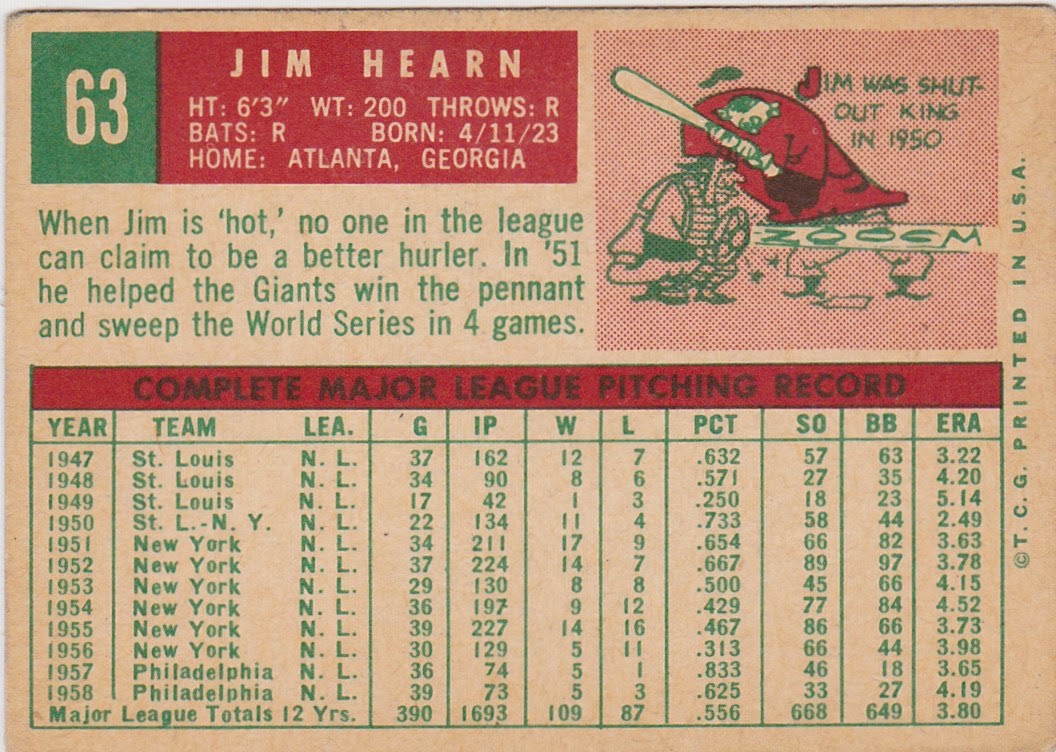
#63 Jim Hearn


In 1959 pitcher Jim Hearn was at the end of his baseball trail. He pitched in 6 games, didn't win any and was released by the Phillies in May, a few months after this Series One card was released. But he'd had a pretty nice career previously, winning 108 games with a solid 3.81 ERA and getting himself a World Series ring with the 1954 Giants.

In 1942 the Cards signed Hearn, a native of Atlanta, out of Georgia Tech and he had a good season of Class B baseball before he was off to the military for three years during WWII.

When he returned in '46 he got in another year in the minors and debuted with the Cardinals in 1947. He went 12-7 that season, slid just a bit in '48, split the '49 campaign between the Cards and the minors and found himself waived to the Giants in July 1950.

He returned to his rookie form with the Giants, went 11-3 the rest of that '50 season, pitched five shutouts and won the NL ERA crown. Not a bad year for a guy who was essentially a late inning mop-up man for the first three+ months of the season.

In 1951 the Giants relied on Hearn as a #3 starter behind 20 game winners Sal Maglie and Larry Jansen. Hearn won 17 games and went on to win his only start in the Series that year against the eventual champion Yankees.  

Hern remained a part of the Giants' rotation through 1956 and won 14 games in '52 and '55. In the Giants 4 game sweep of the Indians in that year's World Series Hearn, by now the clubs' fourth starter, didn't see the field.

Despite a nice ERA he went 5-11 for New York in 1956 and was traded to the Phillies that October. He spent two seasons pitching out of the Phils' bullpen and then, as noted, was released in 1959. He was charged with a loss, the final decision of his career months after his release due to a May game being suspended. He was 'on the hook' for that game and when it was completed in July he took the loss.

Hearn hit two inside-the-park home runs in his career. One came in a game in July of 1955 in which he also hit fence-clearing homer. Pretty remarkable to have two 'leg' homers given that here have been only a total of eight hit by pitchers since 1954. 

Hearn's card features a view that you don't see often (or ever?) in this set. Behind him looms the far left field/center field grandstands of Connie Mack Stadium. Over Hearn's left shoulder is the scoreboard which is topped by the Ballantine Beer sign. 

"Make that three ring sign, Ask the man for Ballantine"


Tuesday, December 11, 2012

#39 Ed Bouchee


After an impressive 1952 debut in the minors Ed Bouchee spent a couple of years serving in the military during the Korea conflict. He returned in 1955 and as a Phillies farm hand he continued his fine hitting. He got his chance in the majors as the regular first baseman for the Phils in 1957 and didn't disappoint. In fact he was second in Rookie of the Year balloting and picked up some significant MVP votes. He had lots of promise.

But that all changed following that '57 season when he was arrested on a morals charge in his native Seattle. No need to re-tell the story here but it's easy enough to find it. The incident cost Bouchee the first half of the '58 season and Topps dropped his card from the 1958 set. Returning in July Bouchee just couldn't match the spark of his rookie year and in fact he never did.

He was dealt to the Cubs for the 1960 season and was taken by the Mets in the '61 expansion draft. The woeful '62 Mets proved to be Bouchee's final stop in the big leagues although he spent 1963 with their AA club. He finished with a .262 lifetime average and 61 homers.

This pink framed card marked Bouchee's return to the Topps card world. And note how Topps handles his 1958 season. They state he 'got a late start.' That's Connie Mack Stadium that he's posing in. I guess it wasn't too much of a hike for the Topps photographers to get down to Philly. I never did get there despite not living all that far away for many years as a kid.

BTW.... indispensable blogger Bob Lemke has produced a nice '58 Topps 'card that never was' for Bouchee.

Tuesday, November 6, 2012

#278 Chuck Essegian


Six big league teams employed outfielder Chuck Essegian in six big league seasons. And in only one season, 1962 with the Indians, was he anything close to being a regular. But there is more to Essegian than that. He had a big moment in the sun during the 1959 World Series as a Dodger.

In that Series he pinch hit a pair of homers, the second of which came when he hit for Duke Snider. Essegian tells that story (and a lot more) in this L.A.Times article from 1995. He'd been with the Dodgers for only six weeks before that fateful Series. He had come over in a mid-season deal from the Cardinals and then was in the minors for a few months before being called up.

In a lot of the stuff I dug up on Essegian he seemed to have put baseball completely behind him once his career ended. But during his second career, as a lawyer in California, he seems to have mellowed. Again the L.A. Times relays a story about Essegian and a young fan with whom he reconnected many years later. Yet another L. A. Times article, this one from 2006, elaborates on Essegian's times with the Dodgers.

As a football player at Stanford before his baseball days Essegian played in the Rose Bowl and remains one of very few players to have appeared in that game and a World Series. Essegian's contemporary Jackie Jensen is another other as is Jackie Robinson.

As noted Essegian rarely had a full-time spot with any club but he certainly had a good year in 1962 when he knocked out 21 homers in just under 400 at bats. That was as close as he ever came to matching the power he flashed in his minor league career.

Nice portrait on Essegian on this card. The smile is in contrast to the reputation he had as a glum and dour personality. Obviously an airbrushed logo on his cap. Looks like Connie Mack Stadium behind him. He played in Philadelphia in 1958 and by blowing up the card I could barely make out pinstripes on Essegian's jersey.

Saturday, September 29, 2012

#353 Robin Roberts


From 1950 through 1955 Robin Roberts was a truly dominant force in the National League. He won 138 games over that six year stretch, made the All Star game each season and finished in the top 7 of MVP balloting five times.

Not that he was slouch for the rest of his 19 year Hall of Fame career but on the mound during the first half of the decade he was damned impressive.

From his Baseball Reference Bullpen page:

  • 7-time NL All-Star (1950-1956)
  • 4-time NL Wins Leader (1952-1955)
  • 5-time NL Innings Pitched Leader (1951-1955)
  • 2-time NL Strikeouts Leader (1953 & 1954)
  • 5-time NL Complete Games Leader (1952-1956)
  • NL Shutouts Leader (1950)
  • 15 Wins Seasons: 10 (1949-1956, 1958 & 1959)
  • 20 Wins Seasons: 6 (1950-1955)
  • 25 Wins Seasons: 1 (1952)
  • 200 Innings Pitched Seasons: 14 (1949-1960, 1963 & 1964)
  • 300 Innings Pitched Seasons: 6 (1950-1955)
  • Baseball Hall of Fame: Class of 1976

After signing with the Phillies in 1948 Roberts pitched a very strong half season in Class B Wilmington before a call-up in June of that year. He had decent results but he didn't quite show any sign of what was to come. A 15-15 year in 1949 led to a 20 win season in 1950 as the 'Whiz Kids' made it to the World Series where they fell in four to the Yankees. Roberts pitched a 10 inning Game Two and lost a 2-1 decision to a Joe DiMaggio homer.

Roberts never made it back to the postseason but he did make it to Cooperstown after nearly two decades in baseball. After 14 years with the Phils Roberts had stints in Baltimore (four years), Houston and Chicago with the Cubs. He finished with 286 wins while pitching for some pretty sad teams.

After his final major league game in 1966 Roberts pitched for the Reading Phillies in 1967. He later coached for nearly a decade at the University of South Florida.

Little known Robin Roberts facts: He was sold to the Yankees for 1962 and was on their roster but didn't appear in a game before being released and signed by the Orioles in late May. He's the only pitcher to have beaten the Braves in Boston, Milwaukee and Atlanta. He had a traveling basketball troupe during the baseball off-seasons and frequently faced the Globetrotters. His hometown of Springfield, Illinois has a stadium named for him.

Roberts poses here in a shot taken at Connie Mack Stadium. Nice break from the Yankee Stadium shots that dominate this set. 

Sunday, April 24, 2011

#452 Chico Fernandez


Guys don't go by 'Chico' very often these days. This 'Chico', Cuban born Humberto 'Chico' Fernandez,  was a hot shortstop prospect when he signed with the Dodgers in 1951. Only one thing kept Fernandez from grabbing a roster spot in Flatbush... Pee Wee Reese. Brooklyn brought Fernandez up in July of 1956 and gave him a audition, moving Reese over to third to hold down Jackie Robinson's slot for a few weeks. Fernandez batted .227 in his time on the big club and was dealt to the Phillies for the 1957 season.

He held down the starting job there for a couple of seasons before losing it (possibly to a mid-year injury) in 1959. Traded to Detroit before the 1960 season he took over the shortstop job there for three seasons. In 1962 he hit 20 homers. This from a guy who hit a total of 40 in his entire career. I wonder if they checked his bat?

In May of '63 he was traded to the Braves and on to the Mets in one day. He finished out that year in New York and then bounced around through the systems of several organizations and the Mexican League. He quit for good in 1968.

Off-center, pink frame, foul ground fielding pose. Nothing really special here, except the ballpark! It's Connie Mack Stadium for sure. Nice to see something besides Yankee Stadium on a card.

Monday, April 18, 2011

#99 Ted Kazanski


Here is Ted Kazanski. This is the last card I needed to finish this set and it was generously provided to me by fellow Oriole fan and collector Ed Schott. Thanks again, Ed.

Kazanski was a Phils signee in 1951 and received a reported $100,000 bonus. He made his way to the majors in 1953 and made a splash in his debut becoming the first shortstop since 1920 (when RBIs became an official stat) to drive in four runs in his first game.

He spent six years with the Phils frequently traveling between AAA and the big club. He had a career .217 batting average. In March of '59 he was dealt to the Braves but never again played in the majors. After bouncing between six clubs' organizations he retired in 1964.

Kazanski's career highlight came on September 25, 1955, the final game of that season. That day in the Polo Grounds against the Giants he performed an extremely rare feat. Kazanski hit an inside-the-park homer and started a triple play to finish off a 3-2 Phillies win! How rare is that combo of unusual baseball plays? It wasn't until last season, 55 years after Kazanski's moment in the sun, that it was duplicated. The Mets' Angel Pagan pulled it off on May 19 against the Nationals.

Kazanski talked about his accomplishment in the wake of Pagan's big day. You can read a couple of accounts of it all here and especially here . Really good stuff with some interesting side plots including a Phils narcoleptic reliever sleeping through it all in the bullpen.