Showing posts with label Phillies. Show all posts

Friday, January 4, 2013

#65 Frank Torre


Frank Torre may not have had the baseball success enjoyed by his younger brother Joe, but he did alright for himself after signing with the Braves out of Brooklyn's St. Francis Prep in 1951. After a year in the minors, two in the service and two more back with the Braves farm clubs Torre debuted in 1956.

For four years with the Braves he either held down the first base job or split time with Joe Adcock. Torre hit two homers and batted .300 in ten at bats in the 1957 World Series win over the Yankees. 1958 was his best season as he hit over .300 and had career highs in homers and RBI. The back of the card write up makes note of his fielding prowess at first base.

His numbers dropped in 1959 and by the following season he was back in the minors for a long stretch. After another full minor league season he was sold to the Phils for 1962 and he hit .310 for them in a part time role. He retired after 1963 to work for the Rawlings Sporting Goods Company.

In later year Torre received both a heart and kidney transplant. He is the father of one time Pirate prospect Frank Torre Jr. who currently coaches high school ball.

I really am partial to this card. Looks like the Polo Grounds in the background, the light blue frame compliments the Braves uni and card logo, the 'M' cap is one of my favorites and, maybe most of all, Frank Torre looks like and extra from the original Oceans Eleven that starred Frank Sinatra and Dean Martin among others.


Sunday, November 18, 2012

#527 Solly Hemus


Solly Hemus served a four year apprenticeship in the Cardinals chain in the 40s as he climbed through their talent-rich system. He took over the shortstop job in 1951 and held it for more than three seasons displaying a decent bat and the ability to score runs. His playing time waned as players like Ken Boyer emerged in the mid to late fifties and eventually he was dealt to the Phillies.

With the Phils he was primarily a second baseman and once again had a starting job in 1958. But he was released and signed on with the Cards for the 1959 season as a player-manager, a job description much more common back in the day than it is now.

Hemus managed for two and a half seasons but didn't appear as a player after 1959. He was replaced by Johnny Keane midway through the 1961 season. He later coached with the Mets and Indians and managed in the Mets system until he entered the oil business in Houston where he had played for three years in the Cards' chain.

A couple items of interest... pretty nice write up of Hemus' career can be found here and a 1954 Sports Illustrated article about the baseball cards of the day uses Hemus in the title.

And finally here is a closer look at the cartoon on the back of Hemus' card. As was pointed out in the case of the cartoon on Ron Kline's card by Deal, this one wouldn't fly today.


Tuesday, November 6, 2012

#278 Chuck Essegian


Six big league teams employed outfielder Chuck Essegian in six big league seasons. And in only one season, 1962 with the Indians, was he anything close to being a regular. But there is more to Essegian than that. He had a big moment in the sun during the 1959 World Series as a Dodger.

In that Series he pinch hit a pair of homers, the second of which came when he hit for Duke Snider. Essegian tells that story (and a lot more) in this L.A.Times article from 1995. He'd been with the Dodgers for only six weeks before that fateful Series. He had come over in a mid-season deal from the Cardinals and then was in the minors for a few months before being called up.

In a lot of the stuff I dug up on Essegian he seemed to have put baseball completely behind him once his career ended. But during his second career, as a lawyer in California, he seems to have mellowed. Again the L.A. Times relays a story about Essegian and a young fan with whom he reconnected many years later. Yet another L. A. Times article, this one from 2006, elaborates on Essegian's times with the Dodgers.

As a football player at Stanford before his baseball days Essegian played in the Rose Bowl and remains one of very few players to have appeared in that game and a World Series. Essegian's contemporary Jackie Jensen is another other as is Jackie Robinson.

As noted Essegian rarely had a full-time spot with any club but he certainly had a good year in 1962 when he knocked out 21 homers in just under 400 at bats. That was as close as he ever came to matching the power he flashed in his minor league career.

Nice portrait on Essegian on this card. The smile is in contrast to the reputation he had as a glum and dour personality. Obviously an airbrushed logo on his cap. Looks like Connie Mack Stadium behind him. He played in Philadelphia in 1958 and by blowing up the card I could barely make out pinstripes on Essegian's jersey.

Monday, October 29, 2012

#178 Ruben Amaro


Ruben Amaro Sr. is the son of a Mexican League star and the father of the current Phillies GM as well as a couple of other budding ballplayers. Born to a Cuban father and Mexican mother Amaro came up through the Cardinals chain as a good fielding/fair hitting shortstop and made his debut with the Redbirds in 1958.

Traded to the Phillies after that season he spent a year plus in their chain and emerged again midway through 1960 as their regular shortstop. He remained with the Phils as a 'semi regular' through the 1965 season, spelling Bobby Wine at short and any number of other infielders.

((Semi-relevant sidebar))-->
Amaro was a member of one of my favorite non-Oriole teams, the 1964 Phillies who were famous for their challenge for the pennant that was derailed by Gene Mauch's use of his starting staff (or so goes the theory). That club featured Dick Allen (his remarkable rookie year), Johnny Callison, Wes Covington and a couple of one-time O's catchers, Gus Triandos and Clay Dalrymple. And on and on. They had a seven some odd game lead in August and ended up finishing a game back of the Cards. I saw them sweep two doubleheaders from the Mets at Shea that year!!!
<--((End semi-relevant sidebar))

Amaro won a Gold Glove for that 1964 club. He did it despite starting only 76 games in the field. Traded to the Yanks for the '66 season he was their regular shortstop in 1967 for a perfectly horrible ballclub. But his career was winding down and after a brief fling with the Angels and a stint back in the Phils minor league chain he was finished as a player after 1971. He remained in the game as a coach, scout and minor league manager. Amaro currently serves as a member of the board of the Baseball Assistance Team (BAT) an organization founded to help former Major League, Minor League, and Negro League players through financial and medical hardships.

Looks to be the Polo Grounds behind Amaro in the card's photo. The Phils logo is a nice accent to the red framed card. 

Saturday, October 13, 2012

#121 Bob Conley The Sporting News Rookie Stars


After signing with the Phils out of Kentucky in 1953 Bob Conley pitched his way up the minor league ladder until he was called up for a September look in 1958.

A seven inning, six hit debut versus the Dodgers was followed by an early KO at the hands of the Cubs a few days later. And that was all there was to Conley's career. He threw for a couple more seasons in the minors before hanging up his glove in 1960.

Not surprisingly Conley info is hard to find. He reportedly worked in the restaurant business after his retirement and lived in New Jersey. That's all I got.

Saturday, September 29, 2012

#353 Robin Roberts


From 1950 through 1955 Robin Roberts was a truly dominant force in the National League. He won 138 games over that six year stretch, made the All Star game each season and finished in the top 7 of MVP balloting five times.

Not that he was slouch for the rest of his 19 year Hall of Fame career but on the mound during the first half of the decade he was damned impressive.

From his Baseball Reference Bullpen page:

  • 7-time NL All-Star (1950-1956)
  • 4-time NL Wins Leader (1952-1955)
  • 5-time NL Innings Pitched Leader (1951-1955)
  • 2-time NL Strikeouts Leader (1953 & 1954)
  • 5-time NL Complete Games Leader (1952-1956)
  • NL Shutouts Leader (1950)
  • 15 Wins Seasons: 10 (1949-1956, 1958 & 1959)
  • 20 Wins Seasons: 6 (1950-1955)
  • 25 Wins Seasons: 1 (1952)
  • 200 Innings Pitched Seasons: 14 (1949-1960, 1963 & 1964)
  • 300 Innings Pitched Seasons: 6 (1950-1955)
  • Baseball Hall of Fame: Class of 1976

After signing with the Phillies in 1948 Roberts pitched a very strong half season in Class B Wilmington before a call-up in June of that year. He had decent results but he didn't quite show any sign of what was to come. A 15-15 year in 1949 led to a 20 win season in 1950 as the 'Whiz Kids' made it to the World Series where they fell in four to the Yankees. Roberts pitched a 10 inning Game Two and lost a 2-1 decision to a Joe DiMaggio homer.

Roberts never made it back to the postseason but he did make it to Cooperstown after nearly two decades in baseball. After 14 years with the Phils Roberts had stints in Baltimore (four years), Houston and Chicago with the Cubs. He finished with 286 wins while pitching for some pretty sad teams.

After his final major league game in 1966 Roberts pitched for the Reading Phillies in 1967. He later coached for nearly a decade at the University of South Florida.

Little known Robin Roberts facts: He was sold to the Yankees for 1962 and was on their roster but didn't appear in a game before being released and signed by the Orioles in late May. He's the only pitcher to have beaten the Braves in Boston, Milwaukee and Atlanta. He had a traveling basketball troupe during the baseball off-seasons and frequently faced the Globetrotters. His hometown of Springfield, Illinois has a stadium named for him.

Roberts poses here in a shot taken at Connie Mack Stadium. Nice break from the Yankee Stadium shots that dominate this set. 

Saturday, July 28, 2012

#492 Gene Conley


Wikipedia states that Gene Conley is the only man to play for championship teams in two of the major sports. Until proven otherwise that's good enough for me. 

On Oklahoma native, he grew up in Washington state and played for Washington State University, Conley was a basketball, track and field (high jump) and baseball star who signed with the Boston Braves in 1949. He had been scouted by and had offers from many MLB clubs as well as pro basketball teams. Interestingly Conley was not drafted to serve in Korea as were many of his contemporaries. The Army considered him 'too tall' at 6'8"

After putting up some excellent minor league numbers he had a taste of the bigs with the Braves in 1952 and made the team in 1954, breaking in with a splash. He went 14-9 that year with a 2.96 ERA, making the first of three All Star squads and finishing third in R-O-Y balloting. 

Meanwhile he signed a pro basketball contract to play in the off season. Conley went on to play for six seasons in the NBA winning titles with the Celtics in '59, '60 and '61. He finished his basketball career with a couple of seasons with the Knicks.

On the diamond Conley's career with the Braves was highlighted by winning the 1958 World Series. But his numbers hadn't matched that rookie season. He pitched in the 1957 Series against the Yankees, getting roughed up in one short appearance.

He moved on to both the Phils and Red Sox before retiring in 1964 and had some success in both cities. Along the way he had some interesting times which are chronicled here in a Boston Globe story, well worth the read. His wife has written a book about his career(s) and their life that can be seen by scrolling down on this page.  


One of a Kind (book cover)

                                     
Pretty cool when you think about the fact that he got to win titles playing with both Hank Aaron and Bill Russell! And his WSU Huskies team was ranked #2 in college hoops in 1950.

Conley founded and ran a paper company after his playing days. Pretty sweet pictures below of Conley on the mound. His size makes him quite an intimidating sight for batters.


The 1959 Topps Conley is a red Phillies card, one of only two issued. He is shown in his Braves uni as he had come over from them prior to the season. And as an aside, Gene Conley looks like a much taller version of my father when he was young.

Friday, June 22, 2012

#382 Curt Simmons


Curt Simmons was a highly sought after high school and amateur pitcher in his Pennsylvania region in 1947. The Phillies landed him with the largest bonus ever paid to that point. The Phils had, in fact, agreed to play an exhibition game in Simmons town in the summer of '47 in order to get an up close and personal look at him. 

The 'bonus baby rules' in effect at the time allowed Simmons one year at the minor league level and then the Phils carried him on their roster for a couple more before he became a front-liner in 1950. He won 17 that year and received a bit of MVP consideration. He was called to the National Guard before he had any chance to pitch for the 'Whiz Kids' in the Series that season.

He had quite a bit of success for the Phils over the next decade, winning 86 games for some weak Phillie clubs. He made three NL All Star squads during that time. After a sore arm caused the Phils to release him in 1960 Simmons signed with the Cardinals and got his second wind. 

The veteran lefty backed up ace Bob Gibson for a St. Louis club that won the '64 pennant and gave him his only taste of the post season. He made two starts in the Series against the Yanks, pitched well despite losing his only decision and got a championship ring.

After one more effective season Simmons wrapped up his career with the Cubs and Angels before retiring following the 1967 season.

His hometown of Egypt Pa. held a parade and a day in his honor just this month. One interesting anecdote from Simmons amateur days concerns a Legion Baseball All Star game he pitched in. The 'managers' were Carl Hubbell and Babe Ruth. Supposedly when Ruth saw Simmons hit and play the outfield after his turn on the mound he suggested to Simmons giving up pitching to concentrate on his other baseball skills. 

Pretty much a standard pose here, Connie Mack Stadium and a green border make a nice frame of the bright Phils duds Simmons is wearing. Clean card with nice corners, too.

Wednesday, June 6, 2012

#339 Roy Face


I can't recall anyone calling him 'Roy'. I always referred to him as 'Elroy' Face. No matter. He was a real relief star of the late 50s and 60s. In an era when save totals were much lower than they are now Face led the league three times, once with 17. He was among the first to take on the role of 'closer' as we know it today. He featured the 'fork ball', a unique pitch he learned from the Yankee's Joe Page.

In 1959 he won 18 games and lost only one, all in relief. He finished seventh in MVP votes that year. Face made three NL All Star squads. In the 1960 Series against the Yankees he saves three of the four Pirate victories. He was property of the Pirates after being drafted off the Brooklyn Dodgers roster in 1952. The Dodgers had drafted him from the Phillies. Branch Rickey was the 'drafter' in both cases. He had begun as a spot starter and reliever but quickly found his place in the bullpen.

He finished his major league career with a brief look by the Tigers and a year in Montreal with the fledgling Expos in 1969. He then pitched a bit of minor league ball in 1970 before exchanging his glove for a band saw and making his living as a carpentry foreman.

I like how Face posed for this card by taking a peek over his shoulder as a reliever would who had entered a game with a runner on. Aside from the mis-cut this is one of the better conditioned cards in my set.

Thursday, May 31, 2012

#175 Dick Farrell


When I think of 'Turk' Farrell I think of hard drinking and fast living. That was the reputation he had whether it was earned or not. But there are plenty stories around Houston baseball circles that make me think there is a lot of truth behind the myth.

Farrell spent several seasons as a starting pitcher moving up the Phils minor league ladder before his 1956 debut and then earning a full time bullpen slot in 1957. He had four solid seasons with the Phils including an All Star selection before a shaky start in '61 prompted a trade to the Dodgers. He was drafted in the expansion draft by Houston and was converted back into a starter. 

He made three All Star squads with the Colt 45s/Astros before being sold to the Phils in May of 1967 for a return engagement. The Phils turned Farrell into a reliever and he was generally effective before he pitched in the minors in 1970/71 and then he retired with a 106-111 record and 87 saves.

Ferrell moved to England and worked on offshore rigs in the North Sea before he died in a car accident in 1977 at the age of 43. 


Tuesday, May 15, 2012

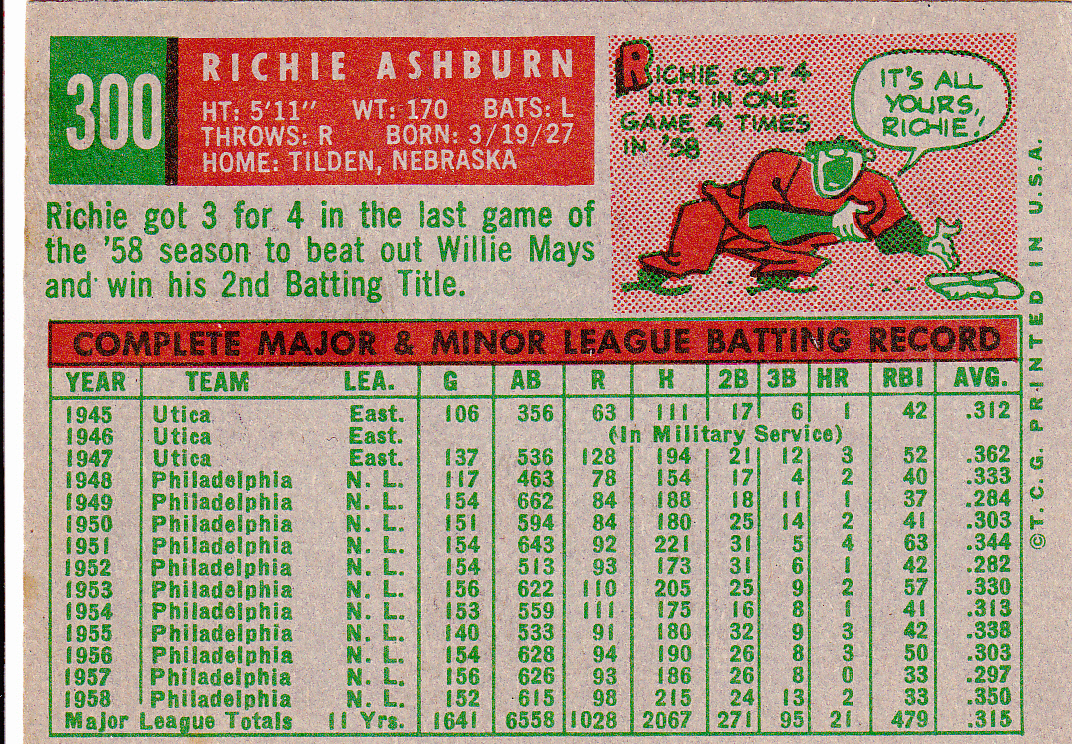
#300 Richie Ashburn


Richie Ashburn is one of six Hall of Famers born in Nebraska. The group consists of Bob Gibson, Wade Boggs, Sam Crawford, Grover Cleveland 'Pete' Alexander and Billy Southworth in addition to Ashburn.

Ashburn sandwiched a couple of years of burning up the Eastern League around a year of military service before breaking in with the Phillies in 1948. He batted .333 that year and led the NL in stolen bases. He finished third in Rookie of the Year voting.

He went on to have a great 12 year run as the Phils' centerfielder. He was a member of the 1950 Whiz Kids club that lost the Series to the Yankees. Through he career Ashburn played in the shadow of three great center fielders, Mickey Mantle, Willie Mays and Duke Snider. Except for the power those players possessed Ashburn was on a par with them in speed, average and roaming the outfield. He had the most hits of any player during the 1950s.

Traded to the Cubs in 1960 Ashburn played two seasons on the north side and was sold to the fledgling Mets for the 1962 season. He retired after a year in New York and soon went into broadcasting, a profession he had long had his eye on.

He broadcast Phils games from 1963 through his death in 1997. During that time he partnered with Bill Campbell, Byrum Saam and Harry Kalas. Baseball Almanac has a page of Richie Ashburn's quotes, most from his days in the booth. He was elected to the Hall by the Veterans' Committee in 1995.

I only saw Ashburn play in person once, as a Met in 1962. But the '59 card is how I (and most folks I'd expect) remember him. It's nice to see a picture in the set that wasn't taken in New York. Those red seats were a feature of Philadelphia's Connie Mack Stadium.

Tuesday, February 22, 2011

#31 Ken Lehman


A nice thing about blogging this set is I'm learning a lot. I was only dimly aware that Ken Lehman had spent two seasons with my Orioles. I looked back and sure enough he's in the '58 set as a Bird. And his hair is so good he could compete with the numerous nice hair guys shown in the '65 Topps Project blog . Looks happy, doesn't he? He should be, wearing that Orioles uniform and posed with that iconic Yankee Stadium upper deck and facade framing his smile and pompadour.

Pictured here on a Phillies card he ended up spending a couple years in their farm system before making it back to the bigs in 1961.

Oh, yeah...... I also discovered that he was pitching in Brooklyn while I was living there as a little squirt just a long fungo from Ebbetts Field. I bet he rode a cab past our rowhouse a few times. I wonder if he ever saw me out front on the steps?