Showing posts with label Ebbetts Field. Show all posts

Saturday, February 22, 2014

#520 Don Elston


Ohio native Don Elston spent eight seasons as a starting pitcher in the Cubs' farm system after he signed with them in 1948. Those years were pretty impressive as a whole and one wonders what kept him 'down on the farm', especially in an organization as mediocre as the Cubs were at the time. The answer is likely his lack of control.

He did get a brief two game look at the end of the 1953 season and was banged around pretty hard. After pitching (and going 17-6) in the tough PCL as property of the Cubs in 1955 Elston was dealt to the Dodgers. Another season in AAA followed and then he made the Brooklyn staff in 1957.

That didn't last long however and after just a single one inning appearance in Ebbets Field in May he was traded back to the Cubs. He finished out that year as a starter/reliever on Chicago's North Side and then in 1958 he emerged as one of the better relief pitchers in the NL. He led the league with 69 appearances, had 10 saves (for a club with just 72 wins) and teamed with lefty Bill Henry to form an effective left/right closing combo.

In 1959 he made the NL All Star squad, pitched an inning and got the save in the first of the two ASGs played that year. He allowed a two out single to Nellie Fox in the top of the ninth at Forbes Field but got Harvey Kuenn to pop out to end it and preserve the NL's 5-4 win. that season he had career highs in wins (10) and saves (13). The save category for pitchers was reportedly created by Chicago newspaperman Jerome Holtzman as a way to show Elston's contributions. Holtzman saw Elroy Face getting wins after blowing leads with the Pirates and thought Elston's work as a reliever was better and deserved recognition.

Elston remained the club's workhorse for several more seasons although his numbers never again matched his '58/'59 run. After spending the 1965 season pitching in the minors Elston retired as an active player although he did manage briefly in the Cubs' system. He then spent the rest of his life in sales and working on behalf of Chicago area charities including the Chicago Baseball Cancer Charities organization for which he served as co-chairperson with another Chicago pitching standout, Billy Pierce.

Elston died at the age of 65 from heart failure in 1995. He had a long history of heart problems extending back to the beginning of his playing days, a fact he never shared with his teammates.

His Chicago Tribune obit has a lot of background and stories from his playing days. This big chunk of that work is worthy of being repeated here:
Don Elston, who died Monday at the age of 65, was like many pitchers of his time. He couldn't get Willie Mays out. Having exhausted his usual repertoire, Elston tried a spitter. Mays hit it over the fence in left center. Next time he threw a knuckler. Again, Mays connected-into the center-field bleachers, a few feet below the Wrigley Field scoreboard. "I don't know what we're going to do with him," catcher Dick Bertell told Elston."And Don said, `Tell him what's coming. He won't believe it, anyway.' "And so Bertell, when he went into his catcher's crouch, asked Mays: "What do you want to hit?"As Bertell recalled Wednesday, Willie didn't reply. "He just gave me a funny look. So I said, `It's going to be a curveball.' And for the rest of that at-bat, I called every pitch."Did Willie take Elston deep again?"No," Bertell replied. "He popped up. From then on, I wouldn't say Don had Willie in his pocket but he didn't get any more big hits off him."

Saturday, December 28, 2013

#364 Danny McDevitt


Danny McDevitt is the first Dodger that I've posted for quite awhile. Looks like a spring training shot that's been 'painted' over. Probably a Vero Beach photo.

McDevitt signed with the New York Yankees late in 1951 out of St. Bonaventure College and reported for work that September to the Yanks' low minor league clubs. He got into 7 games and was whacked around pretty good on the rare occasion he got the ball over the plate. Apparently the Yanks decided that they had made a mistake and released him.

McDevitt signed with the Dodgers that off season and had a much better year in their system but he still had control issues as evidenced by his 171 walks allowed in 199 innings. Then it was off to the military for a couple of years. When he returned in 1955 he began a two and a half season stretch during which he continued to struggle with control. His work in 1957 was good enough however to earn him a promotion to Brooklyn and secure him a spot in the rotation alongside Don Drysdale, Johnny Podres and Don Newcombe. In his first start on June 17 he pitched a complete game against the Reds allowing two runs on seven hits and fanning 11. He went on to a 7-4 record with a couple of shutouts that year.

One of those shutouts came in the very last game ever played in Ebbets Field. McDevitt handcuffed the Pirates that day on five hits. A brief video of that final Ebbets Field out was on You Tube and I've posted it here:


McDevitt's recollections of the game are featured in his L.A. Times obit:
"It was just another game, as far as I knew," McDevitt told Times columnist Jerry Crowe in 2007. "All the older guys – Pee Wee [Reese] and Duke [Snider] and those guys – seemed to know the facts, but I didn't know.
"I couldn't believe that after working my butt off to get to Brooklyn that I would be going back to another minor league town, which is what L.A. was then."

A brutal start to the '58 season earned McDevitt a demotion to the minors and when he was recalled in August he wasn't much better. 1959 was McDevitt's 'bounce-back' season as he went 10-8 in 39 appearances including 22 starts. He earned four saves as well. The Dodgers and Braves tied atop the NL standings that year and McDevitt drew the first playoff game assignment. He was KO'd in the second inning but the Dodgers won the playoff series and went on to win the World Series. McDevitt didn't pitch against the White Sox.

He continued his up and down trend with a poor 1960 season. He was sold to his original team, the Yankees that winter and was traded to the Twins in June. He pitched for the A's in 1962 and was out of baseball as an active player later that year. He went on to work as an umpire in the minors and later sold real estate among other jobs.

A Google search turned up a book on Cuban Winter League baseball that featured a story of an incident between McDevitt and an umpire that had some serious consequences. I also found a neat picture of McDevitt in Ebbets Field.


Monday, January 21, 2013

#90 Bill Skowron


A Chicago native Bill "Moose" Skowron went to Purdue on a football scholarship. But he also played baseball and when he hit .500 in his second season for the Boilermakers (a Big Ten record that held up for a decade) he was headed for a career on the diamond. He signed with the New York Yankees in 1950 and after three very impressive minor league seasons he debuted with the Bombers in 1954. 

After initially platooning with Joe Collins he won won the first base job and in the nine seasons he was there the Yankees won seven league pennants and four World Series championships. He made five All Star squads during his Yankee tenure. He almost always seemed to come up big in the postseason. In eight Series (including the 1963 Series when he was a Dodger) Skowron batted .293 with eight homers and 29 BRIs. 

He hit a grand slam in the 1957 Series and in the 1958 World Series he homered in Game One, drove in the winning run in Game Six, and hit a three-run home run in Game Seven.

In 1963, Skowron was traded to the Dodgers and he won a fifth World Series championship as the Dodgers pulled off the sweep over the Yanks. An interesting insight into Moose comes from his NY Times obit:
Notwithstanding his menacing presence, Skowron was a gentle person, and he harbored no feelings of revenge after hammering his former Yankee teammates in the 1963 World Series.“I was miserable,” he recalled in [Richard Lally's book] “Bombers.”“Twelve years I was with New York, three in the minors, nine in the majors. I loved those guys and it killed me to beat them. My uniform might have said Los Angeles, but in my heart I was always a Yankee.”
 That was his only season in Los Angeles but he went on to play for the Senators and White Sox before retiring after the 1967 season. In 14 seasons Skowron had a .282 batting average, hit 211 home runs and batted in 888 runs in 1,658 games.

After his playing days he worked in community relations for the White Sox. He died in April of last year. His All Star card form this set was featured in the summer of 2011.

Two final things... his 'Moose' moniker came from his childhood post-haircut resemblance to Benito Mussolini. It stuck. And I found a cool picture of Skowron and Roy Campanella taken at Ebbetts Field at a 1957 exhibition game.


Saturday, November 24, 2012

#122 Bennie Daniels The Sporting News Rookie Stars


Bennie Daniels gave two years to the military in between five years in the Pirates' chain after signing out of Compton, Ca. in 1951. He had been an outstanding three sport athlete there. Daniels had a couple of looks from the Pirates during the 1957 and 1958 seasons. In his 1957 major league debut he started for the Bucs in the last game ever played at Ebbets Field. He got a full time shot in 1959 and made 12 starts out of a total of 34 appearances and went 7-9. After a return to the minors for most of 1960 he was traded to the Washington Senators for 1961 where he pitched the last game in Griffith Stadium and started the first game ever played in D.C (later named RFK) Stadium.

In D.C. he had five up and down seasons. His best was his first when he won 12 games and lost 11. He was under .500 every year after that. He spent 1966 in the minors and then retired. He worked for various health and veterans affairs departments after his playing days.


Sunday, October 21, 2012

#427 Charlie Neal


The '59 Charlie Neal card was issued during his best season in the majors. Not only was he a member of the World Champion Dodgers, hitting .373 with two dingers, but he was an All Star, led the NL in triples, won a Gold Glove and scored 103 runs. Oh, yeah... his homer in Game Two of the '59 series was the shot that led to poor Al Smith getting a beer shower. We've looked at that before.

Neal's first pro baseball experience was as a member of the Negro Leagues. He signed with the Brooklyn Dodgers in 1950 and spent six seasons clawing his way up the talent-rich Dodger system. He debuted in 1956 as a second baseman hitting .287 in 62 games. He played with the Dodgers in the World Series that season.

In '57 he took over as the club's regular shortstop. He moved back to second when the team went west in 1958 and he made the All Star team that year. After that eventful 1959 season Neal's hitting and playing time diminished. A Sports Illustrated story that was published after his death mentioned that Neal was never the same after 1959. From that story:
But Neal never hit well again. Plagued by injuries and, perhaps, lethargy—"I quit on myself," he said after batting .235 in 1961—Neal was traded to New York in December 1961, where in his last hurrah he helped the Mets lose 120 games. 
As mentioned Neal was traded to the fledgling Mets and after '62 was passed on to the Reds where he finished his career after 1963.

As I read about Neal I didn't see his fielding prowess mentioned until I read that SI article.
Hall of Famer Billy Herman often said that one of his successors as second baseman for the Brooklyn Dodgers, Charlie Neal, made the double play better than any man who ever lived, and to be sure, Neal turned the pivot with a godsent grace.
That's pretty high praise.

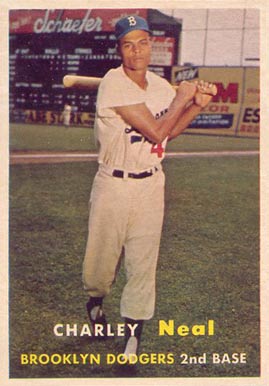
Nothing special about this card, though. Looks like the LA Coliseum in the background. My copy has nice corners but is seriously off center. As far as Neal cards go I'd pick his '57 as my favorite. Love the Ebbets Field rightfield scoreboard and wall in the background.


Friday, February 25, 2011

#217 Carl Erskine


I bet these pink frames were not very popular with kids at the time these cards were out but I think it looks good with the Dodger cap and card logo. And isn't that the Coliseum in the background? Sure looks like it.

Carl Erskine appears happy to be in Los Angeles but in my mind he's a Brooklyn Dodger. 1959 was his swan song with the Dodgers, appearing in just a handful of games. His retirement ended a nice career that saw him claim double digit wins in seven straight seasons. As his cartoon mentions he tossed a couple of no-hitters. He was a fan favorite in Brooklyn earning the nickname "Oisk" as derived from the Brooklynese calls of his name from the bleacher denizens in Ebbets Field.

At age 84 Carl still out there accepting awards and making appearances. He has his own website (actually his agency has it for him) and exploring it will gain you more tidbits and cool facts about the guy than I could hope to include here. Check it out.

I've mentioned living in Brooklyn but I was just a toddler, and we were not there long. My father was the one with the real ties to that borough having lived there for most of his life before going off the D.C. to attend college. My dad was a Yankee fan. He lived literally down the street from Ebbetts Field and never went there to see the Dodgers play. I asked him a few times why that was and he seemed surprised that I'd asked. He said he was a Yankee fan and "why would I go see the Dodgers play?" I never understood that but it made perfect sense to him. He never went, that is, until he scored seats for Game 5 of the 1949 World Series between the Yanks and Dodgers. He got to see the Yanks close out the Dodgers and he saw Carl Erskine pitch. I bet he appreciated the former a lot more than the later.

Tuesday, February 22, 2011

#31 Ken Lehman


A nice thing about blogging this set is I'm learning a lot. I was only dimly aware that Ken Lehman had spent two seasons with my Orioles. I looked back and sure enough he's in the '58 set as a Bird. And his hair is so good he could compete with the numerous nice hair guys shown in the '65 Topps Project blog . Looks happy, doesn't he? He should be, wearing that Orioles uniform and posed with that iconic Yankee Stadium upper deck and facade framing his smile and pompadour.

Pictured here on a Phillies card he ended up spending a couple years in their farm system before making it back to the bigs in 1961.

Oh, yeah...... I also discovered that he was pitching in Brooklyn while I was living there as a little squirt just a long fungo from Ebbetts Field. I bet he rode a cab past our rowhouse a few times. I wonder if he ever saw me out front on the steps?