Showing posts with label Yankee Stadium. Show all posts

Tuesday, March 11, 2014

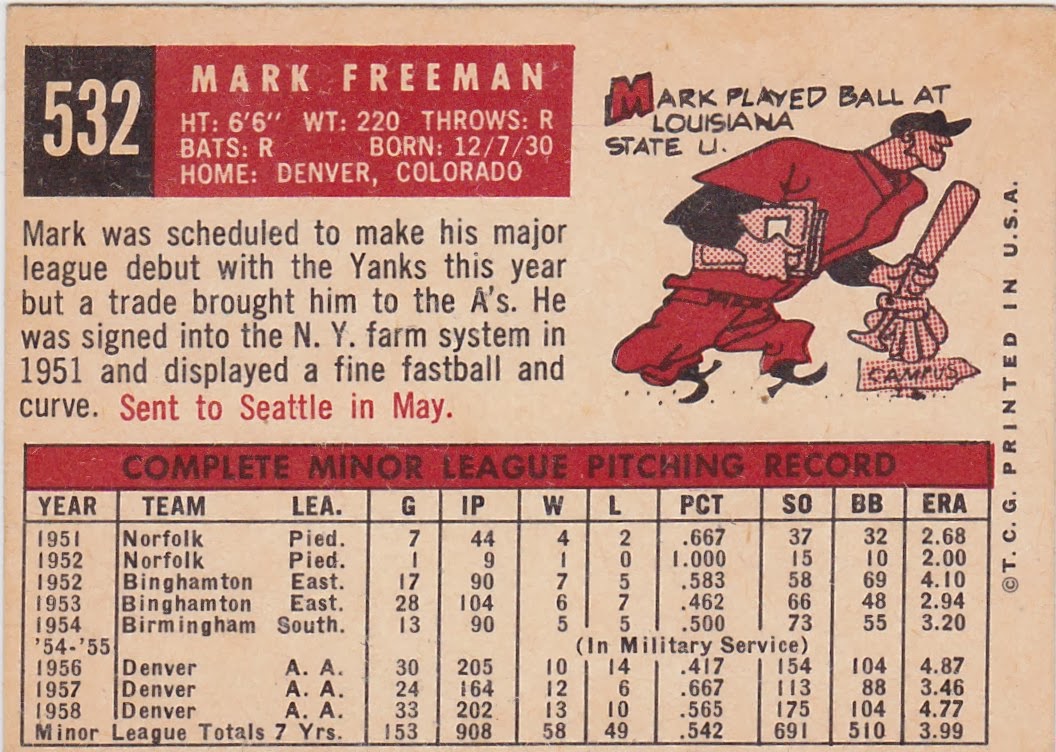
#532 Mark Freeman


Mark Freeman graduated from Memphis' Christian Brothers High School in 1948 where he lettered in baseball and basketball, and was an All-State baseball pitcher. He was awarded a baseball/basketball scholarship to LSU.

Freeman signed a contract with the Yankees in 1951 and began his pro career but he continued his education and received his degree from LSU in 1953. Meanwhile he had begun a seven year climb towards the majors taking a nearly two season detour to serve in the U.S. Army as a First Lieutenant and Sports Officer and manager of Ft. Jackson baseball team at Ft. Jackson, South Carolina.

He returned to civilian life and baseball in 1956 and was a double digit winner for three straight seasons in Denver where the Yanks had their AAA club. While there he established team marks for season strikeouts and shutouts.

On the eve of the 1959 season he was traded to the Kansas City Athletics and made it into three April games as a reliever for them. In mid-May he was returned to the Yanks. I cannot find anything to suggest why and given the history of the Athletics and Yankees during the 1950s it was likely another on of those deals of convenience for New York. The Yanks sent him to pitch in Seattle of the PCL and he had another fine AAA season there including a no-hitter. In September the Yanks activated Freeman and he capped his tumultuous season with a start at Yankee Stadium against the Orioles. He pitched seven innings allowing only six hits and two runs while fanning four. He left with the game tied but the Yanks lost it in 11 innings.

He was back in the minors to open 1960 but the Yanks dealt him to the Cubs in May and he spent the rest of that season pitching in the National League. He made eight starts over 30 appearances and went 3-3 with his only career save.

He retired to Denver, Colorado after that season to work full time in the mutual funds business which he had dabbled in for the last several years of his baseball career. He was a very successful business man and established an endowment fund for supporting the tutoring of student athletes at LSU in 2003.
His LSU bio (he was alum of 'distinction') mentions that he was founded and served as President of the Denver Broncos Quarterback Club (their official booster club).

His card shows him in a spring training shot with a retouched cap featuring the Athletics' logo but untouched Yankee pinstripes. I came across several versions of a story that goes like this:

Once, during a game when Mark Freeman was pitching for the New York Yankees, a bee buzzed his head and he balked. Casey Stengel, the Yankee manager, told him: "Next time ... swallow it."
Volume 4 of the Baseball Hall of Shame series of books contains the same story but stated the game was played against the Tigers.

Two problems with this. First of all Freeman never pitched for the Yanks against the Tigers. His only game was that September '59 start against the Orioles. And second of all, according to Baseball reference game summaries he never committed a balk. Not in his big league career anyway.

My guess? It was a spring training game or it's a story that somehow evolved from some other incident and mutated in the retelling. With Casey Stengel stories that's very possible.

 Here he is in his Yankee gear, unblemished by the Topps artist's brush and another spring camp shot in which he warms up while Stengel watches closely.


And here he is as a businessman years later:


Freeman died in 2006.

Almost done,


cards remain.

Monday, January 13, 2014

#430 Whitey Ford


Whitey Ford didn't pitch the first game of every Sunday doubleheader at Yankee Stadium that my father and I attended, it only seems that way as I look back. No doubt I saw the great lefty pitch more than any other starter in the years I've been going to games. The Astros' Don Wilson would likely be second.

Anyway, Ford was a favorite of my father's. Probably second only to Allie Reynolds as far as Yankee pitchers go. He signed with the Yanks in 1947. He was a local kid having grown up in the Astoria section of Queens and attending Aviation Tech High School. Three and a half seasons of very impressive pitching in the minors earned him a shot with the Yanks in July of 1950.

He was hit hard in his first appearance but when put into the rotation his numbers steadily improved and he won his first nine decisions. He finished that first season with a 9-1 mark and pitched the fourth and final game of the '50 World Series. He beat the Phils 5-2 with both Phillies' runs being unearned. He went 8 2/3 before giving way to Allie Reynolds for the final out. Coincidentally that out was the strike out of Stan Lopata mentioned in Lopata's entry day before yesterday. He was second in the AL Rookie of the Year voting (to Walt Dropo) despite pitching only half a season.

Ford, like so many players in that era, was called to military service and spent two years in the Army. When he rejoined the Yanks in 1953 he picked up where he left off and reeled off a career very worthy of his 1974 Hall of Fame induction. The highlights include:
  • 8-time AL All-Star (1954-1956, 1958-1961 & 1964)
  • ML Cy Young Award Winner (1961)
  • 1961 World Series MVP
  • 2-time AL ERA Leader (1956 & 1958)
  • 3-time AL Wins Leader (1955, 1961 & 1963)
  • 3-time AL Winning Percentage Leader (1956, 1961 & 1963)
  • 2-time AL Innings Pitched Leader (1961 & 1963)
  • AL Complete Games Leader (1955)
  • 2-time AL Shutouts Leader (1958 & 1960)
  • 15 Wins Seasons: 10 (1953-1956, 1959 & 1961-1965)
  • 20 Wins Seasons: 2 (1961 & 1963)
  • 25 Wins Seasons: 1 (1961)
  • 200 Innings Pitched Seasons: 11 (1953-1956, 1958, 1959 & 1961-1965)
  • 200 Strikeouts Seasons: 1 (1961)
  • Won six World Series with the New York Yankees (1950, 1953, 1956, 1958, 1961 & 1962)
  • All Time World Series Game Wins Leader (10)
  • Baseball Hall of Fame: Class of 1974

His bio on the Hall of Fame site reads as follows:
Edward 'Whitey' Ford was the big-game pitcher on the great Yankees teams of the 1950s and early '60s, earning him the moniker The Chairman of the Board. The wily southpaw's lifetime record of 236-106 gives him the best winning percentage (.690) of any 20th-century pitcher. He paced the American League in victories three times and in ERA and shutouts twice. The 1961 Cy Young Award winner still holds many World Series records, including 10 wins and 94 strikeouts, once pitching 33 consecutive scoreless innings in the Fall Classic.
Not much I can add to all that other than to say that I knew (and if I didn't my Dad reminded me) that watching Ford work was watching a master craftsman.

Plenty of Whitey Ford links for those interested:


I don't remember how much I spent on this card but I do know it was a bargain. It's about as nice as any of the non-graded cards I picked up for this set. It has just the slightest corner wear and the colors look as good as the day it came out of the pack. Plus, it's Whitey Ford at Yankee Stadium. I put a Yankee pin on my Dad's lapel just before they buried him. I wish now I had had a copy of this card to slip into his suit.

He sure liked the 'follow-through' pose didn't he?


Random cool pics from around the 'net.


Ford on the cover of Sports Illustrated in September, 1956


Friday, January 3, 2014

#386 Jim Delsing


When this card was issued in 1959 outfielder Jim Delsing had played 806 of his 822 major league games, he hadn't been in the majors for two years, he was still a year away from returning to the bigs (briefly) and he had never taken the field in a Washington cap (and never would).

Also in his rearview was a unique moment that arose in August of 1951 when, as a member of the St. Louis Browns, he was called upon to pinch-run for Eddie Gaedel the 'little person' that owner Bill Veeck had his club use as a pinch-hitter. Delsing describes the whoe situation in his SABR bio thusly:
"Mr. Veeck owned St. Louis back in 1951, and he was always doing some promoting. This happened at a Sunday double-header on August 19, and between games they brought out a great big, huge cake. Out of the cake popped Eddie Gaedel, wearing a St. Louis Browns uniform, with 1/8 on the back. He gets out of the cake and walks over to the dugout. We knew nothing about it. We took a look at the lineup. I had a couple of hits in the first game, so I thought I would sure be playing." 
"I went up to Zack Taylor, who was manager, and he said, Cool it. You'll be all right.' Taylor had Frank Saucier leading off. When it came time for Saucier to bat, Taylor called him back, and told Gaedel to bat for Saucier. We all thought it was a joke, because Mr. Veeck used to do all kinds of promotions. Gaedel walked up to the plate, and the umpire said, You can't bat.' But Mr. Veeck had this all worked out. Gaedel reached in his pocket and pulled out a major league contract. So they had to let him hit. Bob Cain was the Tiger pitcher, and Bob Swift was the catcher. Gaedel had a strike zone that was about an inch and a half! He walked on four pitches, and Zack Taylor said to me, Now go run for Gaedel.' Then I knew what he was talking about, why I wasn't playing the second game."

That's Gaedel in the center of this picture and Delsing is #18 leaning against the pole to the left.


Delsing had begun his pro career in 1942 with a year of independent ball in his native Wisconsin. He was signed by the Cubs and played a minor league season in their chain before serving Uncle Sam for two years. Returning from the service Delsing found his contract had been obtained by the White Sox and he played for nearly three full seasons in the upper reaches of that team's system. He hit well enough to earn looks with the Sox at the beginning and end of the 1948 season.

He was traded to the Yankees prior to 1949 and was called up for a September look during which he hit .350 and impressed his teammates enough that they voted him a small World Series share despite his not being active for it.

He hit well to start the 1950 season for the Yanks but was traded to the Browns in June as part of a seven player deal. He was a regular in the Browns outfield putting up pedestrian numbers and was traded again, this time to the Tigers in August of 1952.

Three plus seasons as an everyday player for the Tigers was highlighted by his best season, 1953, when he hit .288 with 11 homers and 61 RBI. Subsequent seasons brought diminishing numbers and in May of '56 he was again traded, this time back to the White Sox. Over the next three years Delsing moved around the minors via a dizzying string of trades and purchases that saw him being the property of the Tigers (again), the minor league Houston franchise, the Senators (for a few months of the off-season between the 1958 and 1959 seasons) and finally the Kansas City Athletics where in 1960 he re-emerged in the majors for the last five weeks of the season. that was his last in uniform.

After baseball Delsing worked for the archdiocese of St. Louis for thirty years. He has a son who is a pro golfer and a grandson who played Major League Soccer.

For more of Jim Delsing and his interesting career (and he has some cool stories to tell) see his SABR bio or this interview done a few years back with the Missouri History Museum's magazine.

As noted Delsing never suited up for the Senators in a regular season game and his shot features a drawn "W" logo on his cap. I get the vague impression the this pic shows the left-centerfield area of Yankee Stadium in the background.

Saturday, December 14, 2013

#259 Jim Pisoni


Hometown boy Jim Pisoni made his big league debut with the St. Louis Browns by appearing in the final three games in the franchise's history as they prepped to move to Baltimore. He'd been in the Brownie's chain since he signed as an outfield prospect in 1949 sandwiching three fairly successful minor league seasons around a two year military stint.

He went 1 for 12 in those three '53 games (his one hit was the next-to-last homer in Browns' history) and found himself back in the minors from 1954 through mid-September of 1956 when the Orioles included him in a trade to the Kansas City Athletics. He got into 10 games with the A's and hit a pair of homers as he flashed the power that had marked his minor league days.

The following season Pisoni was a semi-regular in the Kansas City outfield before he was part of a (surprise!) trade package that sent him to the Yankees. After a season and a half as Yankee property (but never playing for the big club) he was drafted by the Braves for 1959 but after a handful of games in Milwaukee he was returned to the Yankees. This archived article on Google concerns the Braves hopes when they took him in the Rule 5 draft.

He got into nearly 40 games over the next two years for the Yanks but spent the bulk of his time in the minors. He played for the reds' AAA club in 1961 and then retired to become an electrical contractor. He passed away in 2007.

Two points of interest... the shot on his card was taken in Yankee Stadium and the "M' is airbrushed over his Athletics' logo and the card-back leaves off his 1958 minor league stat line despite the write-up mentioning his "solid performance".

Tuesday, November 5, 2013

#449 Tom Gorman


Tom Gorman began his professional career was a Yankees prospect who they drafted in 1946 after he had been in the Navy serving in the Pacific in WWII. He was more or less a local kid having been born and raised in Valley Stream on Long Island.

He pitched erratically in the Yankees' chain but got a call mid season in 1952. He made six starts with an equal number of bullpen outings and went 6-2. He made an appearance in the World Series that year against the Dodgers getting into the Game Three in the ninth inning after Eddie Lopat had allowed the deciding runs in the loss.

The next season he pitched in 40 games for the Bombers, all but one in relief and posted six saves which was good for ninth best in the A.L. He made another World Series appearance and earned his second ring. In that Series he pitched three innings in relief of White Ford in Game Four and struck out the first batter he faces, Brooklyn's Billy Cox. Gorman allowed a run in that outing and even came up to hit once and whiffed.

He pitched for the Yanks up until July of the '54 season when he was farmed out despite decent numbers. I can't find out anything more but I suspect he was blocking the progression of a younger arm. Tom Morgan perhaps?

Either way the Yanks traded him to Kansas City in the off season (Another deal with K.C.? Shocking!). Gorman pitched for the Athletics for four full seasons and part of a fifth. 1955 was his busiest and best year. He collected a career high 18 saves which translated to second among AL bullpen guys. He was a spot starter for the A's in '56 and '57, went back to the pen full time in 1958 and was washed out of the big leagues early the next season.

Gorman died in Valley Stream in 1992. He is not related to umpire Tom Gorman who worked in the NL for nearly three decades or to the Tom Gorman who pitched for several NL clubs in the 1980s.

I've always liked his 1953 Bowman. Anyone out there collect these? I'd love to swap for some of your dupes.


Sunday, November 3, 2013

#373 Herb Plews


Herb Plews is one of 181 players who have gone from the University of Illinois-Champaign/Urbana to the ranks of pro baseball. One of them is a Hall of Famer, Lou Boudreau.

Plews was signed by the Yankees out of UI in 1950. He took spent four seasons as a pretty good hitting infielder and a couple of years in the service before he debuted with the Washington Senators in 1956. He had been traded by the Yanks to the Nats that winter. With Washington Plews spent three years as a semi-regular at second base and filling it at third and short.

His numbers were actually pretty good for a middle infielder as he hit .264 with 82 RBI for Washington. He was traded to the Red Sox early in the 1959 season. But after only 12 at bats in 13 games he was shipped to the minors when the Red Sox finally integrated their club by bringing up Pumpsie Green.

Beginning in 1960 Plews was an everyday infielder in AAA for five different organization over six seasons. He retired in 1965 and currently resides in Denver.

There sure is a lot of Herb Plews material available to read. Here is a Denver Post article about Plews in his days as a Yankee farmhand in Denver. He was part of one of the best minor league teams ever assembled. Hobby blogger Tom Owens recounts his interactions with Plews in this entry. Here is another lengthy but worthwhile interview done in 2010. And of course SABR has perhaps the definitive Plews bio.

Herb Plews' smiling visage in Yankee Stadium on his '59 card seems to reflect his overall personality and character. These traits come through in all those articles. For a guy I'd never really been aware of he seems to have acquired quite a fan base among writers.

Sunday, October 20, 2013

#376 Hal Naragon


Catcher Hal Naragon spent all or part of 10 seasons in the majors between 1951 and 1962. He averaged about fifty games a year in his eight complete big league campaigns. Signed by the Indians in 1947 Naragon worked his way through the team's minor league system while hitting adequately but without any power.

In 1951 he got a look at big league pitching with a late season call-up but then proceeded to spent the next two years in the military. He returned in 1954 just in time to play behind Jim Hegan on the Indians' A.L. championship club. He continued to spell Hegan for most of his time with the Indians through 1957. He was farmed out for much of '58 and was traded to the Senators in May of 1959.

He managed to play a bit more than he was used to with the Nats that year and ended up with over 240 plate appearances. He played sparingly through the franchise's move to Minnesota, mostly sitting while Earl Battey played, and ended his active career after the '62 season.

He stayed on with the Twins as bullpen coach through their 1965 Series effort and then moved on to do the same job with the Tigers. He earned a ring in Detroit in 1968. On both clubs he worked with pitching coach Johnny Sain. He also lost both jobs when Sain lost his after having issues with the clubs' managers.

He currently resides in Ohio where he was raised and the high school stadium in his hometown of Barberton is named for him. His SABR bio is here and you can here his opinions on the 2013 Indians in a recent interview on and Ohio TV station site.

Yet another Yankee Stadium shot with Naragon resplendent in the classic Indian uni of the era.

Here is Hal Naragon going into the crowd to try for a foul ball.


Monday, October 14, 2013

#10 Mickey Mantle (Blog Post #500)


I figured a good way to celebrate the 500th post on this blog was to feature the (arguably) most popular and (definitely) most expensive card in the set, that of Mickey Mantle. I consider myself lucky to have grown up watching Mantle. Although I wasn't a Yankee fan it was easy to find yourself in awe of him and his persona. My father and I were regular Sunday visitors to Yankee Stadium and if the Yanks were playing a doubleheader (they did that a lot) then Mantle usually started one of the games. If it was a single game there was a chance he would be sitting it out. That always disappointed me (and probably everyone else in the place).
There isn't any point to summarizing his career or life here. You can Google infinite pages of Mantle info including both 'official' and 'unofficial' dedicated sites. But, as with the other mega-stars shown in this set, I'll paste in the list of achievements as listed on Mickey's Baseball Reference Bullpen page.

16-time AL All-Star (1952-1965, 1967 & 1968)
3-time AL MVP (1956, 1957 & 1962)
AL Triple Crown (1956)
AL Gold Glove Winner (1962)
AL Batting Average Leader (1956)
3-time AL On-Base Percentage Leader (1955, 1962 & 1964)
4-time AL Slugging Percentage Leader (1955, 1956, 1961 & 1962)
6-time AL OPS Leader (1952, 1955, 1956, 1960, 1962 & 1964)
5-time AL Runs Scored Leader (1954, 1956-1958 & 1960)
3-time AL Total Bases Leader (1956, 1958 & 1960)
AL Triples Leader (1955)
4-time AL Home Runs Leader (1955, 1956, 1958 & 1960)
AL RBI Leader (1956)
5-time AL Bases on Balls Leader (1955, 1957, 1958, 1961 & 1962)
20-Home Run Seasons: 14 (1952-1962, 1964, 1966 & 1967)
30-Home Run Seasons: 9 (1955-1962 & 1964)
40-Home Run Seasons: 4 (1956, 1958, 1960 & 1961)
50-Home Run Seasons: 2 (1956 & 1961)
100 RBI Seasons: 4 (1954, 1956, 1961 & 1964)
100 Runs Scored Seasons: 9 (1953-1961)
Won seven World Series with the New York Yankees (1951, 1952, 1953, 1956, 1958, 1961 & 1962)
Baseball Hall of Fame: Class of 1974 (Mantle's Hall of Fame page)

As for the card, well it's a classic and one of my favorite Mantle Topps cards. I can't say I remember pulling it from a pack as I wasn't buying packs in 1959 but in the early to mid 60s it was a big thrill to pull a Mantle from a pack no matter how you felt about the Yanks. I picked this one up for what I thought was a reasonable $100 after many losing bids on lower conditioned examples. It's more appealing in person than it appears in my scan which seems to have washed out some of the color. Mantle poses near the batting cage in Yankee Stadium with some teammates and the third base seats in the background.

I met Mantle once some years after he had retired. In the late 70s and early 80s I would spend a day every spring at the Houston Open Wednesday Pro-Am. Back then there would be actual sports and entertainment celebrity players out on the course. I'd get there very early and hang out around the clubhouse parking lot area seeing who I could see. I never approached any of the celebs with one exception. I'll never forget turning around to see Mickey Mantle alone on the passenger side of a golf cart parked in a row of other carts near the clubhouse steps. Oddly no one else was around so I went over and said hello and mumbled something about the fact that my Dad's two favorite players were him and Joe DiMaggio. I don't remember what he said but he did shake my hand and smiled. I never thought to ask for an autograph. I probably didn't have anything for him to sign anyway.


When my Dad died I stuck a Mickey Mantle pin onto his lapel just before they closed his casket. I'd bought the pin on a whim a few years earlier at a game in the old Yankee Stadium. Probably the last game I attended in the park I'd enjoyed so many Sunday afternoons at with my father. Even though it looked different due to the refurbishings it had gone though it was still Yankee Stadium and it held some great memories for me.
Here is my favorite picture of Mickey Mantle....


Saturday, September 7, 2013

#164 Johnny Groth


A three sport standout at the famed Chicago Latin School, Johnny Groth joined the Navy when he graduated. Playing alongside such notables as Bob Feller Groth's reputation spread beyond the military ball-fields and he was signed by the Tigers in 1946.
After a brief look late that year Groth spend most of the next two season's in the minors before being named a starting outfielder in 1949. Labeled as the 'next Joe DiMaggio' it would have been near impossible for Groth to live up to that hype. He hit .293 in his rookie year and continued to hit well if not spectacularly for the Tigers before being traded to the Browns for 1953. After a year in St. Louis the Browns (actually they were becoming the Orioles) traded him to the White Sox and he went on to play for the Senators, A's and then the Tigers again. he had a nice career but obviously never did become the star he was projected to be.
He managed in the minors after his playing days ended in 1960. On his card he poses in front of the visitors' dugout at Yankee Stadium. Assuming the shot was taken in 1958 it appears to be Herb Moford warming up, maybe for a start. That would put the day at August 24th as it was Moford's only start that season in New York.
Groth has an interesting backstory and as always his SABR page is recommended reading.
Posted below is his 1954 Bowman with him airbrushed into the Orioles uni that he never really wore.


Sunday, July 21, 2013

#453 Les Moss


This is one of my favorite cards in the '59 set. First of all Ohio native Les Moss was an original Baltimore Oriole having come over with the club from St. Louis for the '54 season. He's wearing a uniform I favor, the simple White Sox road gray of the mid/late 50s with the sleeve number. And finally he is posing in the classic catchers' pose, the 'baseball card squat' and has the facade, lights and flags of the original Yankee Stadium displayed behind him.

Moss' professional baseball career was long and varied. He spent all or parts of 13 big league seasons with four AL clubs beginning with the Browns in 1946 and ending with the White Sox in 1958. Never an everyday catcher, Moss has six or so years in which he carried about half the load behind the plate. While never an All Star or dangerous hitter, Moss did have some seasons with double digit homers and respectable batting averages. His primary skill, however, was as a defensive standout and he was known as an exceptional handler of pitchers.

By the time this card was issued Moss was no longer a major leaguer. In fact he had had only two at bats in 1958 despite having been on the White Sox roster all that year. He served as the teams' bullpen and third catcher for the season and got into only two games. In 1959 and 1960 he was transitioning from active player to the coaching and scouting jobs by working in the Sox organization at the major league and AAA level and occasionally playing for the Sox' San Diego farm club.

From that point forward Moss held scouting, coaching and managerial jobs until he finally left the game in 1995. He managed in the majors with the White Sox on two occasions in the late 60s as interim skipper and he took the reigns of the Tigers in 1979. Just when it appeared that Moss, called a 'faithful soldier' by some, was going to get a long deserved shot at a full time managerial gig, Hall of Famer Sparky Anderson came available and the Tigers jumped. Just 53 games into that '79 season, and with Moss directing his club to a one game over .500 record, Detroit, not wanting Anderson to take another available job, kicked Moss to the curb and signed the former Reds' manager.

Moss bounced back by taking a job in the Cubs' organization as a pitching coach/instructor and then in 1982 he joined the Astros as pitching coach and outlasted several managers in Houston. He was very well thought of and respected by the Houston press and the fans. He moved on to the Giants' organization and served as pitching coordinator before finally retiring in 1995.

A long and distinguished career leads to a lot of kudos and Moss, who died in 2012, has a rather interesting SABR bio. It's recommended reading.

Here is Les Moss' '54 Bowman. Part of my Orioles collection.


And here is the 1979 Topps Tigers Team card featuring Les Moss.


Monday, July 15, 2013

#153 Jim Marshall


I'd venture a guess to say the two closest things to major league baseball without actually being the majors have been the old independent PCL and the Japanese Leagues. Jim Marshall spent quite a bit of time in both of those, and he got in five seasons in our big leagues as well.

Marshall signed with the White Sox in 1950 and for the next eight seasons he put up some big power numbers with the Oakland Oaks of the PCL and various farm clubs in the Sox, Giants and Orioles' chains.

He debuted with the Orioles in 1958, was the regular first baseman for awhile and in August was waived due to his .215 average and went to the Cubs. His averages continued to be low while his power, so good in the minors, dried up against major league pitching. 1959 was his busiest and best big league season. He got into over 100 games with the Cubs and had 11 homers and 40 RBI in nearly 300 at bats.

That off season was a hectic one for Marshall. He was traded to the Red Sox who in turn traded him to the Indians during spring training of 1960. But when Sammy White, the other player traded to the Indians, refused to report Marshall was returned to the Cubs. Four days later, still before the season started, the Red Sox dealt Marshall to the Giants for Al Worthington.

He spent two seasons with the Giants, was sold to the expansion Mets for '62 and then was traded to the Pirates in May. While a member of the Mets he became the first player to homer in consecutive games for that club.

Following his tour with the Bucs he went to Japan and played three seasons over there.Since his playing days he has been a coach on two continents, managed in the big leagues for both the Cubs and A's and is currently in the front office of the Arizona Diamondbacks as Senior Advisor, Pacific Rim Operations. 

That's an Orioles uni Marshall is wearing at Yankee Stadium on this '59 card. Love the facade and flags flying on top of Yankee Stadium. So many memories.

Marshall is the victim of a very shoddy airbrush treatment on his 1961 Topps card. Just look at the cap. 


Friday, June 7, 2013

#98 Arnie Portocarrero


Righty pitcher Arnie Portocarrero was a New York city kid born of Puerto Rican-American descent who signed with the Philadelphia A's in 1949 at the age of 18. Following the pattern we've seen many times here he played a bit in the minors before serving in the military during the Korean War.

When he returned in 1954 he went straight to the majors and claimed a spot in the A's rotation. Making 32 starts Portocarrero went 9-18 with a 4.06 ERA. His hits per inning ratio was good, as was his strike out totals but wildness kept him from having more success. He led the AL with 9 wild pitches.

The following season, with the A's now in KC, saw him get fewer starts but similar results and in 1956 he spent almost the whole season in Birmingham, a Yankee affiliate. I can't find a transaction that sent him to the Yanks, and given the chummy relationship the A's and Yanks had in those days it may well have been a case of a player 'loan'.

He was back in KC in 1957 and didn't see much mound time and was traded to the Orioles prior to 1958. He blossomed there in Baltimore under Paul Richards, at least for one year. On a lousy club he somehow won 15 games and lost only 11 with an ERA of 3.25, easily his best year. He then spent the '59 and '60 seasons trying without success to replicate his banner 1958 campaign. In 1960 he split his pitching between the Orioles and their farm club. He was out of the game by early in the 1961 season.

His obit states that he was involved in amateur baseball in the Kansas City area after his retirement. He died in 1986 at the young age of 54. I came across this article online dated last winter that chronicles an adopted young man's search for his birth parents. It turns out that his father was Arnie Portocarrero.

On this card Arnie is in Yankee Stadium in his home town. I hope his family got to see him pitch there. He got into one game in the Bronx in 1958, the fifth game of the season with a relief appearance. He didn't fair well but his year sure turned out well.

Sunday, May 26, 2013

#498 Dick Hyde


Dick Hyde's career, short as it was, is a testament to perseverance and drive. Signed by the Senators in 1949 the small framed right-hander struggled through six minor league seasons and served two years in the U.S. Army before he made any impact in the major leagues. This after grade problems cost him a chance at college success. Along the way he suffered rejection, arm misery, being mocked because of his unusual 'submarine' pitching style and lack of control of his pitches.

In 1957 he righted himself and went 4-3 for the Nats in 52 appearances, all but two out of the bullpen. In 1958 he appeared in 53 games and had a 10-3 record, an ERA of 1.75 and 18 saves, 2nd in the AL. Dick Hyde had arrived! But it was a short lived bit of glory. In 1960 he struggled and was traded in June to the Red Sox. He was quickly returned to the Senators and the deal cancelled because he had a sore arm and was sold to the Orioles a month later.

His time with the O's was brief and after some addition minor league work he was out of the game after 1961. Hyde worked as a stock broker, managed a gas station and worked for Illinois Power after retiring.

This 1958 feature in Sports Illustrated uncovers much of Hyde's back-story. It's a quick, interesting read.

Pictured on this card is Hyde and a baleful gaze towards the home team's dugout. I bet he's wondering how different his life would be if he had had that 1958 success here in the 'City That Never Sleeps'. He'd probably be rubbing elbows with Frank Sinatra at Toots Shor's club along with chums like Hank Bauer and Mickey Mantle.

On second thought, no way.

Thursday, May 2, 2013

#236 Ted Bowsfield


Ted Bowsfield is another guy who has a lot more interesting story than you'd think at first glance, mostly because he comes across as such a neat guy and one who truly enjoyed and appreciated his time in the big leagues.

He attracted scouts when he mowed down a visiting team of Cuban All Stars in an exhibition game at the age of 17. The native of British Columbia, Canada was signed by the Red Sox in 1954 and worked his way up through the organisation, debuting in relief in a game on July 20, 1958. That game was significant because the opposing pitcher, the Tigers' Jim Bunning threw a no-hitter at the Sox in Fenway. He went on to post a 4-2 record that rookie season with three of those wins coming against the Yankees. All that caused Casey Stengel to refer to Bowsfield as "the feller who throws them ground balls!".

Despite that early success he spent most of 1959 in the minors and was traded to the Indians during the 1960 season. He was drafted, returned and re-drafted (don't ask) by the Los Angeles Angels following that season and spent '61-'62 with the expansion club. He went 20-16 with the newest AL club including a career high 11 in 1961.

He was traded to Kansas City and pitched for the A's for two seasons before retiring after some minor league work in '65. His career record was 37-39 while pitching for a series of pretty weak clubs. He went on to hold front office jobs with a couple of big league teams.

Tom Owens has a nice interview with Bowsfield on his Baseball by the Letters blog. And Bowsfield is a member of the Canadian Baseball Hall of Fame and his page there has more details. And a Canadian baseball-centric blog post by Kevin Glew is a good read as well.

Hey, Bowsfield posed at Yankee Stadium for Topps. I'd like to think it was before one of the games he won over them.