Showing posts with label New York Mets. Show all posts

Monday, November 11, 2013

#105 Lee Walls


Lee Walls was a high school phenom as a pitcher in California and he caught the eye of Pittsburgh GM Branch Rickey. Walls was also an outfielder with hitting skills and that is what interested Rickey. After signing with the Pirates in 1951 as an 18 year old Lee Walls spent a productive year in the lower minors and opened the 1952 season as a major league outfielder. But a slow start sent Walls back for more seasoning and it wasn't until 1956 that he returned to the bigs.

And when he did come back it was with a nice season hitting .274 with 11 homers and 54 RBI. About a month into the '57 season he was dealt to the Cubs. His '57 numbers were below the previous season but he peaked in 1958 and represented the Cubs on the NL All Star squad and got into the games as a pinch hitter and played left field. His season of 18 doubles, 24 homers, 72 RBI, and .304 average were all career highs.

Walls never again approached his 1958 totals but he did remain a regular for a year or so and than as a part time outfielder and pinch hitter for the Reds, Phils and Dodgers. He was gone from the majors after 1964 but he played a season in Japan before returning stateside to manager in the minor leagues.

One note of interest is that Walls was the 22nd and final player selected by the Mets in the expansion draft of 1961 but he was traded to the Dodgers (along with $100,000) for Charlie Neal two month later.

Topps had a handful of capless Walls pictures and used them for several years.


1961 Topps, Walls in Pirates gear(?) on a Reds card. Hard to say if the piping is Cubs' red and blue or Pirates gold and black.
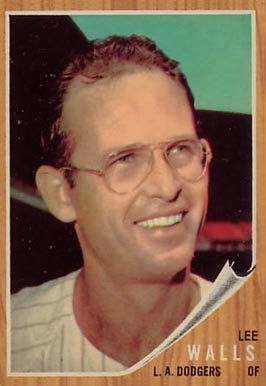

Above and below are his two issued 1962 Topps cards. The photo above seems to have been taken at Connie Mack Stadium and the pinstripes on Walls' jersey colored gray to hide the Phillies' red ones.

This second '62 uses the same picture as the '61 and I'm leaning towards Cubs' colors on his color.


Third time is a charm for this shot as it appears on his '63 cards. Now I'm pretty certain the picture is one that was taken during his days in Chicago.


Saturday, October 26, 2013

#422 Hobie Landrith


One of seven brothers, all of whom played catcher at Northeast High in Detroit, Hobie Landrith got his first taste of the major league life as a 15 year old kid. He was asked to catch batting practice for his hometown Detroit Tigers by a Tiger scout. The story behind this (and the rest of a really neat interview) can be found right here. Landrith went on to play at Michigan State University before signing with the Reds in 1949.

He debuted with the big club in 1950 while getting a four game taste and did the same in 1951. In '52 he got a slightly longer look and he made the Reds as a back-up catcher in 1953. He spent three seasons as a part-timer in Cincy before being traded to the Cubs for 1956. That year he played in 111 games and had career highs in at bats and RBI. But the next season saw him in St. Louis where he played two seasons before moving to the Giants for three.

In 1961 the Mets made Landrith the first player selected by the team in the expansion draft. Casey Stengel is credited with an oft repeated quote. When asked why they chose Hobie Landrith Casey explained that you have to have a catcher or you'll have a lot of passed balls! On May 12 of that first Mets' season Landrith homed to give the team a walk off win.

But Landrith played in only 23 games for the Mets before he was traded to the Orioles who in turn dealt him to the Senators early in 1963.  In 14 full or partial seasons in the majors Landrith batted .233 and hit 34 homers. His longevity came be credited to his defensive skills and handling of pitchers more than any hitting prowess. He coached for the Senators briefly after retirement and then went into public relations and sales for California Volkswagen dealerships.

That looks to be the Polo Grounds behind Landrith in his card. He sports a poorly inked-in Giants logo on what was probably a Cardinals cap in the original photo. My copy of this one is pretty much near mint. My scan doesn't make the colors look as vibrant as they really are.

EDIT (March 2014) A tip received as the blog wound down has clarified the site of the photo on this card:.
"There's some confusion over where the photo for #422 Hobie Landrith was taken. It's Wrigley Field. If the stands aren't a giveaway, look under his right arm - the angled brick wall down the left field foul line made famous many years later by Moises Alou and Steve Bartman.
Topps didn't shoot any photographs in Chicago in 1956, unsure about 1957, so this is probably Landrith in a Cardinals' road jersey with the cap airbrushed, taken in 1958."


Landrith, by the way, is the only major leaguer with the given name of Hobart. There have been over a dozen in the minors however. My favorite name among them has to be Hobart Van Alstyne. With a name like that he should have been the King of Prussia instead of a late 19th century ballplayer for teams like the 1886 Binghamton Crickets.

Sunday, August 4, 2013

#66 Joe Ginsberg


Note: This and the next few posts will be rather short and sweet as I am currently on the road between Houston an Lincoln, Nebraska on family business and putting these together on the fly. 

Born and raised in Detroit, Joe Ginsberg was actually named Myron but he was called 'Little Joe' much of his early life (his Dad's name was Joe) and 'Joe' stuck with him throughout his career. His sig on this card reflects his real given name.

Signed by his hometown club in 1944 Ginsberg played in the minors and served in the military before debuting for a short stretch in 1948 with the Tigers. He was back up in 1950 and in 1951/'52 he was as close to being a regular catcher as at any time in his career. He got over 350 at-bats both seasons and he hit .260 in 1951. In May of 1952 he caught the first of Virgil Trucks' no-hitters.

He played for the Indians and Athletics before finding himself in Baltimore from 1956 through early in 1960 where he was, at least at times, a platoon catcher. After his time with the Birds he played for the Red Sox, White Sox and, for a few games, with the original Mets club in 1962.

Monday, July 15, 2013

#153 Jim Marshall


I'd venture a guess to say the two closest things to major league baseball without actually being the majors have been the old independent PCL and the Japanese Leagues. Jim Marshall spent quite a bit of time in both of those, and he got in five seasons in our big leagues as well.

Marshall signed with the White Sox in 1950 and for the next eight seasons he put up some big power numbers with the Oakland Oaks of the PCL and various farm clubs in the Sox, Giants and Orioles' chains.

He debuted with the Orioles in 1958, was the regular first baseman for awhile and in August was waived due to his .215 average and went to the Cubs. His averages continued to be low while his power, so good in the minors, dried up against major league pitching. 1959 was his busiest and best big league season. He got into over 100 games with the Cubs and had 11 homers and 40 RBI in nearly 300 at bats.

That off season was a hectic one for Marshall. He was traded to the Red Sox who in turn traded him to the Indians during spring training of 1960. But when Sammy White, the other player traded to the Indians, refused to report Marshall was returned to the Cubs. Four days later, still before the season started, the Red Sox dealt Marshall to the Giants for Al Worthington.

He spent two seasons with the Giants, was sold to the expansion Mets for '62 and then was traded to the Pirates in May. While a member of the Mets he became the first player to homer in consecutive games for that club.

Following his tour with the Bucs he went to Japan and played three seasons over there.Since his playing days he has been a coach on two continents, managed in the big leagues for both the Cubs and A's and is currently in the front office of the Arizona Diamondbacks as Senior Advisor, Pacific Rim Operations. 

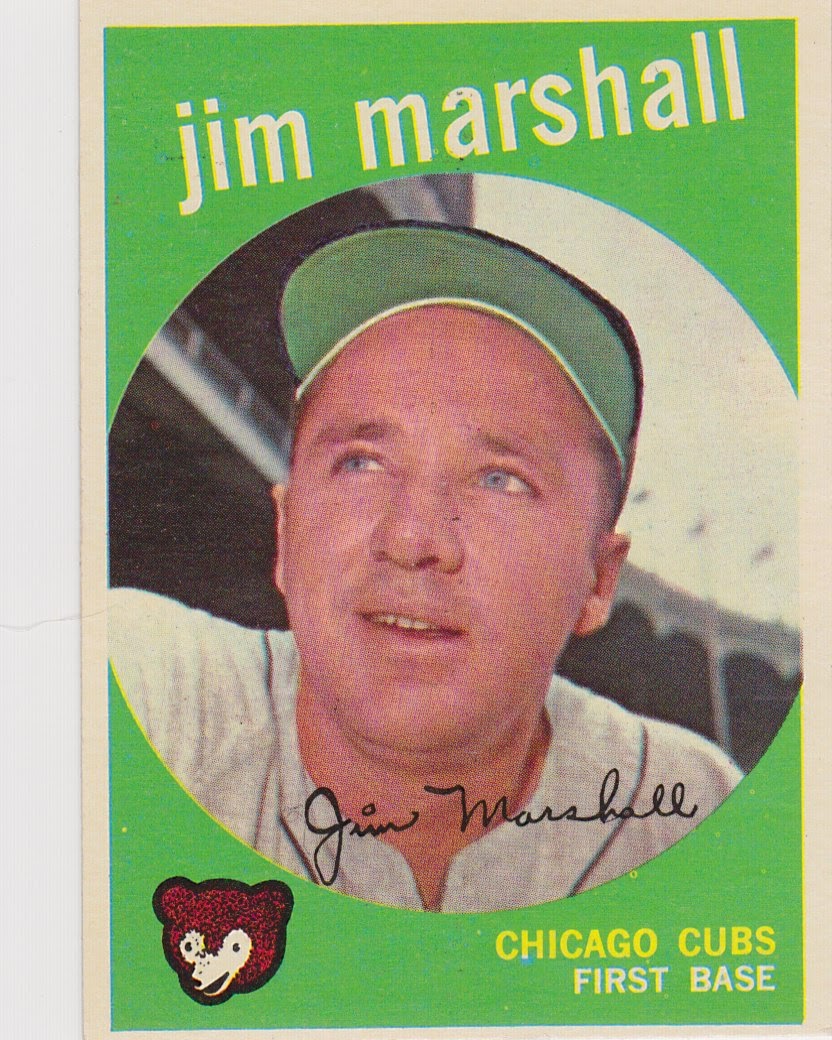
That's an Orioles uni Marshall is wearing at Yankee Stadium on this '59 card. Love the facade and flags flying on top of Yankee Stadium. So many memories.

Marshall is the victim of a very shoddy airbrush treatment on his 1961 Topps card. Just look at the cap. 


Sunday, June 23, 2013

#490 Frank Thomas


Frank Thomas has appeared here previously on a 'special' multi-player card. And I ragged on that card a lot. Time to give 'The Original One' his due.

Thomas was signed in 1947 by the Pirates. He got a taste of the big leagues in 1951 when he was called up in mid-August and played as a regular through the end of the year. Did do badly either. But he spent most of the '52 season in the minors before getting a starting job with the Bucs in their outfield in 1953. He hit 30 homers and drove in 102 runs and got some MVP votes but not a peep in the ROY balloting. I'm guessing he was ineligible because of his '51 experience. It should be noted that the '52 Pirates went 42-112 so that fact that Thomas wasn't up for much of that season was probably a blessing.

The Original Thomas had what could be called an 'interesting' career. First there is his nickname, 'The Big Donkey'. Yes, the miracle of Google has informed me that Adam Dunn also has that name so I suppose that Thomas could claim to be the 'The Original Big Donkey'. But anyway Thomas played on seven different national League clubs during his 16 year career. He must have kept a bag ready because his transaction log resembles MapQuest directions from Alaska to Tanzania.

Other high and low lights:

-He was traded by the Phillies to Houston in 1965 for starting a fight with teammate Dick Allen on the field. Now considering that Thomas supposedly earned his nickname because of his lousy people skills a fight with the charisma impaired Dick Allen was probably a hot wager in the Phillie clubhouse.

-He played on the Original (snort) New York Mets in 1962, another team considered among the worst of all time.

-Bill James's win shares (of which I am clueless), sez he was the worst fielding third baseman ever among those among the top 300 in innings played at third.

-In 1958 he made his third NL All Star squad and had his best season. That year he hit 35 homers with 109 RBI to go with a .281 average.

-As the first baseman for the Pirates e made the last putout at the Polo Grounds when it was the home of the New York Giants on September 29th of 1957.

He appeared on the cover of Sports Illustrated in July of 1958. If you open that issue there is a feature story on him with pics of his family. (Also an unrelated swimsuit pic of an attractive French model appears in the letters section. SI hasn't changed all that much I guess). 

You know, for a guy who was supposedly not the most friendly, he has a lot of 'smiley' shots.


Friday, May 24, 2013

#405 Roy McMillan


Slick fielding shortstop Roy McMillan who, as the card-back notes, was known as 'Mr. Shortstop',  signed with the Reds out of Texas A&M in 1947. He had one good hitting season in the Reds' system but mostly used his glovework to move up to the Reds in 1951. He held down their shortstop spot for 10 seasons while winning three Gold Gloves and making a couple of NL All Star teams.

He was so respected for his defense that he finished sixth in MVP voting in 1956 despite a .263 batting average. He led the NL in assists at SS four times, putouts three times, DPs three times and fielding percentage three times. Veteran player and manager Jimmy Dykes called McMillan the best shortstop he'd ever seen. McMillan earned himself a Sports Illustrated cover appearance and called it the greatest honor of his career. He's a member of the Reds' Hall of Fame.

He was traded to the Braves for the 1961 season so he missed both the Red's title (gone too soon) and the Braves pair of titles (there too late). After three plus seasons in Milwaukee he was dealt to the Mets where he finished out his career. After retiring as a player he coached and managed and had brief stints as manger of the Mets and Brewers.

Roy McMillan died in 1997. His '59 card is a Seals Stadium shot with the seafoam green frame. Good stuff.

Here is his Sports Illustrated cover:


Thursday, January 17, 2013

#95 Carl Willey


Carl Willey (I always heard him referred to as 'Carlton') was a Maine resident when he was signed by the Braves in 1951. Some nice minor league seasons (25 wins in '51-'52) were interrupted by a two year hitch in the service. When he returned he had a pair of mediocre season before blossoming in 1957 when he won 21 games.

In early 1958 he made the Milwaukee roster, was sent back to the minors for a stretch and then returned to the Braves where he went 9-7 in 19 starts and had a league leading four shutouts. He pitched an inning in the World Series' Game Five that year and whiffed two of the three Yankees he faced. He pitched four more seasons with the Braves but never could match his first season.

Sold to the Mets for the '63 season Willey won nine games in a career high 30 starts. An injury plagued 1964 (broken jaw, arm miseries) kept him sidelined quite a bit. He opened the '65 season with the Mets, spent some time with their AAA club, returned to the bigs to end the year but retired that winter.

Willey spent nearly a decade as a scout for the Phillies after retirement and then worked an assortment of jobs in his home state of Maine. He died in 2009.

His SABR bio is here but it's not as colorful as Sal Maglie's. How could it be? He's got a nicer card than The Barber, though....the oddly attractive pink frame and of course the mighty fine Braves uni. The cap alone makes it a winner.

Tuesday, December 11, 2012

#39 Ed Bouchee


After an impressive 1952 debut in the minors Ed Bouchee spent a couple of years serving in the military during the Korea conflict. He returned in 1955 and as a Phillies farm hand he continued his fine hitting. He got his chance in the majors as the regular first baseman for the Phils in 1957 and didn't disappoint. In fact he was second in Rookie of the Year balloting and picked up some significant MVP votes. He had lots of promise.

But that all changed following that '57 season when he was arrested on a morals charge in his native Seattle. No need to re-tell the story here but it's easy enough to find it. The incident cost Bouchee the first half of the '58 season and Topps dropped his card from the 1958 set. Returning in July Bouchee just couldn't match the spark of his rookie year and in fact he never did.

He was dealt to the Cubs for the 1960 season and was taken by the Mets in the '61 expansion draft. The woeful '62 Mets proved to be Bouchee's final stop in the big leagues although he spent 1963 with their AA club. He finished with a .262 lifetime average and 61 homers.

This pink framed card marked Bouchee's return to the Topps card world. And note how Topps handles his 1958 season. They state he 'got a late start.' That's Connie Mack Stadium that he's posing in. I guess it wasn't too much of a hike for the Topps photographers to get down to Philly. I never did get there despite not living all that far away for many years as a kid.

BTW.... indispensable blogger Bob Lemke has produced a nice '58 Topps 'card that never was' for Bouchee.

Wednesday, August 15, 2012

#326 Marv Throneberry


My memories of Marv Throneberry are as an object of derision during and after his end-of-career run with the horrific expansion Mets. What Mario Mendoza was to the 70's, Throneberry was to the 60s, at least among the kids I hung with. And it really was an unfair assessment. I mean a .237 average with fifty some homers is a tidy little career nest-egg, no? He hit 16 in 1962 when the Mets played in the spacious (except for the foul lines) Polo Grounds.

Marv's reputation as a bad ballplayer, combined with his good-natured ability to laugh at himself, led to some Miller Lite commercials that put him in the spotlight more than he ever was in his playing days. 

A Yankee signee he made a one game appearance in 1955 but actually broke in with the '58 team after putting up some impressive power numbers in the minors. He was AA MVP in 1956 and hit over 80 homers in a two year span in Denver's thin air. But, like most Yankees who couldn't budge the regular out of the lineup (Hi, Moose!), he traveled the highway out to Kansas City for a bit beginning in 1960. From there it was on to Baltimore and finally a trade to the Mets early in the 1962 season. He finally had a regular gig and played better than you'd expect from a guy who became the butt of baseball humor, hitting .244 and collecting 49 RBIs. 

Marv's older brother Faye Throneberry played for the Nats and a couple of other clubs through the 50s. Faye has a card in this set as well. It's unknown if Marv lorded his .237 career average over Faye's .236 at family get-togethers. Or the fact that he had an at bat in the 1958 World Series. OK, so he whiffed against Lew Burdette in Game Two. That's one more AB than Faye ever got in a Series. And Marv had a World Series ring to flash around.

Here are a couple of post-career looks at Marv. Neither is very high quality but they are worth linking. First his Miller beer ad....

...and then a feature done about him on the CBS Sunday Morning show.
Pretty nice card, too. The red frame, classic Yankee duds and unusual pose against the blue sky and YS facade make this card stand out. Good for you. Marv. Who's laughing now?

Sunday, August 12, 2012

#365 Gus Bell


Louisville native Gus Bell broke into the majors with the Pirates in 1950. He showed a lot of promise with the Bucs his first two season but his numbers went south in 1952. The Pirates dealt him to the Reds after that season but they lived to regret giving up on the slugging outfielder.

For the next five years Bell, played at an All Star level, never hitting below .290 with 121 homers. He made four All Star teams and had three seasons of 100+ RBI. As the back of his '59 card states 1958 was an 'off' year for Gus Bell and true to Topps' prediction he rebounded nicely in '59. He hit .293 with a career high 115 RBIs.

Bells production slid from that point and the Reds let him be drafted by the expansion Mets for 1962. He played rightfield in the franchises' first game and got the teams' first hit, a 2nd inning Opening Day single. After a partial season for the Mets, Bell was traded to Milwaukee where he finished his career a couple of years later.

Bell died in 1995 but left behind a legacy. His son Buddy Bell had a long major league career including All Star selections and Gold Gloves. He also managed nine seasons for three clubs. Buddy Bell's sons David and Mike were major league infielders in the last decade.

Bell had one post-season shot. He pinch hit three times in the 1961 World series against the Yankees. It's also notable that he was one of the seven Reds to be elected as All Star starters by fans in 1957 as part of a ballot 'stuffing' campaign. Ford Frick, baseball's commissioner, removed most of them from the team but Bell was chosen to play by Walt Alston and he had a two run double.

A black framed Reds card. Always a treat, Especially one in  the kind of shape this one is in.

Here are a few other Gus Bell pics and cards including the absolutely terrific 1960 Gus Bell. How can you not love this card?


Gus Bell appeared along with fellow Reds sluggers Wally Post and Ted Kluszewski on a 1956 Sports Illustrated cover.


Here are the '76 and '85 Topps Father and Son with Gus and Buddy Bell:


Check out the smile on Buddy's face in this next one. Looks familiar, yes?


Tuesday, May 15, 2012

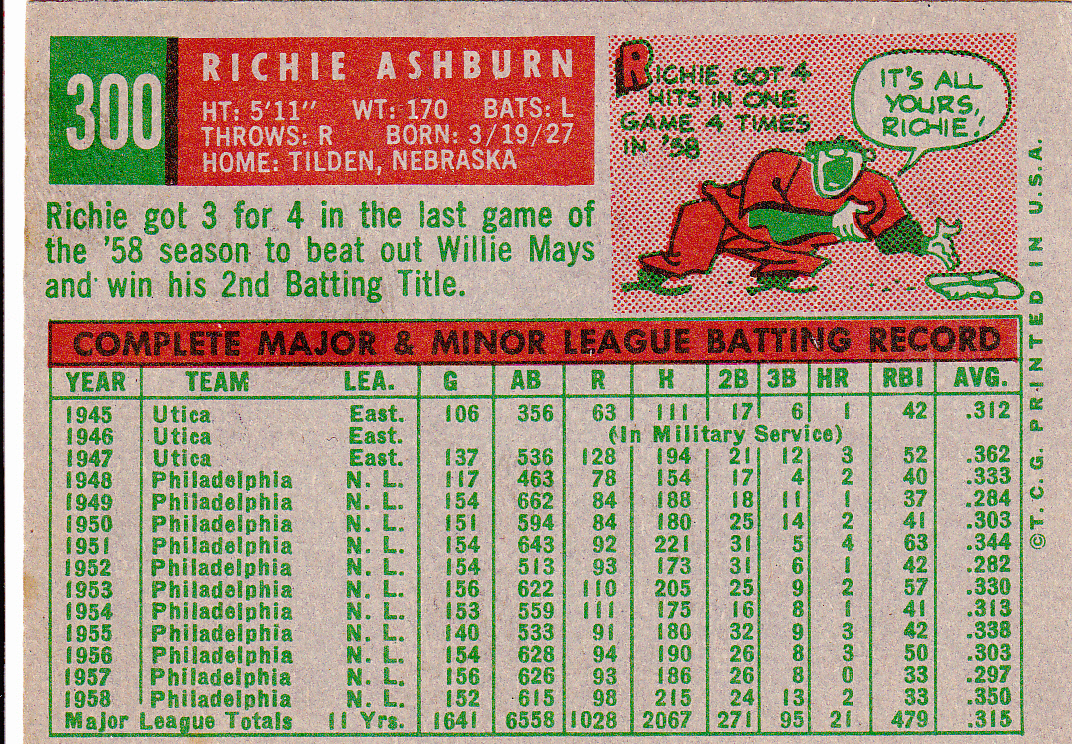
#300 Richie Ashburn


Richie Ashburn is one of six Hall of Famers born in Nebraska. The group consists of Bob Gibson, Wade Boggs, Sam Crawford, Grover Cleveland 'Pete' Alexander and Billy Southworth in addition to Ashburn.

Ashburn sandwiched a couple of years of burning up the Eastern League around a year of military service before breaking in with the Phillies in 1948. He batted .333 that year and led the NL in stolen bases. He finished third in Rookie of the Year voting.

He went on to have a great 12 year run as the Phils' centerfielder. He was a member of the 1950 Whiz Kids club that lost the Series to the Yankees. Through he career Ashburn played in the shadow of three great center fielders, Mickey Mantle, Willie Mays and Duke Snider. Except for the power those players possessed Ashburn was on a par with them in speed, average and roaming the outfield. He had the most hits of any player during the 1950s.

Traded to the Cubs in 1960 Ashburn played two seasons on the north side and was sold to the fledgling Mets for the 1962 season. He retired after a year in New York and soon went into broadcasting, a profession he had long had his eye on.

He broadcast Phils games from 1963 through his death in 1997. During that time he partnered with Bill Campbell, Byrum Saam and Harry Kalas. Baseball Almanac has a page of Richie Ashburn's quotes, most from his days in the booth. He was elected to the Hall by the Veterans' Committee in 1995.

I only saw Ashburn play in person once, as a Met in 1962. But the '59 card is how I (and most folks I'd expect) remember him. It's nice to see a picture in the set that wasn't taken in New York. Those red seats were a feature of Philadelphia's Connie Mack Stadium.