Saturday, July 13, 2013

#93 Julio Becquer


"Money is secondary with me," [Julio Becquer] said. "I love the game and I believe this is true of most major league players. In fact, many would play for nothing because they love the game so much."


That comes from a 1958 interview of Julio Becquer that is quoted on his Baseball Reference Bullpen page. Hard to imagine a player saying that today. Becquer was signed by the Washington Senators out of his hometown of Havana, Cuba in 1952. He was a student who worked as both a bookkeeper and ballplayer in Havana. He is one of a number of black Cubans tagged by the legendary scout/entrepreneur Joe Cambria and signed by the Senators.
Becquer played a season of stateside baseball when he signed with the Nats and then, still their property, played two seasons at home in Havana. He got his first look at the majors in 1955 with a 10 game trial and returned to the minors in '56. For four seasons, through 1960, Becquer played as a part time first baseman and pinch-hitter for the Senators.
He was drafted by the expansion Los Angeles Angels for the '61 season but barely was fitted for a halo before he was sold to the Phillies in May who assigned him to Buffalo. He was then sold again, back to the Twins (the former Senators) in June.
Becquer spent most of the '62 through '64 seasons playing in Mexico. But he returned to the Twins for one game in 1963 to qualify for his pension. He pinch ran and scored in that game which is a nice touch for a guy who by all accounts was a very nice man.
I'd be willing to bet that Bequer, if asked, would list his July 4, 1961 pinch hit walk-off grand slam as his career moment. It beat the White Sox 6-4 and came just two weeks after he homered as a pinch hitter leading off the bottom of the ninth to beat Jack Fisher and the Orioles, 5-4. That homer marked both the first walkoff and first pinch homer in Minnesota Twins' history. It was an especially sweet dinger for the Twins because after leading 4-1 they were tied in the top of the ninth by a three run homer off the bat of Earl Robinson.
This card shows Becquer in what appears to be his home pinstriped Nats uni but the stadium behind him looks like Yankee Stadium. But I'm pretty sure is Griffith Stadium. There have been several other Senators in pinstripes in that same pose/spot on their cards. When you look at Roy Sievers' card you can see the differences. I conclude that: 1) Becquer is posing in Griffith and 2) I'm likely the only person in the free world who actually gives this any thought.

Thursday, July 11, 2013

#208 Willie Jones


This, my friends, is Willie 'Puddin' Head' Jones. You have to love a guy who uses that nickname as his signature.


He was a ten year starter at 3rd base for the Phillies from 1949 through 1958. He was a contributor to the 1950 Whiz Kids club in Philadelphia and had his best season that year. He had personal bests in hits, runs, triples homers and RBIs. He played in a league high 157 games that year which isn't easy given the 154 game schedule.

Jones had signed with the Phils in 1947 and was brought up for an 18 games trial that year. He got a similar look in '48. He took over at third in '49 and kept the job for a decade as noted. On April 20th of 1949 against the Braves he had four consecutive doubles. Seems odd that guy could get four doubles in a game and not score a run. He made two NL All Star squads. In 1950's 14 inning game he played the whole game at third and went 1 for 7. That's a record for most at bats in an All Star game.

Jones was known as a good fielder and he led the NL in fielding percentage from 1952 through 1956. He led again in '58 and finished second in '57 and '59.

In the 1950 World Series he had four hits in 14 at bats. That was his only postseason experience. He was moved twice in 1959, traded from the Phils to the Indians and then sold by the Indians to the Reds. He played in just about half the Reds' games in that season and the next but was let go early in the 1961 season. Had he lasted he would have been around for the Reds pennant that year.

The story of how he got that distinctive nickname isn't clear. This blog post asked the question and the replies varied from his name coming from a popular Rudy Vallee song to his daily intake of liver pudding(!) and a few in between. The actual story seems lost to time.

EDIT: I forgot to mention that it looks like the Polo Grounds is the site of this card's picture. There have been others shot there but this angle gives a look that I don't recall before.

Here is a bonus picture of Puddin' Head that ran in Life magazine. I'm including it here because I like it. He looks like he should be named Puddin' Head, doesn't he?


Tuesday, July 9, 2013

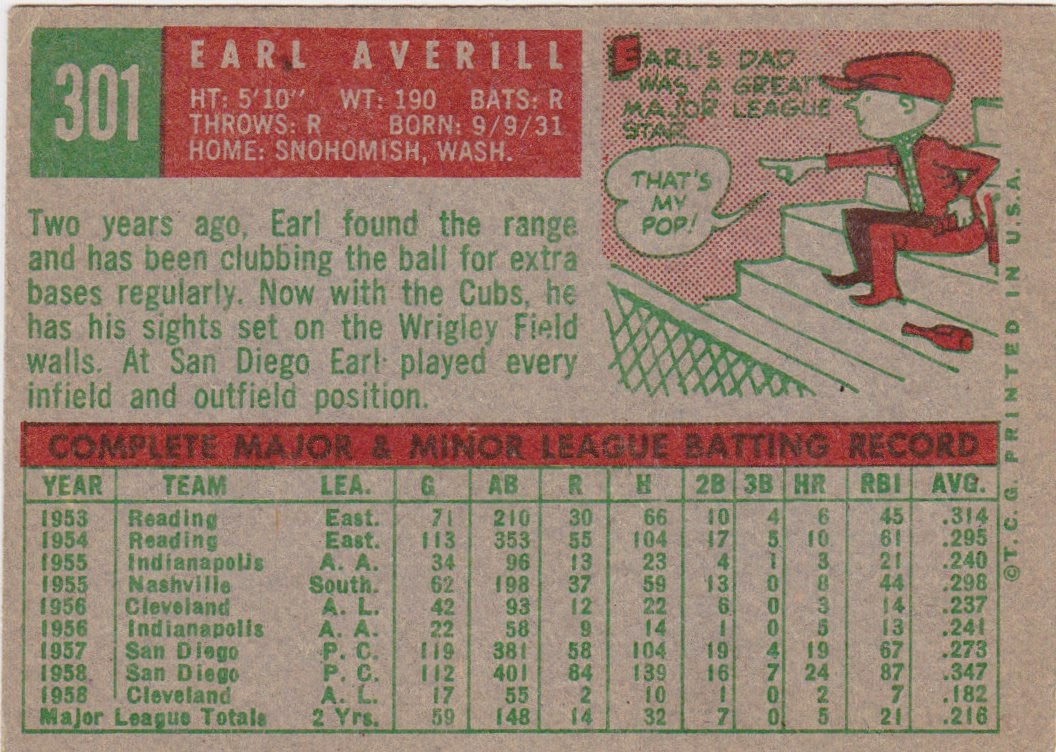
#301 Earl Averill


If the name is familiar it's probably because 3rd baseman Earl Averill is the son of Hall of Fame outfielder Earl Averill. Earl the Younger is not a 'Jr.' because his father's name is actually Howard Earl Averill. Sadly our Earl doesn't carry a spiffy nickname like his father's "The Earl of Snohomish" (which was shared, btw, with another Snohomish, Washington native, Earl Torgeson). 

Earl Averill was signed (six days after my birthday) by his father's team, the Cleveland Indians, as a catcher. He was converted to an infielder in the farm system and got quick looks at the majors in 1956 and 1958. He was dealt to the Cubs prior to the '59 season and spent that year shuffling around the field playing 3rd, the outfield, behind the plate and some at 2nd base. He hit 10 homers in 186 at bats that year. 

In 1960 he was traded by the Cubs to the Braves, spent a month in the minors and was then dealt to the White Sox. After that tumultuous year he was drafted by the expansion Angels. He had his best season in '61, hitting .266 with 21 homers and 59 RBI. He tailed off after that, spent a year with the Phils and a couple in the minors before retiring. 

Looks like Topps' airbrush department caught a break with this card. They were able to take the Indians' 'C' on the cap in this photo and smooth it out to resemble the Cubs' logo 'C'. Probably fooled kids in 1959, as long as they didn't really look too close.

Sunday, July 7, 2013

#275 Jack Sanford


If the term 'bad ass' had been popular back when pitcher Jack Sanford was active, he'd have been called one. He threw hard, didn't always know (or care) where the ball was going, and once was suspended for 10 games for refusing to give up the baseball when his manager came out to take him out of a game. That's bad ass.
Sanford tried out at a Red Sox camp in 1948 after high school but they thought he was too small and he wasn't signed. A Phillies scout had seen his performance and offered him a contract and he pitched until 1954 in their chain. He spent a year in the military and in 1957, his first full season in the bigs, he won 19, lost only 8 and posted a 3.08 ERA to earn NL Rookie of the Year honors.
He was hit with the sophomore jinx in 1958 and his numbers slipped. The Phils traded him to the Giants for Valmy Thomas and Ruben Gomez in a move they regretted soon enough. Sanford rebounded and pitched very well in San Francisco for five seasons. His best year was 1962 when he won 24 games and finished second in the Cy Young voting. 16 of those 24 wins came consecutively. In 1963 the workhorse started a league high 42 games. (It's a different game today, Phil Niekro was the last pitcher to start that many, taking the mound 44 times in 1979.)
Sanford started three games in the 1962 Series for the Giants. He went 1-2 against the potent Yankee squad. He pitched very well in the series and in Game 7 he started and allowed only one run. Sadly for the Giants his club was shutout by Ralph Terry in the deciding game. Each of his Series starts, in fact, came against Terry.
He remained in the majors with the Giants, Angels and A's before retiring after the 1967 season and left with 137 career wins. Following that he coached for a couple of seasons in Cleveland and worked as a country club director.
Sanford died in 2000 of brain cancer. A well written blog post reminisces about his career. That's likely a Polo Grounds shot of Sanford in his Phils uni with a barely visible airbrushed SF logo on his cap.

Friday, July 5, 2013

#548 Elmer Singleton


Righty pitcher Elmer Singleton threw his first pitch as a pro in 1940 in Wenatchee, Washington as a newly signed Yankees prospect. 24 seasons later, in 1963, he completed a circle of sorts as he threw his last one in Seattle, Washington for the PCL Seattle Rainiers.

In between Singleton pitched in 8 major league seasons for the Braves, Pirates, Nats and Cubs. His two complete seasons in the bigs came with the '47/'48 Pirates. He never won more that four games in a year and finished with an 11-17 mark. His last big league season was the year this card was issued, 1959.

He made 526 minor league appearances including 342 staters. His record was 184-186 and that a lot of decisions. His best seasons came in the early to mid 50s with the PCL's San Francisco Seals a a couple of other clubs. From 1952 through 1961 he won in double digits 8 of 9 seasons including 17, 18 and 19 win years. His ERA was never over 3.40 in those years and frequently much lower.

After finally retiring Singleton worked for a car dealership in his native Ogden, Utah. He died in 1996.

On his card Singleton has the slightly road weary look of a guy who has 20 seasons of baseball behind him. I'm not really sure where this was taken. Even blown up the picture doesn't reveal much in the way of clues. It doesn't quite strike me as the Polo Grounds or either of the West Coast parks. There is a slight Ebbets Field 'vibe' to the picture but the seating/wall arrangement looks wrong. I'll have to keep digging, because this stuff is oddly important to me.

Wednesday, July 3, 2013

#56 Carl Sawatski


From his signing with the Phillies in 1945 at the age of 18 until his death in 1991 Carl Sawatski spent nearly his entire adult life in the game of baseball. Born in Pennsylvania but raised in Little Rock Sawatski spent four seasons in the minors as the property of three different franchises before he debuted with a handful of at bats in 1948 with the Cubs. Prodigious power numbers in Nashville in '49/'50 earned him another look at big league pitching before Uncle Sam called and Sawatski gave two years to the military service. His minor league exploits are chronicled here on the Nashville Sounds website.

Returning to baseball he played another season for the Cubs before being traded to the cross town White Sox. He didn't hit much for either club and found himself back in the minors in 1956 and then returned to the bigs with the World Series champion Braves in 1957 as a back-up catcher. He got a couple of Series at bats and a ring for his efforts.

The Braves traded him to the Phils in 1958 and they in turn passed him along to the Cards in 1960. For  six seasons, from 1958 until he retired after the '63 season, Sawatski averaged around 80 games and 210 at bats each year. He twice hit nearly .300 and had a career high 13 homers in 1962.

After retiring he became the GM of the Arkansas Travelers in the Cards chain and then served as the president of the Southern League until his passing.

Looks like a Connie Mack stadium shot here. Topps' East Coast photographers sometimes traveled out of New York, kicking and screaming I'm sure.

And note that the Phils cap on the logo is missing the red ink. From a quick googling it appears all the '59 Sawatski cards suffered from this. It is not listed as a variation or error on this usually reliable list. Perhaps printing anomolies are not considered errors/variations.

Monday, July 1, 2013

#97 Jerry Lynch


If I had a buck for every guy in this set that played one season of minor league ball and then went into the service, well I'd have enough to upgrade this set quite a bit. But my Jerry Lynch wouldn't require upgrading, it's pretty sweet.

Anyway, Lynch, who played six and a half seasons with the Pirates sandwiched around six and a half with Cincinnati, is known as one of the game's best pinch hitters. As of this writing his 116 pinch hits ranks him tenth on the all time list. When he retired his 18 pinch homers was the best of all time and he still ranks third in that category.

When he returned from the service after the Korean War he played a season in the Yankee chain and then was drafted by the Pirates. He got 300 plate appearances  with them in 1954 and '55 but he hardly played in 1956 (injury?). The Reds drafted him from the Pirates and he he carved out a place for himself there as an outfielder and key man off the bench.

He spent a lot of his big league seasons as what I'd call a 'semi full timer', getting 300 to 400 at bats. His best season came in 1961 when he hit .315 and drove in 25 runs as a pinch hitter. That year the Reds took the NL crown. This comes from Lynch's obit (he died last year):
In his New Bill James Historical Baseball Abstract, James made a case for Lynch being named MVP for his 1961 heroics:
"He hit over .400 as a pinch hitter with power and played 44 games in the outfield. His slugging percentage of .624 and 50 RBI in 181 at-bats was a far better rate than Roger Maris had that same season, hitting 61 home runs," James wrote. "More than that, Lynch had big, big hits; game after game, when the Reds were in danger of falling short, Lynch came up with the big hit to put them back in front, and the Reds, picked to finish sixth, won the pennant."
Lynch got three at bats in the '61 Series and went hitless but was issued an intentional walk. After retirement he and former teammate and friend Dick Groat were in the golf course management business together.  He was selected as a member of the Reds' Hall of Fame in 1988.