Showing posts with label Cincinnati Reds. Show all posts

Monday, February 24, 2014

#494 Don Pavletich


Don Pavletich is an interesting guy on an interesting card. He was signed out of Wisconsin by the Reds for a big bonus in 1956. The card-back claims it was a 'reported $40,000' while Pavletich, in this book excerpt on Google which I referenced numerous times for this post, says it was $30,000 but reported as $20,000. Whatever it was it qualified him as a 'bonus baby' and obligated the Reds to keep him on their roster.  

He began his pro career in 1957 when he reported to spring training. He was on the Reds roster as the season opened and pinch hit (he walked for Don Newcombe) in one game. Then at the urging of the Reds he joined the Army in May. The plan was that he could play service ball and get experience without taking up a valuable roster spot and sitting around. He spent the rest of that year and all of 1958 in the military. Interestingly he says that he was discharged three months before the end of his two year hitch on a hardship appeal. The hardship being that he had to be in spring training to pursue his livelihood!

When he returned in 1959 he again played in a single game but this time, instead of heading overseas, he headed for the minors. He had two solid seasons there, played with the Reds in 1962 and was used sparingly. Two seasons split between the Reds and the minors followed and finally, in 1965, he had a full year as a major league platoon catcher and he hit a career high .319. Another good year  (.294 with 12 homers) followed in 1966 but by then a young Johnny Bench was on the Reds' catching horizon and Pavletich's days were numbered in Cincy.

His numbers and playing time took downward trends (he played more first than catcher in '68) and he was traded to the White Sox for 1969. A broken hand limited his playing time and he was dealt to the Red Sox where he played on a limited basis for two years. After an off season trade to the Brewers in the winter of '71/'72 he was released that March. He did not return to the majors and worked as a mortgage loan officer after baseball. 

That card is pretty unique in this set. Pavletich poses in catching gear with a red cap and in what appears to me to be Connie Mack Stadium. The windows and posts in the stands seem to make it so. Check this picture of the old ballpark and see if you agree. 


But when was it taken? He was with the Reds early in 1957 and they played in Philadelphia early in April so that's a possibility. He was in Europe in the Army during 1958. They also played there early in 1959, maybe early enough to have his photo snapped in time to be included in this set. But knowing Topps that just doesn't seem likely. 

But that cap. Assuming it's not 'colored' by an artist and really is red than that becomes an interesting clue. The Reds wore that cap in 1956 before going to the white crown version in 1957. It may be that Pavletich, after signing in '56, was brought to Philadelphia for a look at the club or to iron out details. The Reds were there in mid-September. And Pavletich himself spoke of signing in '56 but not reporting until '57 Or they team may have had him come for the actual contract signing and some publicity pics. That sort of this isn't unusual even today with big dollar prospects. 

I'll never know but tracking down stuff like this keeps me interested in this set even 500+ posts into it.

Sunday, January 19, 2014

#421 Herm Wehmeier


Herm Wehmeier was signed by his hometown Cincinnati Reds as an 18-year-old high school phenom in 1945. He pitched well enough at the AA level to get a call-up and two game big league look at the end of the season. He was shelled in his debut start and then spent the next two seasons posting wins in the Reds' system.

In 1948 Wehmeier was up to stay and he spent five seasons in the Reds' rotation as their #2 or 3 starter winning about ten games a year with high ERAs for a consistently second division club. His problem with control kept him from having the success his 'stuff' suggested he'd have. According to Wikipedia he led the National League in walks allowed in 1949 (117), 1950 (135) and 1952 (103). He led the NL in earned runs allowed (145) in 1950. He led the NL in wild pitches in 1949 (7) and 1950 (11). He led the NL in hit batsmen (7) in 1952. 

Thus he was a easy scapegoat for the troubles of the struggling team. This chapter from a book by Flip Bondy which I found on Google Books is a fun read. And it is worth the click just for the picture of Herm and Mrs. Herm. Wehmeier lost his starting spot in 1953 and after a terrible start to the 1954 season he was sold to the Phillies in June. He rebounded in Phily and won ten games with outstanding numbers over the second half of his first season there.

Wehmeier's effectiveness fell off some in '55 and in May of '56 he was traded to the Cardinals along with Murray Dickson in a deal that saw the Phils acquire Stu Miller and Harvey Haddix. The irony of that trade is that it came just two days after the Cards had beaten Wehmeier for the 14th consecutive time in his career! He had never beaten them and understandably some must have questioned the trade. He pitched very well for the Cards after a few adjustments in his mechanics and he won 12 games for them the rest of the way. 

The big righthander backed that up with a ten win season in '57 but in 1958, in what was a regular pattern now, his poor start led to a move. He was sold to the Tigers in May. He hurt his arm in July and never pitched again. So his career was over by the time this card was issued.

This very entertaining blog post tells the story of his struggles with the Reds, the trade to the Cards, his post-career life and unusual death (a heart attack while testifying at an embezzlement trial). Well worth the quick read.

If you think this card looks familiar it may be because it's almost a twin to the #417 Virgil Trucks card shown below and blogged here (has it really been two and a half years?). They are even just a few numbers away from each other on the checklist are in the same page in my binder. The difference is that 'Fire' Trucks was photographed at Yankee Stadium. The Wehmeier picture however appears to be a Polo Grounds shot. He wasn't an American Leaguer outside of a few months in 1958 and that is not Yankee Stadium. 

Obviously Wehmeier's cap was altered (as was Trucks'). I'd bet that the same photographer took both shots at different New York locales. 

Here they are together in the binder.


Wednesday, January 15, 2014

#404 Hank Sauer


At the age of 42 in 1959 Hank Sauer was the third oldest player to have a card in the set. Only Enos Slaughter and Murray Dickson had a year on the guy whose nickname was 'Honker'. While he's shown with his last team, the Giants, Sauer's glory days came with the Chicago Cubs with whom he played from 1949 through 1956.

Sauer's pro baseball career began way back in 1937 when he signed with the Yankees after the western Pennsylvania native had spent a couple of years working in a New Deal Civilian Conservation Corps job to help support his family. He spent three years playing in the Yankee's system and displaying a powerful bat before he was drafted away by the Reds. Over the next seven years Sauer played mostly in the minors for Cincinnati while getting three major league trials of various lengths and putting in a year of military service. His minor league exploits led to his being elected to the Minor League Baseball Hall of Fame.

He took over the left-field job for the Reds in 1948 and proceeded to blast 35 homers while hitting .260 and driving in 97 runs. But a slow start to 1949, combined with a propensity to strike out caused the Reds to trade Sauer to the Cubs in June. He made the most of the change in scenery and in less than 100 games he had 27 homers, 83 RBI and a .291 average. His hitting captured the hearts of Cub fans and they would shower him with pouches of his favorite chewing tobacco during games.

His hitting had improved when he switched to a heavy 40 ounce bat and it never let up during a five season stretch on Chicago's North Side. Dubbed the 'Mayor of Wrigley Field' Sauer hit over thirty homers in each of the next five seasons except one. In 1952 he led the NL in home runs with 37 and RBI with 121. He won the NL MVP Award for that production.

His numbers plummeted in 1955 and he had lost his starting job when the Cubs traded him to the Cards. He played well in a reserve role in St. Louis but was released due to what Sauer claims was his being a bad influence on Stan Musial. Sauer discusses this in his SABR bio:

Sauer, playing as a reserve in 1956, batted 151 times, but he averaged .298 with five home runs and 24 RBIs, despite being hit in the face with a bat during one of the team’s practice sessions. Also, he and his roommate stayed out until after midnight two or three nights a week, which, Hank recollected, Musial enjoyed.
The Cardinals’ management, however, did not favor late-night carousing. Sauer observed, “In September of ‘56, the manager [Fred Hutchinson] came up and said, ‘Hank, we’ve got to let you go.’ I said, ‘Let me go! I’m having a pretty damn good year. Why are you letting me go?’
“He said, ‘Yeah, you’re having a good year, but your roommate is having a lousy year. He’s only hitting .315.’ I said, ‘What the hell’s the matter with .315?’ He said, ‘Musial is not a .315 hitter. He’s a .330 hitter. You’re on your way!’ So I was the one who had to go.”
Sauer revived his career with the Giants in 1957 and earned Comeback of the Year honors but in '58 he was back to a reserve role and in '59 he played sparingly before becoming a coach at mid-season. That ended his playing days. He remained with the Giants in various capacities for 35 years. He died at the age of 84 in 2001 while playing golf.

That's Seals Stadium behind Sauer with it's distinctive red railings. The 'Honker' looks every bit of his 42 years, doesn't he?

Sauer's brother Ed played the outfield for three NL teams in the 1940s. His son Hank Jr. played three years in the lower minors in the 1970s. There are several articles about his days in Chicago on the Chicago Tribune web site. And here is his obit in that paper.

Monday, November 25, 2013

#228 Don Gross


I'm not really sure what prompted Topps to pose pitcher Don Gross holding a bat in Seals Stadium much less use the shot on his 1959 card. It's not like he was a good hitting pitcher or a converted position player. Just a curiosity of the set I guess.

Anyway, the left-handed Gross signed with the Reds in 1950 after playing (though not lettering apparently) at Michigan State University. He worked his way up through the Reds' chain with some impressive numbers, spent 1953 in the military, and debuted in July of 1955 with Cincinnati.

He went 4-5 that first half season in 11 starts over 17 appearances. He split the '56 season between the Reds and AAA Havana and then was 7-9 in a spot starters role in 1958. He was traded to the Pirates after that season in a deal that brought Bob Purkey to the Reds. While Purkey went on to All Star status with the Reds Gross won only six more games as his career finished with him bouncing around the minors through 1963.

A near no-hitter against the Braves that turned into a tough luck 1-0 loss on May 28th of 1958 was his career highlight. Or maybe not. Gross was part of a wacky 9 run bottom of the ninth rally that the Giants put together on May 5, 1958 in Seals Stadium.

Cruising along with an 11-1 lead Vern Law looked to finish off the Giants with three more outs. Then this happened:

Leading off, Ray Jablonski singles, and so does Orlando Cepeda. Hank Sauer reaches on an error and the bases are loaded. Willie Kirkland flies out. Jim King hits a pinch double to score two. John Antonelli doubles in two more to make it 11-5. Bob Speake hits a pinch double, the third in a row by the Giants and it's now 11-6. Curt Raydon replaces Law and promptly walks Willie Mays who is then forced at second, the second out of the inning.

Ray Jablonski then hits a 3 run homer to draw the Giants to within two at 11-9. Ron Blackburn comes on to pitch and gives up a homer to Cepeda and it's suddenly a one run game! But were are not quite done. Sauer walks, representing the tying run and on to pitch comes our guy, Don Gross. He walks pinch hitter Bob Schmidt and Jim Finigan, hitting for King grounds to short where it's booted for an error. The bases are now loaded. Any of the 5,502 Giants fans who had stayed to the end on a runaway game must have thought the were about to witness one of the best comebacks in baseball history.

But Don Taussig, the fifth pinch hitter of the inning, pops out to second to end the fiasco and give Don Gross a save, his first of seven that season.

Bottom line on the Giants ninth inning:
9 runs, 7 hits including three consecutive doubles and back-to-back homers, 3 walks, 
5 pinch-hitters, a pinch-runner, 2 errors and 3 LOB.

The line score:
                1  2  3   4  5  6   7  8  9    R  H  E
                -  -  -   -  -  -   -  -  -    -  -  -
Pirates         0  2  0   0  0  1   5  0  3   11 14  3
Giants          1  0  0   0  0  0   0  0  9   10 12  1

And now that I think about it, given the the picture on this card was taken in '58 at Seals Stadium in San Francisco, might Gross have been trying to send some subliminal message by holding up a bat? Taunting the Giants on the day following that crazy game? I guess we'll never know.

Saturday, November 23, 2013

#171 Willard Schmidt


Willard Schmidt has a great card, doesn't he?. The back frame that contrasts and compliments those Reds' duds, Seals Stadium with the distinctive red railings and, maybe best of all, a terrific cartoon on the reverse. It became even greater as I researched his career as you will see. 

Schmidt was signed out of Hays, Kansas in 1949 by the Cardinals. He won 56 games in three seasons as he climbed through the Cards' well stocked farm system. He got brief looks in St. Louis in 1952 and '53 but was back in the minors for the following season and a half where he again was impressive. He won 30 games over that span and was recalled to the Majors by the Cards in July of '55, this time for good. 

He was primarily a starter for that '55 season and continued in that role in 1956. He posted impressive numbers, especially in his rookie campaign. That half year he went 7-6 with a 2.86 ERA and a 1.13 WHIP. He had some memorable games among his fifteen starts. His first start resulted in a four hit complete game win over the Giants in New York. Ten days later he nearly matched that with a five hit win over the Pirates at home.

On August 11th he took a no-hitter into the seventh against the Braves in Milwaukee. Johnny Logan singled to end the no hit bid but Schmidt breezed through the rest of the game for the shutout win. On September 4th he took a perfect game into the 7th before the Cubs got to him and tagged him for a loss. Finally, on September 21, in what turned out to be his final start of the season, he went 12 and a third against Cubs at home. He had allowed just seven hits and three runs going into the 13th but the Cubs rocked him and he took a 7-4 loss. Hard to envision that game given the changes that have taken place in baseball since then. Twelve and a third innings is probably two games work for many of the games starters these days. 

His 1956 numbers were not quite up to those of his rookie season and in '57 he was converted to a reliever. He went 10-3 but his hits per inning went way up and the Cards had younger prospects on the rise. After that year he was traded to the Reds in the deal that brought Curt Flood to St. Louis. In '58/'59 he won six games and then found himself back in the minors to close out his career. 

Before he was done though he was able to grab a bit of notoriety by becoming the first player in major league history to get hit by a pitch twice in the same inning by two different pitchers when Bob Rush and Lew Burdette of the Milwaukee Braves hit him in the third inning of a wild and crazy 11–10 Reds win on April 26th of 1959. From the box score it appears he took a shot off the bat of his old nemesis Johnny Logan that KO'd him. 

After his retirement he co-owned Schmidt-Tullius Dodge and Schmidt Bicycle and Lawnmower Center in the Norman, Oklahoma area and later retired from that to a small farm in Newcastle, Oklahoma. His 2007 obituary states he had been preceded in death by six brothers and three sisters and survived by two other sisters, that his family had been among the first German-Russian settlers in the Hays, Kansas area and that his first language was German. He also attended Fort Hays College for a year before turning to pro baseball.

In the process of researching Willard Schmidt I came across a blog written by his great nephew, James Schmidt. James, a chemist by trade, is a Civil War historian and author who specializes in the art/science of medicine during that remarkable time. As a Abe Lincoln-phile I immediately had my interest piqued and then I was really pleased to find that James lives right here in Houston and does lectures and discussions on his interests and books. In fact I missed one held by the Houston Public Library by just a week or so. Fascinating stuff. 

I had found a post on his blog centered on great-uncle Willard and I reached out to James and he was kind enough to respond and point me to another post and he filled in a bit of his family background. How great is that? I'm looking forward to meeting James Schmidt one of these days and hearing more about his great uncle and especially more about his field of interest, the Civil War. 

Oh, that cartoon on the back of Willard Schmidt's '59 Topps?  Behold this classic:


Thursday, October 31, 2013

#303 Marty Keough


Marty Keough was California kid who signed as an outfielder with the Red Sox in 1952. He hit well enough as a prospect to move up the ladder and he got a couple of looks by the Sox before he made the club in 1958 as a bench player. He got into almost 70 games and although he didn't hit much he was back in 1959 having won over the team with his speed and much improved fielding. He improved his hitting and got into nearly a hundred games with Boston that year. But the Red Sox had more outfielders than they could use and early in 1960 he was traded to the Indians. 

He finished that season with a .248 average and was selected by the Senators in that winter's expansion draft. 1961 in Washington proved to be Keough's busiest season as he had over 430 plate appearances and hit 9 homers to go with a .249 average.

He was traded once again that winter, this time to the Reds where he spent four uneven seasons, sometimes in a platoon role and sometimes, like in 1965, with no role at all. The Reds sold him to the Braves on the eve of the 1966 season but within six weeks or so he was traded yet again, this time to the Cubs. 

He was done with playing in the majors after that but he did spend another year in the minors before putting in a year of baseball in Japan. He has stayed in the games as a minor league manager and scout for several organizations since he ended his playing days.

Keough is part of a baseball family that includes two brothers, a son and grandson all of whom played at least at the minor league level. His brother Joe played in the majors for six years with the A's, Royals and White Sox. Brother Tom was briefly in the minors and also played college baseball and football for Cal including All American honors and a Rose Bowl appearance.

While working as a scout Marty Keough recommended his son Matt as a third base prospect. Matt Keough was drafted by the A's as a pitcher and went on to have a nine year career with several clubs, mostly the A's and was a member of the 1978 AL All Star squad. Finally Matt's son Shane was a prospect in the Athletics organization for four seasons beginning in 2007.

Marty Keough's story is best told on his SABR bio page. His card shows him in what appears to be a smirk, obviously pleased with whatever was happening out near the mound as he posed near the third base dugout at Yankee Stadium.

Worth noting is that this entry easily broke a personal record for "Most Open Tabs While Researching". That happens when you look up a guy with four other ball playing family members.

Saturday, October 26, 2013

#422 Hobie Landrith


One of seven brothers, all of whom played catcher at Northeast High in Detroit, Hobie Landrith got his first taste of the major league life as a 15 year old kid. He was asked to catch batting practice for his hometown Detroit Tigers by a Tiger scout. The story behind this (and the rest of a really neat interview) can be found right here. Landrith went on to play at Michigan State University before signing with the Reds in 1949.

He debuted with the big club in 1950 while getting a four game taste and did the same in 1951. In '52 he got a slightly longer look and he made the Reds as a back-up catcher in 1953. He spent three seasons as a part-timer in Cincy before being traded to the Cubs for 1956. That year he played in 111 games and had career highs in at bats and RBI. But the next season saw him in St. Louis where he played two seasons before moving to the Giants for three.

In 1961 the Mets made Landrith the first player selected by the team in the expansion draft. Casey Stengel is credited with an oft repeated quote. When asked why they chose Hobie Landrith Casey explained that you have to have a catcher or you'll have a lot of passed balls! On May 12 of that first Mets' season Landrith homed to give the team a walk off win.

But Landrith played in only 23 games for the Mets before he was traded to the Orioles who in turn dealt him to the Senators early in 1963.  In 14 full or partial seasons in the majors Landrith batted .233 and hit 34 homers. His longevity came be credited to his defensive skills and handling of pitchers more than any hitting prowess. He coached for the Senators briefly after retirement and then went into public relations and sales for California Volkswagen dealerships.

That looks to be the Polo Grounds behind Landrith in his card. He sports a poorly inked-in Giants logo on what was probably a Cardinals cap in the original photo. My copy of this one is pretty much near mint. My scan doesn't make the colors look as vibrant as they really are.

EDIT (March 2014) A tip received as the blog wound down has clarified the site of the photo on this card:.
"There's some confusion over where the photo for #422 Hobie Landrith was taken. It's Wrigley Field. If the stands aren't a giveaway, look under his right arm - the angled brick wall down the left field foul line made famous many years later by Moises Alou and Steve Bartman.
Topps didn't shoot any photographs in Chicago in 1956, unsure about 1957, so this is probably Landrith in a Cardinals' road jersey with the cap airbrushed, taken in 1958."


Landrith, by the way, is the only major leaguer with the given name of Hobart. There have been over a dozen in the minors however. My favorite name among them has to be Hobart Van Alstyne. With a name like that he should have been the King of Prussia instead of a late 19th century ballplayer for teams like the 1886 Binghamton Crickets.

Thursday, October 24, 2013

#489 John C. Powers


Outfielder Johnny Powers signed with the Boston Red Sox in 1949 and spent one year in their system before he was traded to the Pirates. A two year military stint interrupted his travels towards the big leagues but he hit with power at every stop.

He earned increasingly longer trials with the Bucs from 1955 trough 1957 and he made the club in '58 and stayed all season. But he had very little opportunity to show his talents and was traded to the Reds for 1959 and thus gets the Reds' logo on this card. But even there he didn't play much and was sold to the Orioles in the off season. 1960 proved to be a busy year for Powers. He was the opening day right fielder for the Orioles but quickly played his way out of a job and was sold to the Indians in May. They in turn dealt him back to the Pirates three weeks later. He spent the rest of 1960 and the next five seasons in the high minors, never getting another shot at the majors.

Powers finished with six homers in 151 big league games. He had nearly 300 in his long minor league career. He died in 2001 in his hometown of Birmingham, Alabama. A few side notes came up in checking his career:

--I came across a few references to a story of a foul ball hit by Powers hitting and killing a fan in Miami in 1960 when he played for AAA Columbus.

--There was no other 'John Powers' in the majors at the time of this card yet Topps chose to use 'John C. Powers' on the front. 'Johnny Powers' is used on the reverse. Interestingly there was a Rockabilly performer of some note who was popular at the time and he bears a passable resemblance to 'our' Johnny Powers. Check it out:


OK, maybe it's just the hair. Powers' 1960 card:


Saturday, October 12, 2013

#249 Bobby Adams


Infielder Bobby Adams was 37 years old and in the last season of his pro career when this card was issued. He had signed with the Cincinnati Reds way back in 1939 and spent four seasons in the minors, three of the hitting well over .300. Interestingly he was signed by the Reds as part of a sort of 'family deal' that included his brother Dick Adams.

After the 1942 season both Adams brothers were called to military service and they played alongside Joe DiMaggio in California. Bobby Adams remained in the service through 1945 and re-joined the Reds organization the following spring. He made the big club and played in a platoon/utility roles until he worked into the Reds' full time third base job in the early 1950s.

Always a good fielder, Adams led the league in games played and at bats in 1952 while hitting .283 on 180 hits which was good for third in the league. He even garnered a few stray MVP votes that year. He played everyday again the following season but after that his performance and playing time waned until he was dealt to the White Sox in 1955. He moved on to the Orioles in '56 and then to the Cubs in '57. He played sparingly through 1958 and after three games played in 1959 he was sent to the minors where he saw his final action as a pro.

After his active days Adams served in several capacities in baseball, as a coach, league executive and players association executive. He also raised a major leaguer, son Mike Adams who played for three different clubs in the 1970s.

From the site I linked above comes this picture of the 1943 Santa Ana Army Base team. Bobby Adams is front row, fourth left. His brother Dick is back row, sixth left and Joe DiMaggio is front row, second right.


In the late '40s picture below Bobby Adams is the guy (#12) greeting the runner who is scoring on a wild throw to the plate. I'm always fascinated by how close to the action they allowed photographers to get in those days. 


Sunday, September 29, 2013

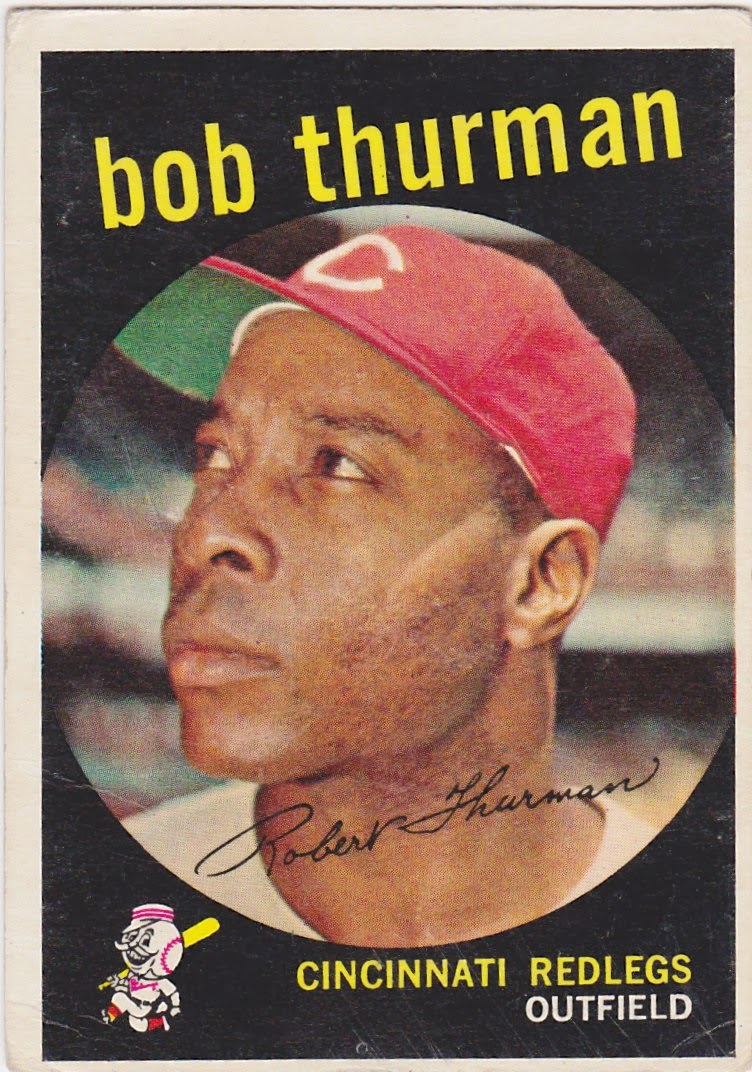
#541 Bob Thurman


If you are like me and know little to nothing about Bob Thurman you are missing out on one of the more interesting players included in this set. Coming out of the military in 1945 Thurman spent four seasons with the Homestead Grays and the Kansas City Monarchs, pitching and playing outfield alongside the future Hall of Famers Satchel Paige, Cool Papa Bell, Buck Leonard, Buck O'Neil and Josh Gibson. He attracted the eye of Yankee scouts who signed him in 1949 thinking he was 26 years old. Thurman is quoted in his SABR bio in regards to his true age:


"Many Baseball clubs like to put players ages back a few years. Mine was put back several times, so much so, that I always use the baseball age. Even when I joined the pension, I didn't think of [using] my correct age. So my real [birth date] is May 14, 1917."

Meanwhile Thurman had played in the Winter League in Puerto Rico and became a star on the island. He was sold by the Yankees to Cubs and he eventually landed with San Francisco of the PCL. In 1953 he signed with a start-up league in Puerto Rico and was banned from organized ball in the US. You can see the 'suspended' notation on the back of his Topps card.

After two years in MLB 'limbo' he was reinstated and joined the Cincinnati Reds for the 1955 season. He displayed power as a part time outfielder and pinch hitter in four years with the Reds but had only a few pinch hitting appearances in 1959 before returning to the minors. He retired after the 1961 season and began a new career as a scout working for the Twins, Reds, Royals and the Major League Scouting Bureau. He died in 1998 of Alzheimer's at the age of 81.

My humble little recap just can't do justice to the career of this special player. You'll need to read his SABR bio to appreciate him. Thurman is a member of the Puerto Rico Baseball Hall of Fame.

Sunday, September 15, 2013

#232 Eddie Kasko


Jersey Boy Eddie Kasko enjoyed a three part career in the majors. Signed by the Browns in 1949 he spent tow years in the service and was traded twice before he debuted with the St. Louis Cardinals in 1957. He stepped into a starting role that year and spent time at short, third and second as he did most each season of his career.

He hit a respectable.273 his rookie year but when his average slipped by 50 some points in '58 he was traded to the Reds. He played four solid seasons in Cincy, hit well, fielded well and made the 1961 All Star squad. He hit .311 in the 1961 World Series against that Yankees.

He was dealt to Houston for the 1964 season as they looked to solidify their defense and played for the Colt .45s/Astros through '65. His last year as an active player was in 1966 with the Red Sox. 

After his playing was over he went on to manage in the the Red Sox chain for several years before he succeeded Dick Williams as Boston's manager in 1970. His clubs finished third twice and then second twice but never could break through for a pennant.

Kasko remained with the Red Sox as a scout and  as the team's director of scouting and vice president, baseball development. He retired in 1994 and was elected to the Boston Red Sox Hall of Fame in 2010.

I believe the Kasko is the first player to appear in this set who has an active Facebook page and Twitter account. Make of that what you will.


Monday, August 26, 2013

#335 Johnny Temple


Johnny Temple signed with the Reds in 1948. There is a bit of mystery concerning his short time at Catawba College in North Carolina, his Navy stint, his real hometown and his actual age when he signed.  The whole convoluted story is chronicled here.

Be that as it may, once he started in pro ball Temple charged through the Reds system hitting very well and displaying an outstanding glove. His minor league credentials earned him a shot with the Reds in 1952 but he struggled. Returned to the minors in June, Temple again showed a good bat and he was called back to the Reds later in the season. He had a bit more success in that stint and by 1953 he was the Reds' starting second-baseman, a spot he held for seven seasons.

Temple teamed up with Roy McMillan and the pair made a formidable DP combo for the club. Temple also found his bat and in seven years with the Reds he hit .291, made three All Star teams and annually ended up first or second in stolen base percentage. His time in Cincy was marked by some well publicized brawls. His spark was coveted by the Indians and after the '59 season they dealt for him.

He spent a bit more than 2 seasons in Cleveland, making the All Star squad in 1961. He bounced from Cleveland to Baltimore and finally back to the Reds as a player/coach in 1964. The end of his second term as a Red came when he got into a huge fight with a fellow coach.

His problems continued after his retirement as he faced the results of bad investments and several legal issues before he passed away in 1994. He's a member of the Reds' Hall of Fame.

Thursday, July 11, 2013

#208 Willie Jones


This, my friends, is Willie 'Puddin' Head' Jones. You have to love a guy who uses that nickname as his signature.


He was a ten year starter at 3rd base for the Phillies from 1949 through 1958. He was a contributor to the 1950 Whiz Kids club in Philadelphia and had his best season that year. He had personal bests in hits, runs, triples homers and RBIs. He played in a league high 157 games that year which isn't easy given the 154 game schedule.

Jones had signed with the Phils in 1947 and was brought up for an 18 games trial that year. He got a similar look in '48. He took over at third in '49 and kept the job for a decade as noted. On April 20th of 1949 against the Braves he had four consecutive doubles. Seems odd that guy could get four doubles in a game and not score a run. He made two NL All Star squads. In 1950's 14 inning game he played the whole game at third and went 1 for 7. That's a record for most at bats in an All Star game.

Jones was known as a good fielder and he led the NL in fielding percentage from 1952 through 1956. He led again in '58 and finished second in '57 and '59.

In the 1950 World Series he had four hits in 14 at bats. That was his only postseason experience. He was moved twice in 1959, traded from the Phils to the Indians and then sold by the Indians to the Reds. He played in just about half the Reds' games in that season and the next but was let go early in the 1961 season. Had he lasted he would have been around for the Reds pennant that year.

The story of how he got that distinctive nickname isn't clear. This blog post asked the question and the replies varied from his name coming from a popular Rudy Vallee song to his daily intake of liver pudding(!) and a few in between. The actual story seems lost to time.

EDIT: I forgot to mention that it looks like the Polo Grounds is the site of this card's picture. There have been others shot there but this angle gives a look that I don't recall before.

Here is a bonus picture of Puddin' Head that ran in Life magazine. I'm including it here because I like it. He looks like he should be named Puddin' Head, doesn't he?


Monday, July 1, 2013

#97 Jerry Lynch


If I had a buck for every guy in this set that played one season of minor league ball and then went into the service, well I'd have enough to upgrade this set quite a bit. But my Jerry Lynch wouldn't require upgrading, it's pretty sweet.

Anyway, Lynch, who played six and a half seasons with the Pirates sandwiched around six and a half with Cincinnati, is known as one of the game's best pinch hitters. As of this writing his 116 pinch hits ranks him tenth on the all time list. When he retired his 18 pinch homers was the best of all time and he still ranks third in that category.

When he returned from the service after the Korean War he played a season in the Yankee chain and then was drafted by the Pirates. He got 300 plate appearances  with them in 1954 and '55 but he hardly played in 1956 (injury?). The Reds drafted him from the Pirates and he he carved out a place for himself there as an outfielder and key man off the bench.

He spent a lot of his big league seasons as what I'd call a 'semi full timer', getting 300 to 400 at bats. His best season came in 1961 when he hit .315 and drove in 25 runs as a pinch hitter. That year the Reds took the NL crown. This comes from Lynch's obit (he died last year):
In his New Bill James Historical Baseball Abstract, James made a case for Lynch being named MVP for his 1961 heroics:
"He hit over .400 as a pinch hitter with power and played 44 games in the outfield. His slugging percentage of .624 and 50 RBI in 181 at-bats was a far better rate than Roger Maris had that same season, hitting 61 home runs," James wrote. "More than that, Lynch had big, big hits; game after game, when the Reds were in danger of falling short, Lynch came up with the big hit to put them back in front, and the Reds, picked to finish sixth, won the pennant."
Lynch got three at bats in the '61 Series and went hitless but was issued an intentional walk. After retirement he and former teammate and friend Dick Groat were in the golf course management business together.  He was selected as a member of the Reds' Hall of Fame in 1988.

Sunday, June 9, 2013

#29 Jim Bolger


Another in a spate of recent 'hometown' signees, outfielder Jim Bolger was a native of Cincinnati and was signed by the Reds in 1950. Despite being only 18 at the time he saw a bit of action with them that year. He got a couple more looks sandwiched around some impressive minor league seasons but was dealt to the Cubs for 1955 but hit only .207 in 173 at bats.

Another minor league season passed and then in 1957 Bolger enjoyed his best days in the majors. He led the NL pinch hitters with 17 hits and a .354 average. He hit .275 overall for the year. In 1958 he numbers dropped off and he was dealt off to the Indians and then to the Phils getting little action in either place. He spent 3 years in the minors and hit well but never got another shot at the big leagues. He retired to go into private business and still lives in Cincinnati.

Bolger touches on his pinch hitting philosophy and the burden of being a ballplayer wearing glasses in a post on Tom Owens' blog.

My copy is off center but is otherwise in EX shape and I like the green frame. I believe the photo was shot in the Coliseum in LA but I wouldn't put money on it. Might be Seals Stadium.


Friday, May 24, 2013

#405 Roy McMillan


Slick fielding shortstop Roy McMillan who, as the card-back notes, was known as 'Mr. Shortstop',  signed with the Reds out of Texas A&M in 1947. He had one good hitting season in the Reds' system but mostly used his glovework to move up to the Reds in 1951. He held down their shortstop spot for 10 seasons while winning three Gold Gloves and making a couple of NL All Star teams.

He was so respected for his defense that he finished sixth in MVP voting in 1956 despite a .263 batting average. He led the NL in assists at SS four times, putouts three times, DPs three times and fielding percentage three times. Veteran player and manager Jimmy Dykes called McMillan the best shortstop he'd ever seen. McMillan earned himself a Sports Illustrated cover appearance and called it the greatest honor of his career. He's a member of the Reds' Hall of Fame.

He was traded to the Braves for the 1961 season so he missed both the Red's title (gone too soon) and the Braves pair of titles (there too late). After three plus seasons in Milwaukee he was dealt to the Mets where he finished out his career. After retiring as a player he coached and managed and had brief stints as manger of the Mets and Brewers.

Roy McMillan died in 1997. His '59 card is a Seals Stadium shot with the seafoam green frame. Good stuff.

Here is his Sports Illustrated cover:


Thursday, April 18, 2013

#255 Del Ennis


Now THAT'S an airbrush job! And not a very good one at that. Del Ennis played just five games for the Reds in 1959 after being acquired from the Cards after the 1958 season and he was dealt off to the White Sox in early May.

Ennis made his name in Philadelphia playing with the Phillies for eleven very productive seasons. He was a hometown boy, signed in 1943. After a season in the minors and a bit over two years in the military Ennis debuted late in April of 1946. His 17/73/.313 line earned him Top Ten MVP votes and he made the All Star squad. 1946 was a year before The Sporting News began their Rookie of the Year awards but he surely would have garnered some consideration. The Baseball Writers voted him the honor although what we think of as the R-O-Y was not yet recognized.

He went on to be an integral part of the "Whiz Kids" who won the NL pennant in 1950. Ennis led the National League with 126 RBI that season and he was fourth in the NL with a batting average of .311, and fifth with 31 home runs. He finished fourth in the MVP balloting. 

But Philadelphia, being Philadelphia, never really warmed up to the big hitting native son. A smart philly.com article discusses this phenomenon and another one makes the case for giving Ennis his due. A Google search turned up well written entries that name him as one of the most underrated Philly athletes of all time and one that puts him at #16 on the list of 100 Greatest Phillies.

In Phillies history Ennis ranks 3rd in Home Runs, 3rd in RBIs, 4th in hits, 3rd in total bases, 7th in doubles, 5th in games played, 9th in runs scored. Makes you wonder why he was never really appreciated in his hometown.


He co-owned a bowling center, Del Ennis Lanes, for 33 years before he closed it in 1991.

Thursday, April 4, 2013

#224 Claude Osteen


Yup, it's 'Gomer'. Claude Osteen got that nickname because folks thought he resembled TV character Gomer Pyle, played by Jim Nabors. I don't know about that but I do know that for me Osteen was, and always will be, associated with the Dodgers.

Osteen signed with the Reds in 1957 and after a few appearances with their minor league team in Nashville (he was a Tennessee native, btw) found himself pitching with the Reds that very year. He pitched four innings  at the tender age of 17.

He spent 1958 and most of '59 back in the minors.  He got into 20 games in 1960 with the big club and then spent most of 1961 down on the farm before being dealt to the Senators. Beginning in 1962, at the still young age of 22, he grabbed himself a spot in the Nats' rotation and held it for three seasons. He won 33 games (15 in 1964) and posted a 3.46 ERA for some lousy Nats clubs.

Traded to the Dodgers for 1965 in a deal that sent Frank Howard to Washington Osteen established himself  as a workhorse in their rotation as he started 335 games in nine seasons and both won and lost in double digits each season. He twice won 20 games and made three All Star squads. He pitched in both the 1965 and 1966 World Series going 1-2 and winning a championship ring.

He spent '74 with the Astros and Cards and 1975 with the White Sox before calling it a career. After his playing days Osteen served in several coaching capacities and currently lives in Arlington, Texas.

As always some good stuff can be found at SABR and this article from a local Tennessee paper tells some of his story in his own words. Although he pitched in the shadows of more famed teammates like Koufax, Drysdale and Sutton, Claude Osteen had a career he can be proud of.

Sunday, March 31, 2013

#506 Bob Purkey


Pittsburgh native Bob Purkey began and ended his major league career with the Pirates but it was the seven seasons he pitched in Cincinnati that were the most productive. Signed by the Bucs in 1948 Purkey worked his way up through the minors, battling injuries and taking two years off for military service (he pitched for some highly successful Army teams) and getting several short looks with the big club before he established himself in 1957. He had learned the knuckleball from Branch Rickey along the way and he went 11-14 that year for a 62-92 seventh place club. Traded that winter to the Reds for Don Gross (who won only seven games in 2+ seasons in Pittsburgh) Purkey became one of the better pitchers in the NL, winning 17 games and making the All Star team.

He won double digit games in all but one of his seasons with the Reds, was a three time All Star, and in 1962 he went 23-5 with a 2.81 ERA and finished a distant third in the Cy Young voting behind winner Don Drysdale despite having numbers that compared quite well with the Dodger righty.

He pitched and lost Game Three of the 1961 World Series against the Yankees. In that game he allowed only six hits in a nine inning effort but homers he gave up late to Johnny Blanchard and Roger Maris cost him a 3-2 decision. He came back to appear in the fifth and final game of that Series as one of seven guys that Fred Hutchinson dragged out of the bullpen in a futile effort to stop the Yankee momentum.

He pitched one season for the Cardinals (1965 winning 10 games) and then returned to Pittsburgh for 1966 where he appeared in just 10 games before being released and retireing.

After baseball he founded an insurance agency which still operates under his name. As always the black frame on this card makes the red Reds uni stand out. Looks like Los Angeles Memorial Coliseum is the scene of the photo shoot.


Friday, March 8, 2013

#271 Orlando Pena


Havana native Orlando Pena debuted with the Cincinnati Reds in 1958 after being picked up from an independent team in Daytona Beach and spending three impressive seasons in the minors.

He then embarked on a 14 season career with eight clubs that spanned from the '58 debut until 1975. His most successful run came with the Kansas City A's from '62 through '64 when he was a member of their starting rotation. His 20 loss 1963 season (he won 12) was actually one of his best numbers-wise.

After that he spent time in six other organizations and kicked around the minors as well and even pitched batting practice for the Royals between major league stints in the early 70s. In 1972 he was a combined 22-3 with Miami and Rochester in the Orioles chain. Oddly he led the AL in fielding percentage as a pitcher in 1963 and then led in errors in 1964.

After leaving the game in 1975 he resurfaced very briefly in 1979 with the independent Miami Amigos with a six frame outing for that Inter-American League club. Davey Johnson managed that team which was part of a brief, failed experimental league.

Nice to see Fidel Castro make an appearance on the back of Topps card, isn't it? And just because I can I'll show you his final Topps card, from 1975.