Showing posts with label Philadelphia Phillies. Show all posts

Friday, February 14, 2014

#482 Russ Meyer


Ol' Russ Meyer looks benign in this, his last Topps card. But in his heyday he had a reputation for being more than just slightly 'off the wall'. He had issues with anger and an inability to keep himself out of trouble. Not legal trouble but, well, 'baseball trouble'. I mean his nickname was the 'Mad Monk'... and he got it as a schoolboy so that should tell you a little about him.


Pitching in his hometown of Peru, Illinois Meyer attracted scouts and he signed with his 'close to home' club, the White Sox, in 1942. After a season in the minors he was called to military duty and ended up on a service baseball team. He collapsed on the mound during one outing and was diagnosed with a burst appendix. Complications kept him in the hospital for months and got him a medical discharge.

Returning to civilian ball Meyer signed with the Cubs (apparently the White Sox had not listed his absence correctly) and moved up through their chain as a starter/reliever and got a quick big league look in 1946. That was enough to earn him a spot on the club in 1947 and he spent two years in the North Side winning 10 games in '48 after being given a spot in the rotation.

He was sold to the Phils after that and he won 47 games in four years including a 17-9 year in 1949. He pitched briefly in two games in the 1950 Series against that Yankees. He took the loss in Game Three when, after entering a 2-2 tie in the bottom of the ninth, he got two quick outs before allowing three straight hits and the Yanks' winning run.

Meyer was involved in a complicated four team deal prior to the 1953 season and found himself in Brooklyn pitching for the Dodgers. His antics no doubt amused the fun loving Brooklyn fans. From his SABR bio:

[Robin] Roberts in his autobiography recalled an incident in 1953, after the Phillies traded Meyer to the Brooklyn Dodgers. Pitching against the Phillies in Connie Mack Stadium, Meyer walked Richie Ashburn with the bases loaded, forcing in the go-ahead run. Meyer charged off the mound to protest to umpire Augie Donatelli. Meyer’s language got him ejected by Donatelli. But he returned to the mound and just refused to leave until manager Charlie Dressen came out to get him. Finally Russ stomped off the mound. As he stomped off the mound he flipped the rosin bag into the air with disgust. The rosin bag flew 30 feet in the air and came down directly on Meyer’s head. White powder flew everywhere, and even Monk had to laugh a little, Roberts said.Monk wasn’t through, however. When he got to the dugout, Roberts said, he yelled at Donatelli and grabbed his crotch. Unfortunately, the game was the television Game of the Week, and a camera in the dugout caught the whole episode and displayed it to the nation. The network switchboard lit up like a Christmas tree. For about the next ten years baseball had a “Meyer” Rule that forbade cameras in the dugout. And Meyer was fined and suspended for three days, one of at least three suspensions he received during his career.
With the Bums Meyer went 26-11 over his first two seasons but his other numbers don't look as impressive and the strong Brooklyn teams helped that win total. He won and lost World Series' with Brooklyn. In the '55 series he entered Game Five with the bases loaded in the third and promptly gave up a grand slam to Mickey Mantle.

Fresh off the '55 Series win he was traded to the Cubs and spent the next few seasons bouncing around the majors with three teams and had a minor league stint before leaving the game and not pitching in 1958. Meyer returned to pitch for the A's in 1959 and he is airbrushed into their cap for this card. He was released in July of that year after 18 appearances.

He went on to coach for the Yankees in their minor league system and for a season as bench coach. He retired in 1992 to operate a bowling alley.

His N. Y. Times obit (he died in 1997) contains this interesting tidbit:
In June 1981, Meyer returned to Brooklyn with his former teammates Carl Erskine and Sandy Amoros to promote a quest to bring the Dodgers back from Los Angeles. But in renewing old times, he lost his treasured rewards from his Dodger days: He was held up at gunpoint and had his 1953 and 1955 Dodger World Series rings stolen. At least it did not happen in Brooklyn -- the scene of the crime was Lexington Avenue and East 25th Street.
Meyer's SABR bio is, as you might expect, an interesting read.

Dodger history fans might enjoy this photo archive site I stumbled across while looking for Meyer facts. Here is one photo and the text that accompanies it:


Close-up of manager and pitcher conferring, apparently on pitcher's mound, with manager pointing finger at pitcher's chest. Caption on verso: "Temper, Temper: Russ Meyer, left, newest Dodger and explosive right-handed pitcher, gets the word to straighten up and fly right from manager Charley Dresses at Vero Beach (Fla.), training camp."

Friday, January 31, 2014

#436 Granny Hamner


Granville 'Granny' Hamner was the captain of the 1950 'Whiz Kids' that won the NL pennant. He was in his third full season with the Phils at that point. As a 17 year old signee in 1944 he played in 21 big league games and held his own hitting almost .250. He struggled the following year and was in the minors for most of it and then spent most of 1947 in the military.

He took over as the teams' starting shortstop in 1948 and held down a middle infield spot for a decade usually hitting between .260 and .280 and showing some power. He held the Phils' record for homers by a shortstop (17 in 1952) until Jimmy Rollins broke it in 2006. He had over 100 career dingers. In that 1950 Series against the Yankees Hamner hit .429 on 6 for 14 with three extra base hits.

Hamner, who's brother Garvin was his teammate and sometimes DP partner in '45, was the first player to be elected as an All Star starter at two positions. He was there as a shortstop in 1952 and was selected as a second baseman the next two seasons. 1954 was arguably his best season as he hit .299 with 11 triples, 13 homers and 89 RBI.

In 1956 Hamner hurt his shoulder which limited his ability to swing a bat but he possessed a pretty good knuckleball and the Phils used him out of the bullpen a few times. That injury and a 1958 blown knee all but ended his career. He was traded to the Indians in May of 1959 but struggled at the plate and retired as an active player (or so he thought).

After moving into coaching and managing in the minors he was pressed into service as a pitcher a few times in the A's system and when injuries crippled the major league staff Hamner was activated by the big club and he got into three games in 1962. His last association with the game in an on-the-field capacity was as a minor league manager in 1988. He spent many years in the Phils' organization as an instructor and minor league supervisor.

He died in 1993. Some fun stuff (including Hamner memories from Richie Ashburn) can be found in this Google book excerpt.

In addition to having a brother who played major league ball Hamner's grandson, Chris Ambrosius was a standout college player at Penn.

I'm puzzled by the text blurb on the back on the card. It implies that Hamner began his pro career as a pitcher before giving it up to play the field. I can't find any evidence that was the case. Hamner made it clear in this interview that his pitching came about as the result of his injured shoulder and he certainly had no aspirations to change to a full time hurler. His minor league career in the 40s as a Phils' farmhand was strictly as an infielder.

Red railings = Seals Stadium in San Francisco. As pointed out in a comment by Bob O. on the Billy Harrell card posted the other day, these 5th Series light blue cards have white type for player names and position, yellow lettering for team designation. Besides the Harrell and Hamner the Elston Howard card falls into this category. Other light blue cards in the set use black letters for name and team, white for position.  I scanned the two recent light blue cards at the same time and something about them struck me as odd. But my copy of the Harrell card is so pale and washed out I chalked up my thoughts to that and only later looked into it further. Yesterday's comment got me to look back at all the cards in that series and I saw the Howard card.

Back in 2012 I did a few posts on the color distribution of the '59 set. I've revised one of those posts to reflect the two different coloring conventions for the light blue cards.

Monday, January 27, 2014

#517 Joe Koppe


First of all, Joe Koppe is not a pitcher. That pose sure makes it look like he is one though, doesn't it? When I hit up his Baseball Reference page I thought I had made a mistake or something, it was all hitting stats. Then I rechecked the card and sure enough it said 'infield'. Proves once again that there are plenty of things for me to learn in the '59 set.

Koppe (who was born Joe Kopchia) may not have been a 'name' player but he sure was at it a long time. He spent seven seasons, from 1949 through '55, playing independent pro ball in Texas and Louisiana and building a reputation as a versatile, fine fielding middle infielder. Then he was signed by Milwaukee and he spent the next three seasons in the Brave's chain finally getting a taste of the bigs at the end of 1958. He played in 10 games, got nine at bats and had four hits. He had three hits in his first two games in six at bats. Koppe didn't get to play in the World Series that year but he did get a 'taste' of the pennant winning spoils... here he is getting a Miller High Life shower from Braves teammate Juan Pizzaro while Felix Mantilla and Hank Aaron (partially hidden) look on on September 22 when the Braves clinched:


Despite that auspicious debut the Braves included him in a trade package with the Phils. Topps included him in their set here in the high numbers and took a picture credited to Spring Training of 1956 and changed it (poorly, the Phils never used that piping) into one of Koppe as a Phillie. Here is the original shot:


Koppe, a 28 year old rookie at this point, took over a spot in the Phillies' infield and had a nice season hitting .261 and hitting seven homers. He was picked to be a part of the 'Topps All Rookie Team' and was so honored on his 1960 card:

Ruben Amaro got the bulk of the work at short for the Phils in 1960 as Koppe's bat all but disappeared. On May 4th of 1961 the Phils traded Koppe to the Dodgers who assigned him to the minors and then in a week and a half, on May 16th, traded him to the Cardinals. A month after that he was purchased by the Angels for the grand sum of  $1000.

For that one grand the Angels got a utility player who played nearly full-time in 1962 and as a handyman for several years after that. After splitting the 1965 season between the Angels and the minors Koppe was out of baseball. He passed away in 2006.


Late Edit:

In the comments for this post reader Paul pointed out that Koppe once posed with a lefty's glove for a card. I found that card. Thanks Paul.


Saturday, January 11, 2014

#412 Stan Lopata


That crouch that Stan Lopata is in on this card's picture isn't just a random pose. Lopata used that stance to become a better hitter after some advice from legendary hitter Rogers Hornsby. The story as relayed to us in Lopata's obituary:

When a baseball legend like Rogers Hornsby gave a hitter advice, he'd be wise to take it.
Stan Lopata, something of a legend himself as a Phillies catcher in the '50s, was having problems at the plate in 1954 when he and outfielder Johnny Wyrostek ran into Hornsby during a road trip.
Referring to Lopata, Wyrostek asked Hornsby, "What do you think about this kid?"
The Hall of Fame infielder (.358 career batting average, 2,930 hits), said that he had seen Lopata on TV and that he missed the ball too many times.
"He said you should get a piece of the ball every time you swing the bat - not necessarily a base hit, but get a piece of it," Lopata said.
Stan took the advice to heart and worked on his stance, getting lower and lower, until he developed his famous crouch, and he concentrated on getting a piece of the ball.
As a result, Stan Lopata became one of the best power-hitting catchers in the National League in the mid-'50s.
And so it was that Lopata was able to emerge from behind Andy Semminick and Smokey Burgess to become the Phil's #1 catcher during the 1955 season. His time as a Phillie stretched from 1948 through 1958 but he had just a three year run as a starter. But he made the most of it. He made the NL All Star squads in '55 and '56. That '56 season was clearly his best as he had 32 homers and 95 RBI. Injuries marred his '57 season and he was back to having a reserve role in 1958.

Lopata, a native of the Detroit area, had originally signed with the Phils in 1946. That was following a military stint during World War II that saw him receive a Bronze Star and Purple Heart earned while serving in Marseilles, France. Once back home he played three seasons in the minors, got a short look in 1948 and then getting some significant time as a reserve in 1949 and 1950. That later edition of the Phils was the 'Whiz Kids' club that took the NL pennant. Lopata got one at bat in the Series against the Yanks. With two out in the ninth he struck out while pinch hitting for Robin Roberts in Game Four and thus ended the Series as the Yanks swept the Phils.

Lopata was in the minors for much of the next season but in '52 he was up to stay. The card-back notes that he was traded to the Braves in March of 1959. He played sparingly for the Braves for two seasons while mixing in some time back in the minors and retired after the 1960 season.

After his playing days Lopata worked for IBM in the Detroit area and then in the concrete business in Philadelphia. He died this past summer and his death reduced the number of living members of that '50 Whiz Kid club to four. Lopata's SABR bio is chock full of stories from his career. Interesting to note that he was the first catcher to wear glasses. The stadium lights bothered him with their glare so he adopted tinted glasses.

That's a Connie Mack Stadium shot on this card. Love the seafoam green frame with the red of the stadium and Lopata's uniform. This is one of my favorite cards in the set. And here are a couple of pix I found on the 'net that show his exaggerated crouch and his tinted glasses (which can be seen on his '57 Topps)..


Tuesday, December 24, 2013

#341 Tom Qualters


Tom Qualters had one of the best nicknames I've come across among the '59 set subjects. His Phillies teammates in 1953/54 called him 'Money Bags'. That came from the fact that Qualters, signed to a $40,000 'Bonus Baby' contract as a high school phenom, was a member of the Phils roster for both of those seasons and pitched a total of one third of an inning. Left him plenty of time to count his cash I suppose.

That old rule required players signed for more than $4,000 to remain in the majors on the signing club's roster for two years or risk losing them to waivers. Qualters was signed out of McKeesport, Pa. and made his debut on September 13 of that '53 season in a blowout loss to the Cardinals. He got an out but allowed six earned runs on 5 hits including a homer, a walk, a wild pitch and to ice the cake, he hit a guy. His ERA for the day/season was 162.00 which is not reflected on his '59 Topps card's stat line.

He was sent to the minors in 1955 and remained there for most of the next three seasons putting up pretty respectable numbers. He was recalled to the Phils in September of 1957 and was treated roughly in seven outings. After one game as a Phil in '58 he was sold to the White Sox. He pitched decently the rest of the way in the A.L. pitching in 26 games but was back in the minors in 1959 and he kicked around several organizations' system before retiring after 1962. His major league totals read 0 wins, 0 losses, 5.64 earned run average.

After baseball Qualters worked as an enforcement officer for the Pennsylvania Fishing and Game Department. His grandson Shawn Stiffler is head baseball coach at VCU. Another grandson, Ian Stiffler was drafted this season by the Braves and pitched in the Gulf Coast rookie league.

According to both Baseball Reference and Wikipedia Tom Qualters, shown on this card in Yankee Stadium, holds the distinction of being the only pitcher to appear on a Topps baseball card four times without ever recording a decision!

Sunday, December 22, 2013

#322 Harry Hanebrink


Harry Hanebrink played for a couple of NL teams as a utilityman in the 50s (he was a member of the Phils by the time this card was put in packs) and had less that 350 plate appearances but in checking him out I found two very different but equally interesting entries.

1) As detailed in this blog post Hanebrink, on August 6 of 1953, hit a bases loaded walk-off triple to propel the Braves to a 3-2 win over the Brooklyn Dodgers. That particular type of hit, a walk-off triple, didn't occur again in Braves' history for 60 years until Andrelton Simmons did it this past season against Colorado.

2) In 1951 Hanebrink and five of his siblings were sued by two other of their siblings over the settlement of their late mother's estate. I have no intention of reading through that entire brief but it seems that a couple of the kids were not happy that the will was changed and contested it on the grounds of their mother's mental state. The Missouri State Supreme Court appears to have come down on the side of the plaintiffs.

You just never know what will pop up in a Google search if you drill down far enough. Like this Toledo Blade newspaper feature on Hanebrink from 1955. It's worth checking out merely for the alliteration used in the headline.

As for Hanebrink, he was a longtime Braves minor league player having signed in 1948. Interestingly he was just 18 at the time but was already a Navy vet. He got that 51 game stretch in 1953 with the big club but didn't return until 1957 when he played in a handful of games and then he stuck with the team in 1958. He hit .270 as a part-timer that year and appeared in the World Series getting two pinch hit at bats.

In '59 he was traded to the Phils and got in 100 at bats in addition to some minor league work. The next year he was back in the minors where he finished his career in 1961.

My version of this card is the more common one which contains the 'traded' line. Here is a shot of the 'no traded line' version.

Thursday, December 12, 2013

#269 Jack Meyer


Jack Meyer was a hard throwing right-hander who was originally pursued by the Yankees but decided to attend Wake Forest University instead. I couldn't find his name among a list of letter winners on their baseball site but those type of things are often incomplete. In any case in 1951 Meyer was signed by the Phils and put together some impressive seasons as a starter as he rose through their system.

The Phils put him on their big league roster in 1955 and used him out of the bullpen for the most part. He rewarded them with a league high 16 saves and finished second to Bill Virdon of the Cardinals in the Rookie of the Year balloting.

Meyer would never again approach those first year numbers. He picked up only five more saves over the rest of his career as the Phils made him into a middle reliever. He was 24-34 over the course of six seasons in Philadelphia before back problems forced him out of baseball at the age of 29 after one 1961 appearance.

He died at the age of 34 of a heart ailment in 1967. His son, also called 'Jack' was well know in the sport of surfing and related industries in the Northwest. He too died of heart problems. He was only 53 when he passed away in 2007.

Meyer follows Seth Morehead as the second consecutive Phillies pitcher to be shown here on the '59 Topps Blog in a Connie Mack Stadium photo. Looking closely at the two cards shows that they were almost undoubtedly photographed on the same day. The banner on the upper deck railing to the right of each of them is identical.

Tuesday, December 10, 2013

#253 Seth Morehead


On the last day of the 1957 season lefty Seth Morehead became the answer to two trivia questions: "Who was the last pitcher to face the Brooklyn Dodgers?" and "Who was the last pitcher to face Roy Campanella?"

In that game on September 29th, Morehead's first career start and first win, he hurled a tidy four hitter as the Phils won, 2-1. Campy pinch hit for Dodger starter Roger Craig in the top of the eighth and flied to center. (Side note... Sandy Koufax pitched the bottom of the eighth to become the last man to throw a pitch in a Brooklyn uniform.)

Up until that point in his rookie season Morehead had pitched 33 times in relief with a loss and a save. He finished the year with an ERA of 3.68 which was down from well over 6 in mid-July. Prior to that season he had spent five seasons as a starter in the Phillies' system following his signing out of Shreveport, Louisiana in 1951.

Morehead made eleven starts for the Phillies in 1958 and was treated pretty roughly by NL hitters. His '59 numbers were trending the same way when the Phils moved him to the Cubs in May. His work that year for the Cubs produced the similar results but in 1960 he improved significantly. Although he was only 2-9 on the North Side appeared in 45 games and had his best WHIP and his ERA was below 4.00 for the first time since his rookie year.

Traded to the Braves on the eve of the 1961 season, Morehead picked up an early season relief win but he was ineffective otherwise and by late May he was in the minors. One last appearance came in September of that year and then he was back in the minors for two seasons before retiring.

After baseball Morehead completed his degree at Baylor University and was in the finance/insurance business for 36 years before he retired for good. In this book excerpt writer Willie Morris tells a good story of meeting him at a banquet many years after Morehead had fanned him four times in a Louisiana youth league championship game.

Pretty neat card with Morehead shown at Connie Mack Stadium inside a black frame.


Friday, December 6, 2013

#247 Don Ferrarese


Don Ferrarese won only 19 games for five different teams over the course of eight seasons. Those numbers don't knock you over but he certainly shouldn't be dismissed that easily. You see it's what Don Ferrarese has done with his life after baseball that makes him stand out. But back to the game...

... Ferrarese signed on with the Phils in 1948. He wound his way through independent ball in the PCL and was dealt to the White Sox and spent time in the service. He was traded to the Orioles and debuted briefly in 1955. He made the O's staff in '56 and then spent 1957 shuttled between the O's and AAA ball. His baseball journey took many twists and turns as he was traded several times and through 1962 he was rostered by the White Sox (again), the Phils (again) the Indians, Cards and finally the Colt 45s for whom he never played.

Through it all he appeared in 183 games including 50 starts. He had a record of 19-36 with 12 complete games, two shutouts and 5 saves. His best game came with the Orioles on May 12 of 1956 when he entered the ninth having held the Yankees hitless. He lost the no-no but won a 1-0 game on a two hitter.

He once tossed four straight shutouts with San Antonio in the Texas League and had a three double day as a hitter for the Indians in May, 1959.

When he retired he went to work running his parents deli business and then he went into the real estate business. He was very successful and established a charitable foundation that benefits, among other things, needy students in his area of California. He has raised and donated millions of dollars. His foundations' website can be seen here. A few interviews with Ferrarese are here and here. More about his foundation is found here and here.

Sometimes what you find when you look into what appears to be just another '59 card can be amazing.


Thursday, November 21, 2013

#197 Ray Semproch


Cleveland native Ray Semproch signed with the Phillies in 1951 and won 17 games in the lower minors that season before he spent the next two years in the military. Returning to baseball in 1954 he worked his way to the majors with four more seasons of minor league ball. Interestingly his 1957 season at AAA was far better than any previous year he spent at a lower level. I came across a few pages in a book on Google that tells of a heroic pitching effort Semproch delivered in the International League championship series in 1956 for Miami.

He earned himself a job in the Phils' rotation in 1958 and he went 13-11. At one point he was 13-6 and his 11 wins at mid-season led the league. A look at his game logs for '58 show that he mixed some really nice starts with some real stinkers. That win total was second only to Robin Roberts on the Phillies' staff and is made even more special when you compare it to the teams' 69-85 season record.

Semproch never again approached the success he had as a rookie. He went 3-9 in 1959 and was then traded to the Tigers. He won three games in relief in Detroit in 1960 but was traded to the Dodgers in mid-season and was farmed out.

He was drafted by Washington in December of '60 thus becoming one of the first players acquired by the 'new' version of the Senators but was sold to the equally new Angels in April of '61. He pitched only twice for the Angels, spent most of the year in the minors, and then retired.

He worked in his brother's Italian restaurant after that. Semproch's first Topps card came in 1958. On it he is listed by his given name of 'Roman'.


His nickname was 'Baby". I have no idea why.

Tuesday, November 19, 2013

#129 Frank Herrera The Sporting News Rookie Stars


Cuban born Francisco "Pancho" or "Frank" Herrera played in 300 games with the Phillies over three years between 1958 and 1961. Don't let that short career fool you. Herrera is one very interesting guy. When he debuted for the Phils at the age of 23 he had already been in organized ball for about 8 years. He began at 15 or so around Havana as a member of a group of youngsters called gitanillos, or little gypsies. These players worked with Cuban pro teams during practices but sat in the stands with the other fans during games. Occasionally they were called on to actually fill-in for a regular.

He was also boxing (until him mother saw him KO'd and made him quit) and an agricultural student around that time. But baseball called and he signed to play pro ball in Cuba in 1950. He was obtained by the Kansas City Monarchs of the Negro American League in 1952. His contract was purchased by the Phillies and he began in their organization in 1955.

He played some in Philly in 1958 and hit .270 in 63 at bats but spent the '59 season in the International League with Buffalo and just tore the league up to earn MVP honors. He stepped into a regular role as the Phils' first baseman in 1960 and finished second in the Rookie of the Year voting. He put together a .281 average with 17 dingers and 71 RBI but he fell off in '61, went back to the minors and was dealt to the Pirates. He never again played in the majors although he hung on in the minors with several organization through 1969 and then played in Mexico and with an independent Florida State league club as late as 1974. At times he served as player/manager.

Along the way Herrera had played winter ball in Nicaragua, Venezuela, Panama, the Dominican Republic and Puerto Rico in addition to Cuba. He made his home in the US in Miami and was part of the Cuban culture there for many years. He worked for United Airlines and for a health service provider in South Florida as well as having several baseball-related interests such as batting instructor in Mexico and running a baseball camp with fellow Cuban Paul Casanova. 

The father of three daughters Frank Herrera died in 2005 in Miami. He is a member of the International League Hall of Fame. You can (and should!) check out his SABR bio here. More info on Herrera and his part in the integration of baseball (he was the Phils first black Latino player) can be found in this book on Google.

This card is one of three 'rookie' cards issued by Topps for Frank Herrera. One version of his 1958 card is prized because of the 'error' which is described as a misspelled name on the front. It seems to be a printing error. 


Here is the more common 'correct' version:


The 1959 Rookie Stars card is featured up top and he also had a 'rookie star' card in the 1960 set. That one is my favorite because I am a fan of that '60 Rookie subset.


Interestingly he had a 1961 All Star card but no regular card by Topps.


Friday, November 15, 2013

#151 Bob Malkmus


Infielder Bob Malkmus came out of New Jersey (not far from where I grew up, btw) and played in 268 major league games spread over parts of six seasons in the majors. Oddly his very best season, the only one in which he was a regular, was his last full year, 1961 with the Phillies. That season accounted for nearly half his appearances and well over half his big league at bats.

Malkmus originally signed with the Braves in 1951 and took the long six year tour of their farm systen before he got into a handful of 1957 games with the big club. He was traded to the Nats prior to the '58 campaign and got into about 40 games. He had a solid season in Denver with the Nats' AAA club in 1959 hitting .300 and earned his way back to the majors via the Rule V draft courtesy of the Phils.

But he was back in the minors in 1962 despite that previously mentioned 1961 season and he finished out his career with five more seasons in the Phillies' chain. That 1961 year, in which he hit .231, garnered him 22nd place in the League MVP voting. Here is an article from the Spokane newspaper of 1965 that mentions some of his minor league exploits.

After he retired as an active player he managed for nine seasons in the minors and then went into private business. He returned to baseball as a scout for the Indians and Giants. He is a shot of him from 2011. He's the guy in the red and white Phillies cap.


Malkmus is wearing pinstripes on this card and his hat is tilted so as to hide the logo. My conclusion is that he is wearing his Senators uni in Griffith Stadium. It's one of those times that Topps used the 'hide the logos he might get dealt' photo when the player was actually on the correct team.

Tuesday, October 22, 2013

#379 Bob Miller


There have been four guys named 'Bob Miller' to play in the big leagues, all of them pitchers and three of them nearly pitched in the bigs at the same time. Our featured Bob Miller, the only one to appear on a '59 Topps, was a member of the 'Whiz Kids' Phillies club of 1950. That was his first full season in the majors and he won 11 games as he finished second in the Rookie of the Year voting. Late that season, after beginning the year 8-0, Miller hurt his back and his effectiveness diminished.

He started (and lost) the fourth and final game of the World Series. In that game he allowed two runs (just one earned) on a pair of hits and a wild pitch. A game opening error contributed to his demise. With the Phils facing elimination he was on a very short leash that day.

His back woes continued to plague him into 1951 and in fact he was never able to match that rookie year. He spent 1952 in the minors and then returned to the Phillies and pitched through 1958, pitching primarily as a starter for a couple of years before moving to the bullpen. On August 9, 1953 Miller tossed a six hit shutout and had four hits of his own in a 7-0 win over the Cubs.

He finished his career with a 42-42 mark and a 3,96 ERA. He had been signed out of the University of Detroit by the Phils and he had served (and pitched) in the Army before his pro career began. After his playing days he went back to coach his old team at the University of Detroit for 39 years and worked in the insurance business. A very nice interview with Bob Miller appeared last summer on MLB.com.

He's pictured on this card as a Cardinal but he was only a member of that club for a short time and he never pitched for them. Late in 1958 he was sent to St. Louis in a conditional deal but the Cards returned him to the Phils the following April. He pitched in the minors very briefly that year before hanging up his glove. Topps re-used a picture of Miller that had been around for awhile and just airbrushed in a St. Louis cap logo.

Here are some of the cards of Miller that used that same photo:

1950 Bowman


1952 Topps


1958 Topps


Wednesday, July 17, 2013

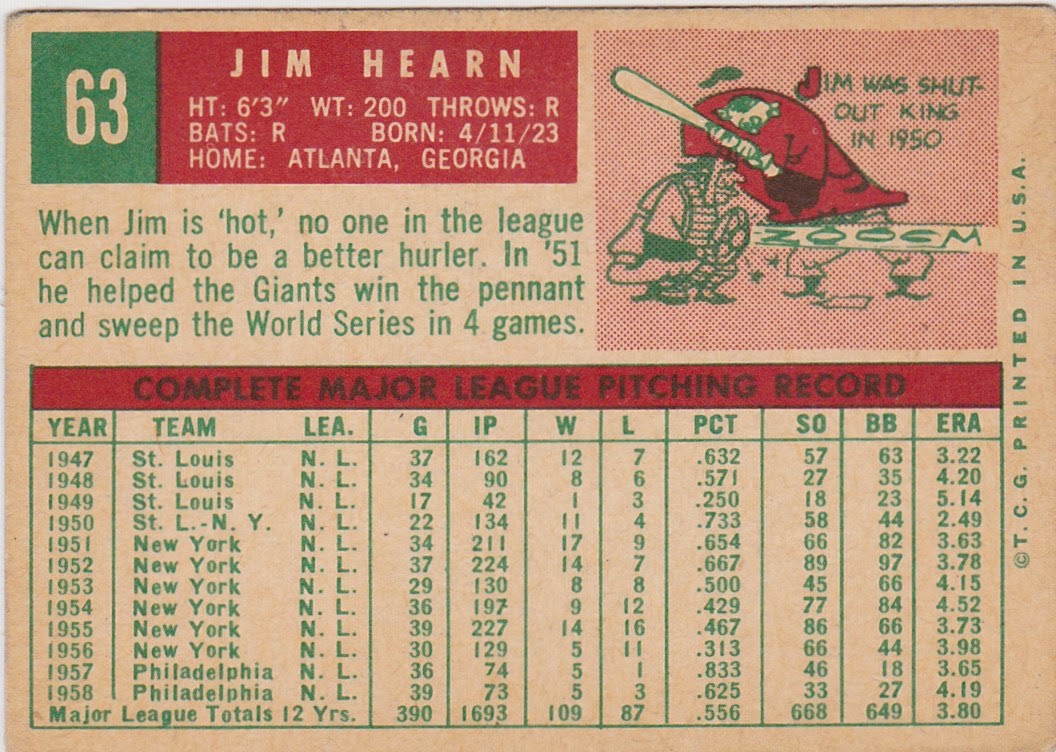
#63 Jim Hearn


In 1959 pitcher Jim Hearn was at the end of his baseball trail. He pitched in 6 games, didn't win any and was released by the Phillies in May, a few months after this Series One card was released. But he'd had a pretty nice career previously, winning 108 games with a solid 3.81 ERA and getting himself a World Series ring with the 1954 Giants.

In 1942 the Cards signed Hearn, a native of Atlanta, out of Georgia Tech and he had a good season of Class B baseball before he was off to the military for three years during WWII.

When he returned in '46 he got in another year in the minors and debuted with the Cardinals in 1947. He went 12-7 that season, slid just a bit in '48, split the '49 campaign between the Cards and the minors and found himself waived to the Giants in July 1950.

He returned to his rookie form with the Giants, went 11-3 the rest of that '50 season, pitched five shutouts and won the NL ERA crown. Not a bad year for a guy who was essentially a late inning mop-up man for the first three+ months of the season.

In 1951 the Giants relied on Hearn as a #3 starter behind 20 game winners Sal Maglie and Larry Jansen. Hearn won 17 games and went on to win his only start in the Series that year against the eventual champion Yankees.  

Hern remained a part of the Giants' rotation through 1956 and won 14 games in '52 and '55. In the Giants 4 game sweep of the Indians in that year's World Series Hearn, by now the clubs' fourth starter, didn't see the field.

Despite a nice ERA he went 5-11 for New York in 1956 and was traded to the Phillies that October. He spent two seasons pitching out of the Phils' bullpen and then, as noted, was released in 1959. He was charged with a loss, the final decision of his career months after his release due to a May game being suspended. He was 'on the hook' for that game and when it was completed in July he took the loss.

Hearn hit two inside-the-park home runs in his career. One came in a game in July of 1955 in which he also hit fence-clearing homer. Pretty remarkable to have two 'leg' homers given that here have been only a total of eight hit by pitchers since 1954. 

Hearn's card features a view that you don't see often (or ever?) in this set. Behind him looms the far left field/center field grandstands of Connie Mack Stadium. Over Hearn's left shoulder is the scoreboard which is topped by the Ballantine Beer sign. 

"Make that three ring sign, Ask the man for Ballantine"


Thursday, July 11, 2013

#208 Willie Jones


This, my friends, is Willie 'Puddin' Head' Jones. You have to love a guy who uses that nickname as his signature.


He was a ten year starter at 3rd base for the Phillies from 1949 through 1958. He was a contributor to the 1950 Whiz Kids club in Philadelphia and had his best season that year. He had personal bests in hits, runs, triples homers and RBIs. He played in a league high 157 games that year which isn't easy given the 154 game schedule.

Jones had signed with the Phils in 1947 and was brought up for an 18 games trial that year. He got a similar look in '48. He took over at third in '49 and kept the job for a decade as noted. On April 20th of 1949 against the Braves he had four consecutive doubles. Seems odd that guy could get four doubles in a game and not score a run. He made two NL All Star squads. In 1950's 14 inning game he played the whole game at third and went 1 for 7. That's a record for most at bats in an All Star game.

Jones was known as a good fielder and he led the NL in fielding percentage from 1952 through 1956. He led again in '58 and finished second in '57 and '59.

In the 1950 World Series he had four hits in 14 at bats. That was his only postseason experience. He was moved twice in 1959, traded from the Phils to the Indians and then sold by the Indians to the Reds. He played in just about half the Reds' games in that season and the next but was let go early in the 1961 season. Had he lasted he would have been around for the Reds pennant that year.

The story of how he got that distinctive nickname isn't clear. This blog post asked the question and the replies varied from his name coming from a popular Rudy Vallee song to his daily intake of liver pudding(!) and a few in between. The actual story seems lost to time.

EDIT: I forgot to mention that it looks like the Polo Grounds is the site of this card's picture. There have been others shot there but this angle gives a look that I don't recall before.

Here is a bonus picture of Puddin' Head that ran in Life magazine. I'm including it here because I like it. He looks like he should be named Puddin' Head, doesn't he?