Showing posts with label Baltimore Orioles. Show all posts

Saturday, January 25, 2014

#507 Bob Hale


In each of Bob Hale's first two years in the minors after signing with the Browns in 1952 he had exactly 473 at bats while playing in 121 games. Identical numbers, both seasons. How did he pull that off?
Anyway his batting average did climb and he continued to hit well for a couple of additional seasons until he got a shot with the Orioles in July of 1955.

He took advantage of it, too. He hit .357 from his July 4th debut until the end of the year. But those numbers were hard to match and Hale split time in each of the next four seasons between the Orioles and the minors. Most of his big league time was as a pinch hitter but he did play first base, too. Oddly he played in the Dodgers', White Sox', and Tigers' organizations at various times during that stretch without being involved in any transactions I can find. Must have been some sort of 'loan-a-bat' program.

He was waived by the Orioles and claimed by Cleveland for 1960 and for a year and a half he was their #1 hitter off the bench. In July of 1961 the Tribe sold Hale to the Yankees and he had a front row seat for the Maris/Mantle home run chase as well as getting to pour pennant winning clubhouse champagne. He did not get to play in that season's World Series.

In a Jerome Holtzman book I found on Amazon Hale discusses his brief Yankee tenure. He comments on the depth of that '61 club by stating that while he was the #1 pinch hitter at each of his previous stops he was #4 on the Yankees. He also mentions that he received a 2/3 Series share despite only having pinch hit seven times for them (actually he had 10 pinch at bats plus one full game, but who's counting?)

Hale goes on to comment on the Yankees' decision to farm him out for 1962 proclaiming that he'd hit .300 at Richmond.and be recalled. That never happened. Hale hit .282 in close to 100 games but never did make it back to the big leagues. So it turned out that his last major league game was the game that Roger Maris hit his 61st homer.

There is not much about Bob Hale that I can find on Google. I did learn from this blog page that from August of 1960 thru August of 1961 he went 60 games with an at-bat without scoring a run. As of 2008 that stood as the fourth longest streak since 1956. Take that for what it's worth.

Bob Hale passed away in September of 2012.

Thursday, December 26, 2013

#363 Bobby Avila


Bobby Avila may not be the most obscure batting champ since WWII (I'd go with Bill Mueller who I've never heard of till now) but he's among them. And that's too bad because Avila had a pretty solid career in the 50s. Growing up in Mexico his well-to-do family wanted him to be a lawyer like his father but the teenage 'Beto' Avila played soccer and well as baseball.

He signed to play in the Mexican leagues and began there at age 19 in 1943. His play caught the attention of big league scouts but Avila turned down several offers before finally signing with the Cleveland Indians in 1948. He spent that season with the Indians' top farm club in Baltimore and then sat on the Indians bench for a good bit of 1949 as a bonus baby. In 1950 he got over 200 at bats and hit .299 as he moved into the Indians lineup at second base.

Beginning in 1951 he held down the teams' keystone spot for eight seasons. He made three AL All Star squads during that time, three times hit .300 or better and twice finished in the top ten in MVP voting. He was a good fielder and bunter and led or tied for the league lead in sacrifice hits twice. His best season was 1954 which not so coincidentally was the year the Indians went to the World Series. Avila won the batting crown that season with a .341 average despite playing for about half the year with a thumb broken in a baseline collision with Hank Bauer. He had career highs in homers and RBIs that year as well. According to unofficial numbers 13 of his 15 homers either tied the game for the Indians or gave them a win.

By 1958, as an 34 year old, his playing time and skills were slipping and he was traded to the Orioles for the '59 season. He played 20 games for the Birds before being waived and picked up by the Red Sox in May. In July he was waived again and this time he was claimed by the Braves where he finished out the year. He was active in the Mexican League in 1960, had a very good and probably very satisfying final season, and then retired.

Following his playing days Avila bought into a Mexican League club and went on to become the league president. He later got into politics and was elected mayor of his native Vera Cruz. He is a member of both the Mexican and Latin American Halls of Fame.

Avila died in 2004.

Wednesday, December 18, 2013

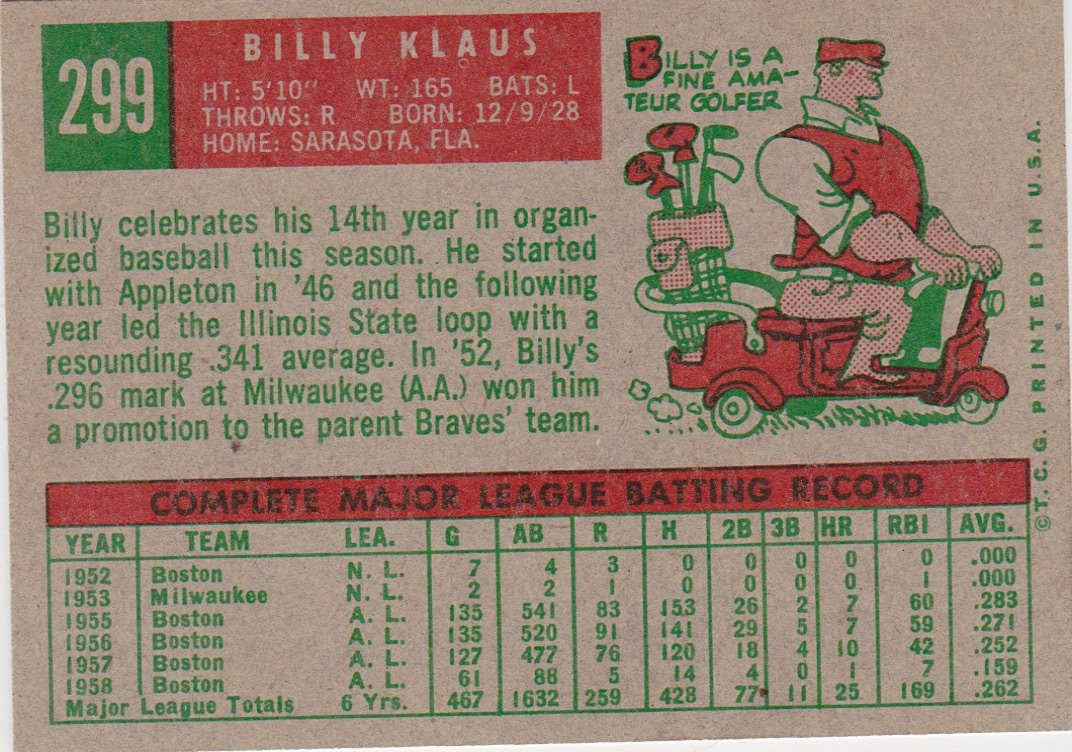
#299 Billy Klaus


Billy Klaus didn't look like such an angry tough-guy hard ass on all of his baseball cards, just the hat-less ones. But I will grant you that on this one he appears to be a guy I'd avoid trifling with.Maybe he just hated being asked to remove his cap.

Klaus originally signed with the Cleveland Indians in 1946 at age 17 and spent a year at their class D affiliate before it was discovered that his signing was illegal (before his high school eligibility was up?) and the contract was voided. He then signed with the Cubs and spent three very productive minor league seasons moving up their ladder.

In 1950 he was drafted by the Dallas club in the Texas League and played for Charlie Grimm. When Grimm moved on to the Braves organization the next year he had them sign Klaus and over the next three seasons he played at their AAA level club getting quick looks at the big leagues on a couple of occasions.

The Braves traded Klaus to the Giants for the '54 season but it wasn't until he was traded again a year later, this time to the Red Sox, that he truly found a baseball home. He won the regular shortstop job in June and his addition to the lineup is one reason the Sox surged over the second half of the season. That's according to Ted Williams and a nice Sport Illustrated story summarizes the Boston turn-around that year.

Klaus finished behind Herb Score in the Rookie of the Year voting (and ahead of fellow Red Sox infielder Norm Zauchin whose card will be shown here next) by hitting .283 and driving in 60 runs. That's pretty impressive for a guy who wasn't even a regular for the first 2 months of the season. He also got some MVP votes that year.

Klaus remained the Sox' starter at short for two more seasons although his numbers steadily declined. His continued fielding issues and back problems he incurred in 1957 led to him finding himself out of a steady job in 1958. He mostly pinch hit in Boston that year and wasn't very good at it and the Sox shipped him to the Orioles that winter.

He played in over 100 games for the Birds in 1959 and briefly played well enough to relegate Brooks Robinson to the minors but was used sparingly in 1960, hit just over .200 and was drafted away by the expansion Senators. One year there, one year plus a bit in Philadelphia and then Klaus took his glove and bat to Japan for what remained of 1963. He wasn't happy with the experience and returned to his home in Florida, opened a paint store, watched his younger brother Bobby play baseball and eventually got back into uniform as a minor league manager.

He managed (and played a bit, too) for the Senators and A's organizations and retired to his paint company for good in 1970. Klaus died in 2007. His story is best told in his SABR bio.

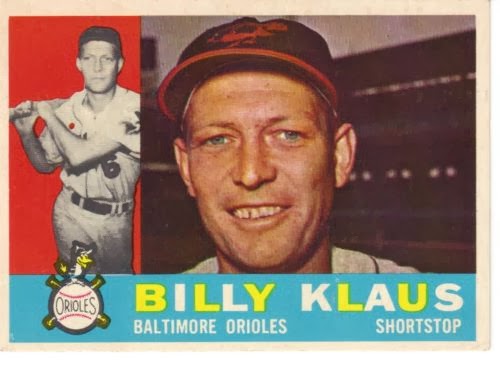
Billy Klaus doesn't always look like a German tank commander (that my original opening line for this entry). And for proof take a look at some of his other cards including my other Billy Klaus, the 1960 Topps:

And his '58.


Friday, December 6, 2013

#247 Don Ferrarese


Don Ferrarese won only 19 games for five different teams over the course of eight seasons. Those numbers don't knock you over but he certainly shouldn't be dismissed that easily. You see it's what Don Ferrarese has done with his life after baseball that makes him stand out. But back to the game...

... Ferrarese signed on with the Phils in 1948. He wound his way through independent ball in the PCL and was dealt to the White Sox and spent time in the service. He was traded to the Orioles and debuted briefly in 1955. He made the O's staff in '56 and then spent 1957 shuttled between the O's and AAA ball. His baseball journey took many twists and turns as he was traded several times and through 1962 he was rostered by the White Sox (again), the Phils (again) the Indians, Cards and finally the Colt 45s for whom he never played.

Through it all he appeared in 183 games including 50 starts. He had a record of 19-36 with 12 complete games, two shutouts and 5 saves. His best game came with the Orioles on May 12 of 1956 when he entered the ninth having held the Yankees hitless. He lost the no-no but won a 1-0 game on a two hitter.

He once tossed four straight shutouts with San Antonio in the Texas League and had a three double day as a hitter for the Indians in May, 1959.

When he retired he went to work running his parents deli business and then he went into the real estate business. He was very successful and established a charitable foundation that benefits, among other things, needy students in his area of California. He has raised and donated millions of dollars. His foundations' website can be seen here. A few interviews with Ferrarese are here and here. More about his foundation is found here and here.

Sometimes what you find when you look into what appears to be just another '59 card can be amazing.


Wednesday, December 4, 2013

#226 Art Ceccarelli


Lefty Art Ceccarelli signed with the Brooklyn Dodgers in 1948 and pitched for four seasons in their minor league system and squeezed in a couple of years of military service, too. He never made the Bums roster and was sold to the Yankees in 1954 before being drafted away by the A's later that year.

He made 16 starts among 31 appearances in his rookie season of '55 for Kansas City and went 4-7 with a high ERA. He spent the next season mostly in the minors but managed to lose one decision for KC. He was traded to the Orioles and went 0-5 in 1957, pitched well in the minors in 1958, was drafted by the Cubs and spent the first part of 1959 in their system.

Ceccarelli was brought up by the Cubs in July of that year and won his first four starts, three with complete games and one on a shut-out. Then hard times hit and he finished the year 5-5. He opened the 1960 season with the Cubs but was traded to the Yanks in May and ended his career in the minors after the 1963 season. He was 9-18 for his careen with an ERA of just over 5.

After baseball Ceccarelli returned to his native Connecticut and taught and coached high school for many years and coached baseball at Southern Connecticut State University. He passed away in July, 2012.

This card uses an airbrushed version of his 1958 Topps on which he is shown in an Orioles uni.


Thursday, October 24, 2013

#489 John C. Powers


Outfielder Johnny Powers signed with the Boston Red Sox in 1949 and spent one year in their system before he was traded to the Pirates. A two year military stint interrupted his travels towards the big leagues but he hit with power at every stop.

He earned increasingly longer trials with the Bucs from 1955 trough 1957 and he made the club in '58 and stayed all season. But he had very little opportunity to show his talents and was traded to the Reds for 1959 and thus gets the Reds' logo on this card. But even there he didn't play much and was sold to the Orioles in the off season. 1960 proved to be a busy year for Powers. He was the opening day right fielder for the Orioles but quickly played his way out of a job and was sold to the Indians in May. They in turn dealt him back to the Pirates three weeks later. He spent the rest of 1960 and the next five seasons in the high minors, never getting another shot at the majors.

Powers finished with six homers in 151 big league games. He had nearly 300 in his long minor league career. He died in 2001 in his hometown of Birmingham, Alabama. A few side notes came up in checking his career:

--I came across a few references to a story of a foul ball hit by Powers hitting and killing a fan in Miami in 1960 when he played for AAA Columbus.

--There was no other 'John Powers' in the majors at the time of this card yet Topps chose to use 'John C. Powers' on the front. 'Johnny Powers' is used on the reverse. Interestingly there was a Rockabilly performer of some note who was popular at the time and he bears a passable resemblance to 'our' Johnny Powers. Check it out:


OK, maybe it's just the hair. Powers' 1960 card:


Wednesday, October 16, 2013

#475 Jack Harshman


San Diego native Jack Harshman began his baseball 'life' as a power hitting, free swinging first baseman for the San Diego Padres of the PCL in 1945. After a year or so of playing on the west coast and a short Navy stint Harshman was obtained by the New York Giants in 1947 and he slugged his way through the Giants' chain for several years. He had modest success in his brief shots in the majors and finally his minor league team owner suggested that Harshman, who pitched batting practice to his teammates regularly, might try pitching full time as a way to return to the majors.

He became a full time pitcher in 1953 and went 23-7 for Class AA Nashville. Despite those lofty numbers the Giants sold him to the White Sox that fall and Harshman began a second life as a major league starting pitcher. In his first season as a major league starter, 1954, Harshman struck out 16 Red Sox in one game and pitched a 16 inning complete game 1-0 shut-out against the Tigers. It is estimated that Harshman threw 245 pitches in that one. 

He went 48-34 in 4 seasons with the Sox and then was traded to the Orioles for 1958. His 12-15 record doesn't compare to his 2.85 ERA that year. A rocky start in 1959 earned him a trade to the Red Sox in June and a waiver ride to the Indians in July. He pitched sparingly for Cleveland in 1960 and had a few minor league appearances in '61 before he retired. 

He never lost his power at the plate. He twice had six homer seasons and that number was good for fifth best among all players on the 1958 Orioles. Among his 76 major league hits are 21 homers! That's quite a ratio. 

Harshman is truly a fascinating guy. Lots to read about in his personal life and professional career. As always there is his SABR bio and then there is a multi-part blog series that I found pretty interesting. You can get to through this site

Here is a 'teaser' from one installment, a quote from the Saturday Evening Post:


Jack Harshman could hit the ball a mile, but his batting average was anemic. Then, aided by the uninhibited girl he married, he turned into a surprisingly crafty pitcher.
"Uninhibited" didn't have the same connotation back then. In this case, it's because she gives advice and shares opinions about his pitching performances.
 There may never have been a baseball wife quite like Frances DeVee Oldman Harshman. She is pert, pretty -- and candidly ambitious for Jack. Her terse, matter-of-fact husband refuses to blow his own horn, but this uninhibited little blonde has been doing it for him ever since they were married in 1950.

Finally, check out this great picture of Harshman as a Giants 1B prospect:


Wednesday, September 25, 2013

#148 Mike McCormick


As alluded to in the card's cartoon, Mike McCormick was one of the 'bonus baby' signees back when he was penned to a big contract by the New York Giants in 1956. McCormick was fresh out of high school and only 17 years old when he joined the club for his mandated two year roster stay. In those two years he had a total of 27 appearances including 7 starts. In '56 he didn't get into a game until September 3rd. 

He took a spot in the Giants' rotation beginning in 1958 and had double digit wins for four straight seasons. He led the NL in ERA in 1960 and was a member of the NL All Star teams in 1960 and 1961. He developed shoulder problems the next season and was traded to the Orioles for whom he pitched for two seasons. 

Traded again, this time to the Senators proved a tonic for McCormick and his numbers improved. In December of 1966 the Nats traded him back to the Giants for Cap Peterson and Bob Priddy. Turned out to be a steal for San Francisco. McCormick had the best season of his career in 1967 winning 22 games, posting a 2.85 ERA and winning the Cy Young. 

I found two interesting facts about McCormick's '67 season. He was the first Cy Young winner for the Giants' franchise and the only one prior to Tim Lincecum. Hard to believe that Juan Marichal never took home that hardware. Burden of pitching in the pitching-rich 1960s I guess. And McCormick was one of 17 pitchers to win the award without having made their league's All Star team in that season. This article lists those pitchers. It's from 2010 but I have checked the subsequent seasons.

McCormick had a couple of solid seasons following his 1967 zenith and then his numbers fell off. He finished his career with short stints with the Yanks and Royals before pitching in the minors to close out his active career. 

Two final tidbits:
On June 121959 he threw a rain-shortened "no-hitter" versus the Phillies. He allowed a hit in the 6th, which was eliminated from the official records as rain cancelled the game and the official game became a five inning affair.

The red railings in the stands behind McCormick on this card signify Seals Stadium.

Tuesday, September 17, 2013

#540 Willy Miranda


Before the 'Mendoza Line' there might well have been the 'Miranda Line'. Willy Miranda was the prototypical 'good field/no hit' 50s shortstop. In 9 seasons he hit .221 with six homers. That's really not terrible but there are a couple of great quotes that show how Miranda's hitting prowess was viewed. 

These are from his Baltimore Sun obit:
A newspaper columnist wrote that Mr. Miranda was the only "Major Leaguer to hit three ways -- righty, lefty and seldom."Manager Richards fumed that Mr. Miranda couldn't hit a ball with any consistency until one afternoon in Cleveland, when he got three straight hits. When he was replaced by a pinch hitter, Mr. Miranda inquired as to why."You already have three hits and it defies logic to think you're going to get four," said Mr. Richards.
But there are also quotes, found in that same obit, that give a glimpse of how Miranda's glove was viewed:
He was called "Ringling Brothers" by Orioles' Manager Paul Richards, who said he had "the hands of a pickpocket."Gus Triandos, a catcher during those years, described Mr. Miranda as "flashy a phenomenon" whose arm was almost "abnormal for such a small guy.""Had he been able to hit, he would have been a greater player than he was," Mr. Triandos said yesterday from his home in San Jose, Calif."He was a wizard with a glove -- and you need a strong glove like his when you play the most demanding position on the field," said Orioles Manager Davey Johnson, who said Mr. Miranda's death was a "personal tough loss.""He was the best defensive shortstop I've ever seen and I've seen plenty," said recently retired Los Angeles Dodgers Manager Tommy Lasorda, who played ball with him in Cuba. "This guy could do it all."
In 1948 Miranda was signed out his native Cuba by the Washington Senators.  He later defected to the U.S. by hiding in the cockpit of a Pan Am airliner with the help of the crew. He helped Cuban nationals leave as part of the Mariel 'boatlift' in 1980. He received honors from the city of Baltimore in the mid 70s for rescuing a man from a burning house. Seems like he could do everything...except hit.

In his career he played for the Senators, White Sox, Browns/Orioles and Yankees. His two years as a regular came with the Orioles in 1955/56. He played two more seasons as a platoon player in Charm City. During the 12 months from October 1951 through October 1952 he was involved in four separate transactions that saw him bounce from the nats to the White Sox to the Browns and back again a few times. He ended his career with a couple of minor league seasons. He later managed in the Mexican League.

As is usually the case SABR is the go-to site for details on this most interesting player.


When I pulled this card for scanning I noticed that the Orioles logo appeared 'different'. 


Here is the logo from Gene Woodling's card. The red stitches are black on Miranda's card and the Bird's face is only partially colored. it appears this was consistent over all the '59 Miranda cards I've seen.


Sunday, August 4, 2013

#66 Joe Ginsberg


Note: This and the next few posts will be rather short and sweet as I am currently on the road between Houston an Lincoln, Nebraska on family business and putting these together on the fly. 

Born and raised in Detroit, Joe Ginsberg was actually named Myron but he was called 'Little Joe' much of his early life (his Dad's name was Joe) and 'Joe' stuck with him throughout his career. His sig on this card reflects his real given name.

Signed by his hometown club in 1944 Ginsberg played in the minors and served in the military before debuting for a short stretch in 1948 with the Tigers. He was back up in 1950 and in 1951/'52 he was as close to being a regular catcher as at any time in his career. He got over 350 at-bats both seasons and he hit .260 in 1951. In May of 1952 he caught the first of Virgil Trucks' no-hitters.

He played for the Indians and Athletics before finding himself in Baltimore from 1956 through early in 1960 where he was, at least at times, a platoon catcher. After his time with the Birds he played for the Red Sox, White Sox and, for a few games, with the original Mets club in 1962.

Monday, July 15, 2013

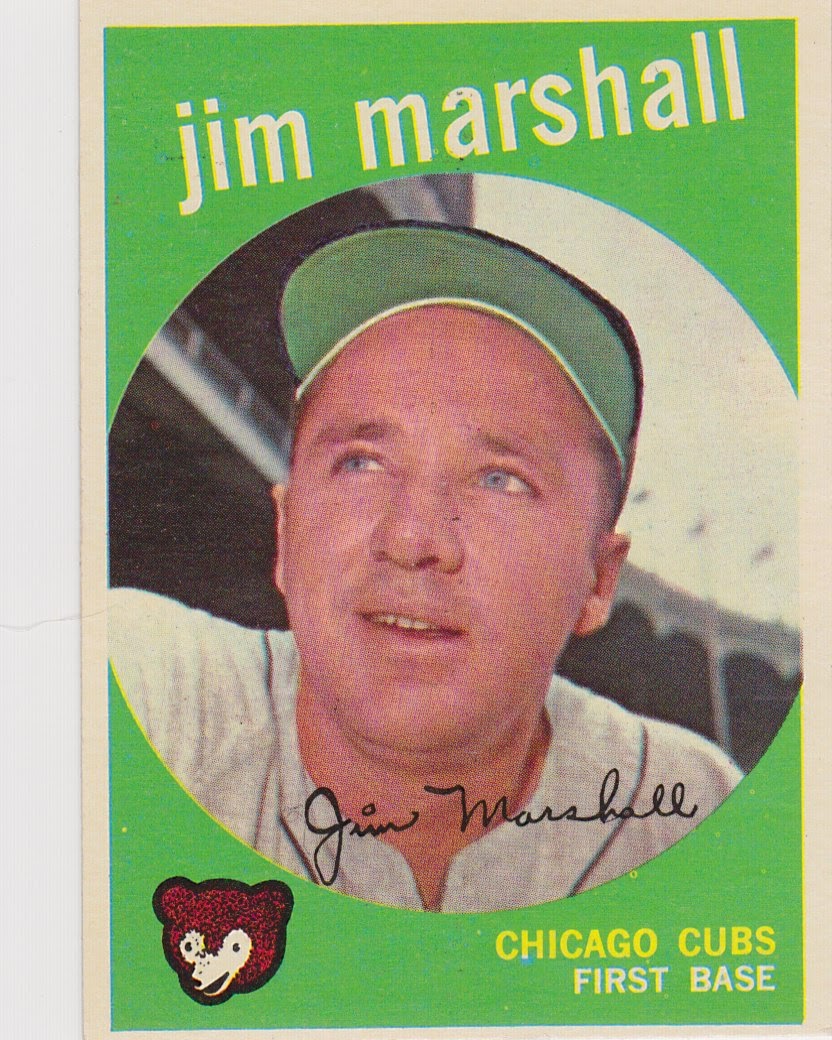
#153 Jim Marshall


I'd venture a guess to say the two closest things to major league baseball without actually being the majors have been the old independent PCL and the Japanese Leagues. Jim Marshall spent quite a bit of time in both of those, and he got in five seasons in our big leagues as well.

Marshall signed with the White Sox in 1950 and for the next eight seasons he put up some big power numbers with the Oakland Oaks of the PCL and various farm clubs in the Sox, Giants and Orioles' chains.

He debuted with the Orioles in 1958, was the regular first baseman for awhile and in August was waived due to his .215 average and went to the Cubs. His averages continued to be low while his power, so good in the minors, dried up against major league pitching. 1959 was his busiest and best big league season. He got into over 100 games with the Cubs and had 11 homers and 40 RBI in nearly 300 at bats.

That off season was a hectic one for Marshall. He was traded to the Red Sox who in turn traded him to the Indians during spring training of 1960. But when Sammy White, the other player traded to the Indians, refused to report Marshall was returned to the Cubs. Four days later, still before the season started, the Red Sox dealt Marshall to the Giants for Al Worthington.

He spent two seasons with the Giants, was sold to the expansion Mets for '62 and then was traded to the Pirates in May. While a member of the Mets he became the first player to homer in consecutive games for that club.

Following his tour with the Bucs he went to Japan and played three seasons over there.Since his playing days he has been a coach on two continents, managed in the big leagues for both the Cubs and A's and is currently in the front office of the Arizona Diamondbacks as Senior Advisor, Pacific Rim Operations. 

That's an Orioles uni Marshall is wearing at Yankee Stadium on this '59 card. Love the facade and flags flying on top of Yankee Stadium. So many memories.

Marshall is the victim of a very shoddy airbrush treatment on his 1961 Topps card. Just look at the cap. 


Friday, June 7, 2013

#98 Arnie Portocarrero


Righty pitcher Arnie Portocarrero was a New York city kid born of Puerto Rican-American descent who signed with the Philadelphia A's in 1949 at the age of 18. Following the pattern we've seen many times here he played a bit in the minors before serving in the military during the Korean War.

When he returned in 1954 he went straight to the majors and claimed a spot in the A's rotation. Making 32 starts Portocarrero went 9-18 with a 4.06 ERA. His hits per inning ratio was good, as was his strike out totals but wildness kept him from having more success. He led the AL with 9 wild pitches.

The following season, with the A's now in KC, saw him get fewer starts but similar results and in 1956 he spent almost the whole season in Birmingham, a Yankee affiliate. I can't find a transaction that sent him to the Yanks, and given the chummy relationship the A's and Yanks had in those days it may well have been a case of a player 'loan'.

He was back in KC in 1957 and didn't see much mound time and was traded to the Orioles prior to 1958. He blossomed there in Baltimore under Paul Richards, at least for one year. On a lousy club he somehow won 15 games and lost only 11 with an ERA of 3.25, easily his best year. He then spent the '59 and '60 seasons trying without success to replicate his banner 1958 campaign. In 1960 he split his pitching between the Orioles and their farm club. He was out of the game by early in the 1961 season.

His obit states that he was involved in amateur baseball in the Kansas City area after his retirement. He died in 1986 at the young age of 54. I came across this article online dated last winter that chronicles an adopted young man's search for his birth parents. It turns out that his father was Arnie Portocarrero.

On this card Arnie is in Yankee Stadium in his home town. I hope his family got to see him pitch there. He got into one game in the Bronx in 1958, the fifth game of the season with a relief appearance. He didn't fair well but his year sure turned out well.

Monday, June 3, 2013

#89 Billy Gardner


Billy Gardner began playing professional baseball when he signed with the New York Giants as an 18-year-old infielder in 1945. He banged around their chain and spent a year in the military before he finally debuted in 1954. In April of 1956 he was purchased by the Orioles and stepped into the role of starting second-baseman that year.

In 1957 Gardner blossomed and had the best season of his career, batting .262 while playing every game and leading the league in plate appearances and tying for the lead in doubles. He was voted as the Orioles' MVP and in what had become their first .500 season. While in Baltimore Gardner was known as an 'average Joe' who could be found after most home games enjoying steamed crabs at the popular Obrycki's. 

Gardner, who was known as 'Shotgun' for his powerful arm spent two more seasons as a regular in Baltimore and then was dealt to the Senators where he continued his regular 2nd base duties. Moving with the team to Minnesota, Gardner was lucky enough to be traded to the powerhouse Yankees in June of that year and as a result he picked up a World Series ring. He pinch hit for Luis Arroyo with two down in the bottom of the ninth in Game Two and lined out to short to end the Reds 6-2 win. But his days as an everyday player were over.

He was traded again, now to the Red Sox, in 1962 and played in Boston for one more season before turning his sights to coaching and managing on both the minor and major league levels. As a manager in the Boston organization he was even able to pick up a few at bats as late as 1971 meaning he had a playing career that spanned three American wars.

Gardner managed the Twins from 1981 though part of 1985 with his best season being a third place finish in the AL West and a .500 record. He took over for the ill Dick Howser with the Royals in 1986 but was replaced late in the year. His son, Billy Jr., continues to be a minor league manager.

The Baltimore Sun had a nice article/interview with Gardner in 2011. He currently lives in his home state of Connecticut and seems to be as 'scrappy' as ever..

It's a pretty ordinary card, yellow frame with a Yankee Stadium shot, but Gardner is an Oriole so that's a big plus.

Monday, May 20, 2013

#336 Billy Loes


Billy Loes won 80 games in 11 seasons with the Dodgers, Orioles and Giants but he left behind a much bigger legacy as a character and 'eccentric'. The Long Island native was a Brooklyn Dodger signee in 1948 Loes had an impressive minor league season the next year and got a taste of the majors in 1950.

He spent '51 in the service and returned for begin a string of successful seasons in Brooklyn, going 50-25 in the course of four seasons. He pitched in three World Series for the Boys of Summer, winning a ring in 1955.

Sold to the Orioles in May of '56 he won 12 games in 1957 but never saw much success while hanging on through 1961 with the Giants. But as noted, Loes is remembered for his colorful and generally odd personality.

From a New York Daily News story published after Loes' death in 2010:


Dodgers Hall of Fame catcher Roy Campanella once said of Loes: "How can I say why he doesn't win 20 when I can't even tell what he's going to do from pitch to pitch."That was never more evident than in Game 2 of the 1955 World Series against the Yankees when Loes hurled three innings of shutout ball, striking out five and inducing three double play balls - only to suddenly get kayoed on five hits and four runs in the fourth. Said Campy: "He started thinking. He had 'em going on fastballs and curves for three innings when he suddenly decided to throw change-ups."Before the 1952 Series, Loes reportedly predicted the Yankees would beat the Dodgers in six games. Years later, however, he said he was misquoted. "I never said that," he insisted. "What I said was they'd beat us in seven games." Which they did.But perhaps the most infamous Loes episode occurred in Game 6 of the '52 Series at Ebbets Field when he claimed to have lost a ground ball in the sun. What happened was Yankee starting pitcher Vic Raschi hit a ball off Loes' leg that caromed into right field, scoring Gene Woodling from second and sending the Yanks to a 3-2 victory that tied the Series 3-3. They won it the next day. Everyone laughed when Loes insisted he'd lost Raschi's grounder in the sun, but as Dodger pitcher Carl Erskine later explained: "That's exactly what happened. At that time of the afternoon in Ebbets Field, the sun came through a space in the grandstand behind the plate and could blind you."


Billy Loes and his dog in 1954. 


Wednesday, March 27, 2013

#484 Willie Kirkland


Outfielder Willie Kirkland played nine seasons of major league ball after being signed by the New York Giants in 1953.  He worked his way up through the Giants' chain and kicked some serious minor league butt in the process by batting well over .300 and averaging 30+ homers a season between '53 and '56.
He served the next year in the military and debuted with the Giants in San Francisco a few weeks into the 1958 season. He immediately took an outfield slot and kept it for three years hitting over 20 homers each year.
He became the odd man out in a crowded Giants' outfield and was traded to the Indians for 1961. In three years with the Tribe he played as a regular and displayed his above average power in cavernous Municipal Stadium. He was traded to the Orioles for 1964 and on to the Senators in August that year. He was a regular into the 1966 season even as his numbers slipped. He spent 1967 in the minors.
Released after that season he played in Japan for an additional six years.
In 1961 Kirkland had an unusual day which is chronicled on the Hardball Times website. He homered in his first three at bats against the White Sox and then drew a walk. With a four homer game staring him in the face as well as two men on while his club trailed by a run, Kirkland laid down a sacrifice bunt to advance the runners to second and third. It turned out that the Indians couldn't score the runners but the story illustrates Kirkland's selfless baseball style.
These sea-foam green cards have really grown on me. There are 19 of them among National Leaguers.

Tuesday, March 12, 2013

#170 Gene Woodling


Gene Woodling's career stretched from 1943 with the Indians through 1962 with the expansion Mets. Along the way he was a reliable hitter who had a good on base percentage, a .284 lifetime average, hit .318 in five World Series (he won them all as a Yankee and they were in consecutive years), had enough power to register double digit homers nine times, made the AL All Star team in 1959 and garnered a reputation as an all around valuable edition to every team he played for and a good guy to boot.

He broke into pro ball in 1940 as a 17 year old Indians signee and made the bigs in 1943 as noted. After a couple of years in the Navy during WWII Woodling returned to the Indians, was traded to the Pirates and then to the Yankees where he spent 6 seasons and won his five rings.

His first run with the Orioles, in 1955, wasn't very successful but after three years in Cleveland he returned to Charm City in 1958 and was one of the clubs better players. He continued on to play for the expansion Senators and then the Mets before retiring.

After his playing days he served as a coach for the Orioles for several years. He published a book on hitting in the late 60s. He died in 2001. EDIT: for some reason my browser is giving me a malware warning when I attempt to access the SABR site. YMMV  His SABR page is a very complete bio... as always it's recommended.


more late edit:

Gene has a page at the Baseball in Wartime blog. And it features this great picture. Not sure how I missed that in my initial research.


VERY LATE EDIT (Feb 20, 2014)... In a comment Paul pointed out that this picture on the baseball in Wartime site was flipped horizontally. Here is a corrected picture:


Sunday, March 10, 2013

#268 Tito Francona


John Patsy "Tito" Francona (yes, his middle name is 'Patsy.. I bet he grew up tough) signed with the St. Louis Browns in 1952 and spent a couple of years in their chain before Uncle Sam called and he spent a few more in the service. By the time he made the bigs the woeful Brownies had moved to Baltimore and become the woeful Orioles.

Francona stepped right in and played full-time in the O's outfield in 1956 hitting .258 with nine homers. He finished tied with Rocky Colavito for second in the Rookie of the Year balloting in the AL that season. That means he and The Rock each got a vote while Luis Aparicio got the other 22!

Despite that he spent some time in the minors early in the 1957 season and when he did return he wasn't quite able to produce consistently. He was traded to the White Sox in December of 1957 and split the '58 season between Chicago and, after a trade, the Detroit Tigers.

Another trade, in March of 1959, sent Francona to the Indians and it was in Cleveland that he finally established himself. That season he had a 'Brady Anderson' year hitting 20 homers and batting .363 for no apparent reason. Harmonic Convergence perhaps.

He continued to play well for the Indians over most of his six seasons with the club. From 1960 through 1963 he's pop up in the lists for Top Ten in various hitting categories.

After his run with the Indians Francona went on to play for the Cardinals, Phillies, A's and Brewers. For the most part he was no longer an everyday player but he did hit .286 with almost 400 plate appearances with the '68 Braves. And in 1969 he hit .319 in limited play in a season he split between the Braves and A's. His 1970 release by the Brewers marked the end of his career.

Tito Francona is, of course, the father of Terry Francona who piloted the Red Sox to much success (two titles) in the last decade, managed the Phils before that and is the new skipper in Cleveland, completing a circle of sorts.

Tito also holds a place in my heart because he wore the #44 for the Orioles which was 'my' number back when I was wearing one.


Monday, March 4, 2013

#209 Lenny Green


Always nice to see an Oriole pop up, even one that didn't play a whole lot in Charm City. Baltimore signed Lenny Green in 1955 out of Detroit's Pershing High School. He put up some impressive minor league numbers and earned himself a look with the big league club in 1957.

He failed to stick and split the '58 season between the O's and the minors. In late May of 1959, despite a .292 average in limited play, Green was dealt to the Senators. He earned a job in the Nats/Twins outfield for 1960 thru 1962 and hit well and stole some bases. He hit a career high 14 dingers in 1962.

With his numbers declining he began bouncing around the AL including a second ride with the Orioles. He recaptured a bit of magic in Boston in 1965 when he earned over 400 plate appearances. He finished his career with the 1968 Tigers but was not around at season's end to possibly enjoy the Tigers World Series spoils.

He worked with the Ford Motor Company for 27 years after his baseball days. His SABR bio (as usual) is chock full of interesting details about Lenny Green. And early in his career Green was considered (by some) to be the first 'true' African-American player for the Senators. Details in an interesting web page found here.

I love the fact that the card depicts Green's smiling face with Memorial Stadium in the background. I think that style of light tower was unique to that dear old ballpark.

Sunday, February 10, 2013

#192 Charley Beamon


This card is seemingly the only place you'll see pitcher Charlie Beamon's name spelled as "Charley". Why Topps used a "Y" is a mystery to me. Anyway, Beamon came out of Oakland's McClymonds High School as did several other major leaguers including two Hall of Famers, Ernie Lombardi and Frank Robinson. In addition to Robinson three players with 1959 cards already featured here came from McClymonds: Vada Pinson, fellow Oriole Willie Tasby, and Curt Flood.

Beamon began his pro career on the West Coast in 1953 and found his way to the Oriole system by the end of 1955. In '56 he pitched for the Os' Vancouver club and earned a September call up. He debuted in fairly spectacular fashion with a four hit shutout of the New York Yankees. Beamon and the Birds beat Whitey Ford 1-0 on September 26 and prevented him reaching 20 wins for the season. How cool is that?

He actually picked up another win in his only other 1956 game with a victory in a four inning relief stint over the Senators. Unfortunately that five day span was to be the highlight of Beamon's brief career. In 1957 he pitched in four games while spending most of the season in the minors and then in 1958 he spent most of the year in the majors, made a handful of starts mid-season and ended up with a 1-3 record in 21 games. He never returned to the majors after that and retired in 1961.

Beamon's son, Charlie Beamon, Jr. spent parts of three seasons with the Jays and Mariners between 1978 and 1981. He was listed as a DH, pinch hitter and pinch runner by Baseball Reference.

Behind Beamon in the Yankee Stadium shot we see what I believe is a member of New York's Finest. He could very well be and usher but I seem to recall the Yankee Stadium ushers wearing hats with and orange or red stripe around the crown. I could very well be wrong on that. I'll try to find other Yankee Stadium backgrounds within the set and dig something up. I love '59 card-based mysteries!

BTW... Charlie Beamon has set an unofficial record for the number of 'open tabs' in my browser during a post write-up. Between Beamon's stat page and bio page, his game logs and two boxscores, tabs for fellow McClymonds grads, two for Charlie Jr, and some odds and ends like Wikipedia and such, there are 24 tabs open. All that for a guy who won three major league games. Nearly one for every appearance. Crazy!

EDIT: I've come up with one picture of what could be late 50s era YS ushers:


And although I think of NYC cops decked out in navy blue I find pics of them in white on a google search. Still inconclusive. And nobody cares except me.