Showing posts with label Kansas City Athletics. Show all posts

Tuesday, March 11, 2014

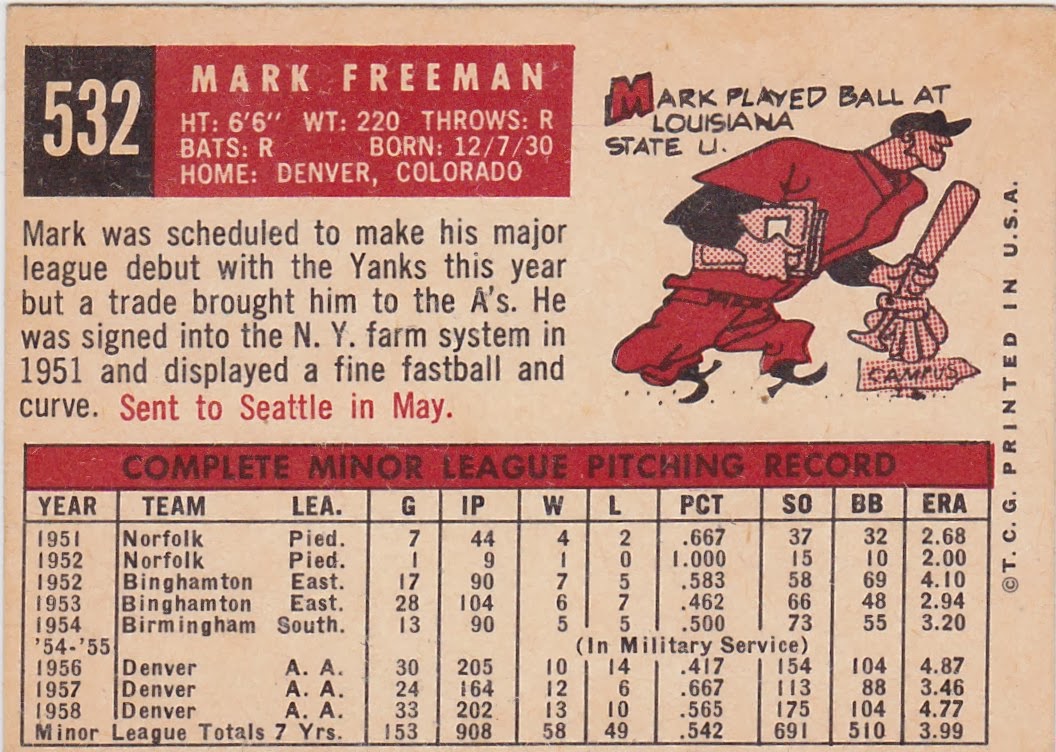
#532 Mark Freeman


Mark Freeman graduated from Memphis' Christian Brothers High School in 1948 where he lettered in baseball and basketball, and was an All-State baseball pitcher. He was awarded a baseball/basketball scholarship to LSU.

Freeman signed a contract with the Yankees in 1951 and began his pro career but he continued his education and received his degree from LSU in 1953. Meanwhile he had begun a seven year climb towards the majors taking a nearly two season detour to serve in the U.S. Army as a First Lieutenant and Sports Officer and manager of Ft. Jackson baseball team at Ft. Jackson, South Carolina.

He returned to civilian life and baseball in 1956 and was a double digit winner for three straight seasons in Denver where the Yanks had their AAA club. While there he established team marks for season strikeouts and shutouts.

On the eve of the 1959 season he was traded to the Kansas City Athletics and made it into three April games as a reliever for them. In mid-May he was returned to the Yanks. I cannot find anything to suggest why and given the history of the Athletics and Yankees during the 1950s it was likely another on of those deals of convenience for New York. The Yanks sent him to pitch in Seattle of the PCL and he had another fine AAA season there including a no-hitter. In September the Yanks activated Freeman and he capped his tumultuous season with a start at Yankee Stadium against the Orioles. He pitched seven innings allowing only six hits and two runs while fanning four. He left with the game tied but the Yanks lost it in 11 innings.

He was back in the minors to open 1960 but the Yanks dealt him to the Cubs in May and he spent the rest of that season pitching in the National League. He made eight starts over 30 appearances and went 3-3 with his only career save.

He retired to Denver, Colorado after that season to work full time in the mutual funds business which he had dabbled in for the last several years of his baseball career. He was a very successful business man and established an endowment fund for supporting the tutoring of student athletes at LSU in 2003.
His LSU bio (he was alum of 'distinction') mentions that he was founded and served as President of the Denver Broncos Quarterback Club (their official booster club).

His card shows him in a spring training shot with a retouched cap featuring the Athletics' logo but untouched Yankee pinstripes. I came across several versions of a story that goes like this:

Once, during a game when Mark Freeman was pitching for the New York Yankees, a bee buzzed his head and he balked. Casey Stengel, the Yankee manager, told him: "Next time ... swallow it."
Volume 4 of the Baseball Hall of Shame series of books contains the same story but stated the game was played against the Tigers.

Two problems with this. First of all Freeman never pitched for the Yanks against the Tigers. His only game was that September '59 start against the Orioles. And second of all, according to Baseball reference game summaries he never committed a balk. Not in his big league career anyway.

My guess? It was a spring training game or it's a story that somehow evolved from some other incident and mutated in the retelling. With Casey Stengel stories that's very possible.

 Here he is in his Yankee gear, unblemished by the Topps artist's brush and another spring camp shot in which he warms up while Stengel watches closely.
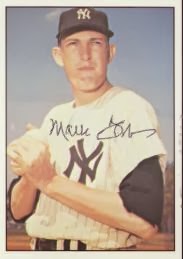


And here he is as a businessman years later:


Freeman died in 2006.

Almost done,


cards remain.

Thursday, January 9, 2014

#369 Dick Tomanek


He was 6'1" and 175 so Dick Tomanek was called 'Bones'. Topps really had a great cartoon for the cardback:


Tomanek was a native of Avon Lake, Ohio and was signed by the Indians in 1950. Cleveland was just down the shoreline and Tomanek tells this story on Baseball Reference:
"My dad told a group of his friends in a bar that if I made it up to the Indians he would walk the twenty miles from our home in Avon Lake to Municipal Stadium to see me pitch, and he did it."
That debut came late in the 1953 season after Tomanek had spent three seasons in the Indians' system and one in the employ of Uncle Sam. It was worth the wait for both Tomanek and his father as the lefty put together a six hit complete game win over Detroit on September 25. 

Tomanek made the big club in 1954. He made his first appearance on April 17th when he was called upon in the first inning following a shelling of Indians starter Art Houtteman by Chicago. Tomanek was rushed into the game and in the second inning he had to be removed with a sore arm. This page from a book on Google gives the details. Tomanek didn't pitch again that season and spent the next two in the minors. 

Back with the Indians in '57 Tomanek had mixed results through the summer of '58 when he was traded to the Athletics as part of the deal that sent Roger Maris to Kansas City. He was more effective that year with the A's than he had been with the Indians but 1959 was another story. He pitched only 21 innings and had a long mid-season idle stretch (injured?) and was gone from baseball after spending a rocky year in the minors in 1960.

Tomanek went to work for B. F. Goodrich Chemical and stayed with them until he retired in 1990. He reportedly still resides in Avon Lake.

I found a Cleveland-centric card website maintained by Tomanek's nephew although it's been inactive for quite awhile. He does feature his uncle's cards on one of the pages.

Yes, that's Yankee Stadium. 

Monday, December 30, 2013

#342 Ray Jablonski


Ray Jablonski was a member of the Cardinals when this card was issued and that fact is noted on the back. In fact Jablonski did a lot of traveling during his career, something that is usually attributed to his lack of defensive ability.

He signed with the Red Sox in 1947 after a military term and played two years in the low minors before he was drafted away by the Cardinals. He bashed his way up the Cardinals minor league ladder and debuted as their regular third baseman in 1953. He had a sterling year with the bat slugging 23 doubles, 5 triples, 21 homers with 112 RBIs to go with a .268 average. He finished third in the Rookie of the Year balloting behind Junior Gilliam and Harvey Haddix. He came back the next year to make the All Star team with an improved batting average (.296) and nearly matching or improving in other categories. During his stay in St. Louis he was known as part of the 'Polish Falcons' a heavy hitting trio of Cards of Polish-American heritage including Rip Repulski and Steve Bilko.

But his fielding deficiencies and the emergence of a young Ken Boyer prompted a trade that sent Jablonski to that Reds. He split time between AAA ball and the Reds in 1955 and had decent numbers in '56 but again found himself on the move. He was dealt to the Cubs after the '56 season. He made it known that he was thrilled to get a chance to play in his hometown of Chicago but he was dealt on to the New York Giants before the 1957 season could get underway. He hit .289 for the Giants but his numbers tailed off in '58 and he was traded to the Cardinals. That deal also sent Bill White to St. Louis so the fact that Jablonski only lasted until August before being waived is just a footnote.

The Athletics claimed him and he played in K.C. for parts of '59 and 1960 before finishing his career with some power hitting minor league seasons through 1964. In 1961 he hit the first homer for the newly formed Hawaii Islanders who were affiliated with the A's.

Ray Jablonski died at the age of 58 in 1985 in his native Chicago.

Saturday, December 14, 2013

#259 Jim Pisoni


Hometown boy Jim Pisoni made his big league debut with the St. Louis Browns by appearing in the final three games in the franchise's history as they prepped to move to Baltimore. He'd been in the Brownie's chain since he signed as an outfield prospect in 1949 sandwiching three fairly successful minor league seasons around a two year military stint.

He went 1 for 12 in those three '53 games (his one hit was the next-to-last homer in Browns' history) and found himself back in the minors from 1954 through mid-September of 1956 when the Orioles included him in a trade to the Kansas City Athletics. He got into 10 games with the A's and hit a pair of homers as he flashed the power that had marked his minor league days.

The following season Pisoni was a semi-regular in the Kansas City outfield before he was part of a (surprise!) trade package that sent him to the Yankees. After a season and a half as Yankee property (but never playing for the big club) he was drafted by the Braves for 1959 but after a handful of games in Milwaukee he was returned to the Yankees. This archived article on Google concerns the Braves hopes when they took him in the Rule 5 draft.

He got into nearly 40 games over the next two years for the Yanks but spent the bulk of his time in the minors. He played for the reds' AAA club in 1961 and then retired to become an electrical contractor. He passed away in 2007.

Two points of interest... the shot on his card was taken in Yankee Stadium and the "M' is airbrushed over his Athletics' logo and the card-back leaves off his 1958 minor league stat line despite the write-up mentioning his "solid performance".

Wednesday, December 4, 2013

#226 Art Ceccarelli


Lefty Art Ceccarelli signed with the Brooklyn Dodgers in 1948 and pitched for four seasons in their minor league system and squeezed in a couple of years of military service, too. He never made the Bums roster and was sold to the Yankees in 1954 before being drafted away by the A's later that year.

He made 16 starts among 31 appearances in his rookie season of '55 for Kansas City and went 4-7 with a high ERA. He spent the next season mostly in the minors but managed to lose one decision for KC. He was traded to the Orioles and went 0-5 in 1957, pitched well in the minors in 1958, was drafted by the Cubs and spent the first part of 1959 in their system.

Ceccarelli was brought up by the Cubs in July of that year and won his first four starts, three with complete games and one on a shut-out. Then hard times hit and he finished the year 5-5. He opened the 1960 season with the Cubs but was traded to the Yanks in May and ended his career in the minors after the 1963 season. He was 9-18 for his careen with an ERA of just over 5.

After baseball Ceccarelli returned to his native Connecticut and taught and coached high school for many years and coached baseball at Southern Connecticut State University. He passed away in July, 2012.

This card uses an airbrushed version of his 1958 Topps on which he is shown in an Orioles uni.


Tuesday, November 5, 2013

#449 Tom Gorman


Tom Gorman began his professional career was a Yankees prospect who they drafted in 1946 after he had been in the Navy serving in the Pacific in WWII. He was more or less a local kid having been born and raised in Valley Stream on Long Island.

He pitched erratically in the Yankees' chain but got a call mid season in 1952. He made six starts with an equal number of bullpen outings and went 6-2. He made an appearance in the World Series that year against the Dodgers getting into the Game Three in the ninth inning after Eddie Lopat had allowed the deciding runs in the loss.

The next season he pitched in 40 games for the Bombers, all but one in relief and posted six saves which was good for ninth best in the A.L. He made another World Series appearance and earned his second ring. In that Series he pitched three innings in relief of White Ford in Game Four and struck out the first batter he faces, Brooklyn's Billy Cox. Gorman allowed a run in that outing and even came up to hit once and whiffed.

He pitched for the Yanks up until July of the '54 season when he was farmed out despite decent numbers. I can't find out anything more but I suspect he was blocking the progression of a younger arm. Tom Morgan perhaps?

Either way the Yanks traded him to Kansas City in the off season (Another deal with K.C.? Shocking!). Gorman pitched for the Athletics for four full seasons and part of a fifth. 1955 was his busiest and best year. He collected a career high 18 saves which translated to second among AL bullpen guys. He was a spot starter for the A's in '56 and '57, went back to the pen full time in 1958 and was washed out of the big leagues early the next season.

Gorman died in Valley Stream in 1992. He is not related to umpire Tom Gorman who worked in the NL for nearly three decades or to the Tom Gorman who pitched for several NL clubs in the 1980s.

I've always liked his 1953 Bowman. Anyone out there collect these? I'd love to swap for some of your dupes.


Wednesday, October 2, 2013

#154 Ray Herbert


Detroit native Ray Hebert signed with his hometown Tigers in 1949 and after putting up some nice minor league stats he got a taste of the majors in 1950. He spent most of 1951 and all of '52 in the service before returning to Detroit and taking a spot in the Tigers' bullpen.

He had control problems and was beaten up pretty badly over two seasons before he was sold to the Athletics for the 1955 season. Another subpar year led to a couple of seasons back in the minors. He returned to the bigs in 1958 and had better results in a swingman role. The next two years saw Hebert gain a spot in the Athletics' rotation and he won 25 games for some pretty bad KC clubs. He was traded to the White Sox in June of '61 and he career took another turn for the better.

He went 20-9 with a 3.27 ERA in 1962 and he made his only All Star appearance, a game he ended up winning. He won fewer games in 1963 (13) but he led the A.L. with seven shutouts and had a 3.24 ERA. His numbers declined after that and he was out of the majors following 1965 after a couple of seasons with the Phillies.


Saturday, September 21, 2013

#281 Walt Craddock


West Virginia native Walt Craddock signed with the Philadelphia A's in 1954 out of Syracuse University. The lefty pitched in the Athletics' farm system for the better part of two years with better numbers than his results indicated.

That got him a taste of the bigs late in 1955... and got lit up. He repeated that in 1956, his late season cup of coffee resulted in him getting lit up. He had a great season in AAA in 1957, leading the International League with 18 wins and then spent the whole 1958 season in Kansas City, for the most part getting lit up.

That was his last season in the big leagues. By the time this card was issued he'd been dealt off to Reds. He spent two seasons in the Reds system, pitched very well, but then retiring. He finished with an 0-7 big league mark.

But he did get to be photographed in Yankee Stadium and had this one Topps card.

Sunday, September 1, 2013

#182 Milt Graff


Yes, this is another nifty, excellent conditioned '59. Off-center as all get out but that is more the rule than the exception I think, at least among my '59s.

Second baseman Milt Graff was signed by the Pirates out of Penn State in 1949 and he proceeded to toil in the Pirates' and Yankees' chains, when he wasn't toiling for Uncle Sam, until he was dealt to the (surprise!) Athletics in February of 1957. He'd shown some real hitting potential in the minors with several seasons of .300+ averages.

But with the A's in '57, after opening the season as a regular, he wasn't able to solve major league pitching and played most of that year back in AAA. After one more at bat in '58 Graff spent six more seasons in the minors before retiring as a player.

He went on to work in baseball after getting an accounting degree. According to Baseball Reference some of the baseball jobs he held assistant general manager and Scouting Director for the Pittsburgh Pirates, infield coach for the Pirates and director of stadium operations at Three Rivers Stadium. He served as a scout for the Pirates, San Francisco Giants and Cincinnati Reds.

He died in Rockdale, Texas in 2005 having migrated to that state earlier. His son, Steve Graff a.k.a "Coach Graffie",  is a former minor leaguer and  major league coach. He now coaches amateur baseball in central Texas. 

Wednesday, August 28, 2013

#72 Bill Renna


William "Big Bill" Renna was a 3-sport collegiate standout at Menlo College and Santa Clara in California when he was signed by the Yankees in 1949. He displayed plenty of power and a hit near or better than .300 in his four year stretch in the Yankee chain. In one game in 1952 playing for the Yanks' AAA club in Kansas city he was part of a 10 home run (six in one inning!), 53 total bases assault. Renna hit two of those homers in a game that set American Association records that stand today.

Renna played in New York in 1953 but, while he hit .314, he failed to show much of his expected power. He was dealt to the Athletics who held on to him until June of 1956 when the bosses in New York decided he might be useful and had the Athletics send him back. During his 2+ seasons with the A's he hit 26 homers but batted just .214. He spent the remainder of the 1956 season with the Yankee farm club and he again showed the bat he had earlier in the minors.

The Red Sox acquired him for the 1957 season and after another season in the minors he played sparingly in Boston through May of 1959. Renna worked in the concrete business after he retired. He tells much of his own story in an interview on the This Great Game site.

I found a couple of variations of this picture of Bill Renna in a couple of places. I like it a lot.


Tuesday, August 6, 2013

#416 Haywood Sullivan


Note: This post will be rather short and sweet as I am currently on the road between Houston an Lincoln, Nebraska on family business and putting it together on the fly. 

Whoever wrote Haywood Sullivan's Baseball Reference Bullpen page bio was not a fan of his:

Haywood Sullivan played in the majors from 1955-63, primarily as a catcher. While he spent four years with the Boston Red Sox and only three with the Kansas City Athletics, he had 718 of his lifetime 851 at-bats with the Athletics. He also managed the Athletics for most of the 1965 season.
Sullivan was General Manager and part owner (with Jean Yawkey) of the Boston Red Sox 1978-83. Sullivan had been assistant GM of the Red Sox from 1966 to 1977. He essentially inherited a contending team in the late 70's including the 99 win 1978 Red Sox.
In his time as GM he traded popular players Rick Burleson, Butch Hobson and Fred Lynn and lost Carlton Fisk to free agency when he failed to offer Fisk a contract before a deadline. He then brought in over the hill stars like Joe Rudi and Tony Perez who along with 43 year old Carl Yastrzemski were well equipped to compete with the 1983 Phillies for oldest team honors. He also drafted and brought to the majors, his son, catcher Marc Sullivan.
On the plus side for Sullivan he did acquire batting champion Carney Lansford who he then traded to Oakland for home run champion Tony Armas. Following the 1983 season, in which the Red Sox were 78-84, Sullivan was replaced by Lou Gorman as GM of the club after a dispute with fellow owner Buddy Leroux.

Not much I can add to that other than the fact that he was a start football quarterback at the University of Florida in addition to playing baseball there. He was a draftee of the Washington Senators expansion franchise in December of 1960 off the Sox roster. The Nats traded him to the Athletics a few weeks later.

Despite his issues in the Sox' front office and as part-owner, he is a member of their Hall of Fame.

Thursday, June 27, 2013

#127 Kent Hadley The Sporting News Rookie Stars


You just never know what you'll find when you follow one of these cards down the rabbit hole. This Kent Hadley rookie is a good example. I figured this would be a straightforward, simple post. Young, power-hitting first baseman comes from Idaho, drafted by the Tigers out of college, traded to the A's, a few years in the minors lead to a taste of the big leagues. He plays a season as a regular before he. like every other Kansas City Athletic in the 50's, gets dealt to the Yanks. He plays a little in NY and then finishes in Japan. End of Story.

Not quite. As I've found, the best stuff doesn't always show up on the first page of a Google search. First there is Hadley's SABR bio which talks in detail about his relationship with legendary college coach Rod Dedeaux at USC. Also there you find stories of his impressive tryout performances which led to his signing by Detroit, Much more of course, SABR is a great resource.

But then I stumbled across a couple of blogs. One is written (as best I can tell) by Hadley's daughter, Lynn. It's not active now but the 27 posts that make up Kent Hadley Idaho Yankee, written in 2009, tell the story on Hadley's life before, during and after his career. Great stuff.

A second blog, written by an Idaho native and journalist, isn't specifically about Hadley but does have an entry about him. What made this special is that it led me to the author's Flickr site dedicated to Hadley. It contains many pics and documents about the ballplayer. Tons of great things to see there including pictures of Hadley and his buddy Roger Maris, who he played alongside in both KC and New York (the two were included in the same trade to the Yanks in 1960).

So now I have a whole new perspective on a guy I'd vaguely heard of from his time with the Yanks. And I discovered his 1960 Topps. It's pink and I love pink cards. I'm adding it to my list of 'wants'. It's much cooler than the '59 rookie.


Wednesday, June 19, 2013

#64 Joe DeMaestri


Welcome to "Joe Week" here at '59 Topps.

A California kid, Joe DeMaestri signed with the Boston Red Sox in 1946. He spent several years in their system, was drafted away by the White Sox and debuted with them in 1951. He was traded to the Browns for 1952 and then back to the White Sox who, in that same off-season, shipped him to the Philadelphia A's in time for the 1953 season.

It was in Philadelphia that DeMaestri earned a starting shortstop job and he held it for seven seasons. If you look at his numbers over his tenure with the A's you see a pretty consistent if not very spectacular run. He always seemed to hit around .245, knock out 6 to 8 homers and drive in 30 to 40 runs.

His hitting numbers were not what kept him in the lineup though. DeMaestri was among the top fielding shortstops of the 50s, usually finishing at or near the top of several defensive categories. He made the AL All Star team in 1957 but didn't play in the game.

In December of 1959 he was dealt to the Yankees (let's all act surprised) along with Roger Maris and Kent Hadley for Hank Bauer, Don Larsen, Norm Siebern and Marv Throneberry. As part of the Yanks in 1960 and '61 he played on a couple of pennant winners. He played in the 1960 Series but not in the '61 Series. He may not have been included on the Series roster for the Yanks that year. No way to know if he received a ring but he likely got a share of the winner's money as he had been with the Yanks all season.

If you scroll down to the bottom of this Sports Illustrated article from the Baseball Preview issue of 1961 you'll find a story about the 'pebble grounder' that hit Yankee shortstop Tony Kubek in the throat in Game Seven of the 1960 Series. Apparently DeMaestri was going to enter the game as part of a defensive switch for Kubek prior to the inning. Casey Stengel had a change of heart and DeMaestri remained on the bench and saw Bill Virdon's grounder to short play a key role in the Series outcome.

DeMaestri owned a beer distributorship for many years after he retired following the 1961 season.


Friday, June 7, 2013

#98 Arnie Portocarrero


Righty pitcher Arnie Portocarrero was a New York city kid born of Puerto Rican-American descent who signed with the Philadelphia A's in 1949 at the age of 18. Following the pattern we've seen many times here he played a bit in the minors before serving in the military during the Korean War.

When he returned in 1954 he went straight to the majors and claimed a spot in the A's rotation. Making 32 starts Portocarrero went 9-18 with a 4.06 ERA. His hits per inning ratio was good, as was his strike out totals but wildness kept him from having more success. He led the AL with 9 wild pitches.

The following season, with the A's now in KC, saw him get fewer starts but similar results and in 1956 he spent almost the whole season in Birmingham, a Yankee affiliate. I can't find a transaction that sent him to the Yanks, and given the chummy relationship the A's and Yanks had in those days it may well have been a case of a player 'loan'.

He was back in KC in 1957 and didn't see much mound time and was traded to the Orioles prior to 1958. He blossomed there in Baltimore under Paul Richards, at least for one year. On a lousy club he somehow won 15 games and lost only 11 with an ERA of 3.25, easily his best year. He then spent the '59 and '60 seasons trying without success to replicate his banner 1958 campaign. In 1960 he split his pitching between the Orioles and their farm club. He was out of the game by early in the 1961 season.

His obit states that he was involved in amateur baseball in the Kansas City area after his retirement. He died in 1986 at the young age of 54. I came across this article online dated last winter that chronicles an adopted young man's search for his birth parents. It turns out that his father was Arnie Portocarrero.

On this card Arnie is in Yankee Stadium in his home town. I hope his family got to see him pitch there. He got into one game in the Bronx in 1958, the fifth game of the season with a relief appearance. He didn't fair well but his year sure turned out well.

Friday, March 8, 2013

#271 Orlando Pena


Havana native Orlando Pena debuted with the Cincinnati Reds in 1958 after being picked up from an independent team in Daytona Beach and spending three impressive seasons in the minors.

He then embarked on a 14 season career with eight clubs that spanned from the '58 debut until 1975. His most successful run came with the Kansas City A's from '62 through '64 when he was a member of their starting rotation. His 20 loss 1963 season (he won 12) was actually one of his best numbers-wise.

After that he spent time in six other organizations and kicked around the minors as well and even pitched batting practice for the Royals between major league stints in the early 70s. In 1972 he was a combined 22-3 with Miami and Rochester in the Orioles chain. Oddly he led the AL in fielding percentage as a pitcher in 1963 and then led in errors in 1964.

After leaving the game in 1975 he resurfaced very briefly in 1979 with the independent Miami Amigos with a six frame outing for that Inter-American League club. Davey Johnson managed that team which was part of a brief, failed experimental league.

Nice to see Fidel Castro make an appearance on the back of Topps card, isn't it? And just because I can I'll show you his final Topps card, from 1975.


Sunday, February 24, 2013

#276 Pete Daley


Pete Daley signed with the Red Sox in 1948 and worked his way to the big leagues one step at a time, finally arriving in Boston in 1955. Along the way he had spent two years in military service. He brought with him a reputation as a fine defensive player with issues at the plate and that's about how his career played out.

He served as a back-up to Sammy White for most of his five season with the Bosox although he got 200+ plate appearances in both 1956 and '57. He actually hit .321 in his very limited duty in 1958. After the 1959 season he was traded to Kansas City where he saw his at bats reach a career high (228) and that year he hit a respectable .263. He played alongside, but was no relation to, pitcher Bud Daley that season.

Drafted by the expansion Senators for the 1960 season Daley again was in a time-share role and after he spent the 1961 season in the minors he called it a career.

Following his baseball days he managed a bowling alley (btw... have you ever passed a bowling center that DIDN'T have a "Leagues Now Forming" sign out front?). He went on to work for the Schick Razor Company and what his Baseball Reference Bullpen page called the "English Leather Company". By that I'm guessing they were referring to the Mem Company which was responsible for the original English Leather cologne.

Not to go off on too deep a tangent but... English Leather!!! That was my favorite fragrance when I used to use that stuff as a teenager. I'm thrown back 45 years whenever I see a reference to it. And if I see a bottle these days (they still sell a reasonable facsimile at Sears and CVS) I can't help but douse myself with the tester supply. What high school girl in 1967 could resist that incredible aroma? Apparently most could judging by my social life in those days.


Sunday, February 17, 2013

#513 Tom Carroll


Tom (or Tommy) Carroll was caught up in the '50s Bonus Baby rule that required the team, in this case the Yankees, to keep him on the active roster for two seasons. I guess someone thought that was a good idea at the time.

Anyway, shortstop Tom Carroll came out of Notre Dame and straight to the Yanks in 1955 and proceeded to sit on the bench with two AL champion Yankee clubs. He did more pinch running than anything else. He managed to bat .348 for the Bombers in 23 at bats total. In the '55 World Series he entered two games as a pinch runner. In the 1956 Series he never left the bench but he did get a ring.

As with many of these 'bonus babies' the two years he spent spitting sunflower seeds in major league dugouts didn't do much to further his development. Back in the minors in 1957 and 1958 he had mediocre numbers and his fielding was pretty poor as well. Traded to the A's in 1959 he played in 14 games but spent much of that year and all of 1960 in the minors. He retired after that.

After his playing days Carroll went to work in the U.S. State Department and saw duty in several countries in Latin America. He is apparently no relation to the Tom Carroll who pitched for the Reds in the mid 70s.

This high number late series card shows Carroll in an airbrushed A's cap wearing what appears to be a Yankee uniform. One can barely make out the pinstripes when the view of the card is large enough. So many Yankees and Athletics players shuffled back and forth in that era that it's a wonder the Topps photographers didn't just carry the other team's cap when photographing either club's players. "Here ya go, Carroll, put this on and we'll take a few more pics, just in case."

Tuesday, January 29, 2013

#101 Alex Kellner


Signed out of Tenssesse by the Cincinnati Reds in 1941 lefty Alex Kellner only had time to pitch one year of (pretty good) minor league ball before the U.S. Navy became his four year home during WWII. After his service in the Pacific (details are here) he briefly returned to semi-pro baseball and then was back in the pros with the A's organization in 1947.

He got a taste of the bigs in 1948 but had an outstanding true rookie season in 1949 in Philadelphia. That year he won 20 games (of the teams' 81 under Connie Mack) and made the All Star club. He was the first to win 20 for the A's since Lefty grove in 1933. Even for a war-seasoned, not-so-young rookie that had to be heady stuff. He was second to Roy Sievers in Rookie of the Year balloting in the A.L.

He remained a member of the A's starting staff (in Kansas City) through 1957. Although he managed to pull down double digit win seasons along the way (and one 20 loss season) he never re-captured the magic of that rookie season. For parts of two seasons he had his brother Walt Kellner as a teammate.

In 1958 he was waived and picked up by the Reds and then traded, despite doing some of his best pitching in half a decade, to the Cards for 1959. He pitched his last innings in June of '59. This card represent the last season and final stop in a respectable career. He was a good hitting pitcher, hitting .215 with four homers.

This picture, with Kellner in a Red's road top, has the L.A. Coliseum in the background so it was shot on one of the Reds trips to the Coast after he was traded from the A's in 1958. The Reds were in L.A. in July and August.

Tuesday, January 15, 2013

#263 Buddy Daley


Bud Daley pitched ten big league seasons (or parts thereof) made the AL All Star squad twice, went to two World Series with the Yankees (pitching a total of eight shutout innings), won a World Series game and two championship rings. Not too shabby.

Born with a right arm partially disabled by a problem at birth Daley pitched well enough in the Pacific Coast League to draw the attention of several big league clubs and he signed with the Indians in 1951. He worked his way up the Indians' system and got a late look at the bigs in September of 1955. The following season he got another look and then he established himself in 1957 getting 10 starts in 24 appearances.

He was traded to the Orioles at the beginning of April of 1958 and then, without having appeared for the Birds, to the Athletics just two days after the season opened on April 15.

It was with the A's that Daley had his best seasons winning 32 games in 1959/60 and made those two All Star teams. He appeared in two of the four All Star Games held in those years (two each season, benefiting the players' pension fund) and allowed only a walk in an inning and a third while whiffing Ernie Banks, Vada Pinson and Orlando Cepeda.

Arm issues limited Daley's workload after 1962 and he was dealt to the Indians for the 1965 season but he was released as the season opened and retired.

Two things... I never heard him referred to as 'Buddy', always just 'Bud'... and that's a nice pic with the classic Yankee Stadium facade and grandstands behind him.


Monday, January 14, 2013

#124 Dan Dobbek The Sporting News Rookie Star


Dan Dobbek signed with the Senators in 1955 and, after a side trip to the military, rose through the minors with a reputation as a power hitting outfielder. He never did produce at the major league level and was gone from the bigs after 1961.

Dobbek was called up by the Senators in September of 1959, put in rightfield as the starter and spent the final month of the season in that role. He hit his first (of 15 total) big league homer off Billy O'Dell that month. He was a semi regular in 1960 and got into 110 games hitting .218 with ten homers. In an April game against the Red Sox he tied a major league record by receiving three intentional walks.

His final season came after the Nats moved to Minneapolis/St. Paul and became the Twins in 1961. That year on May 19th he hit the first grand slam in Metropolitan Stadium. That was the second two homer game of his career, both came against the Athletics.

He was dealt to the Reds after that but never made it back to the majors. He says his career was cut short by a collision with the outfield wall against the Athletics. He finished as a pro with a couple more minor league seasons and then retired. Baseball Reference reports that he lives in Oregon.