Showing posts with label Los Angeles Dodgers. Show all posts

Saturday, December 28, 2013

#364 Danny McDevitt


Danny McDevitt is the first Dodger that I've posted for quite awhile. Looks like a spring training shot that's been 'painted' over. Probably a Vero Beach photo.

McDevitt signed with the New York Yankees late in 1951 out of St. Bonaventure College and reported for work that September to the Yanks' low minor league clubs. He got into 7 games and was whacked around pretty good on the rare occasion he got the ball over the plate. Apparently the Yanks decided that they had made a mistake and released him.

McDevitt signed with the Dodgers that off season and had a much better year in their system but he still had control issues as evidenced by his 171 walks allowed in 199 innings. Then it was off to the military for a couple of years. When he returned in 1955 he began a two and a half season stretch during which he continued to struggle with control. His work in 1957 was good enough however to earn him a promotion to Brooklyn and secure him a spot in the rotation alongside Don Drysdale, Johnny Podres and Don Newcombe. In his first start on June 17 he pitched a complete game against the Reds allowing two runs on seven hits and fanning 11. He went on to a 7-4 record with a couple of shutouts that year.

One of those shutouts came in the very last game ever played in Ebbets Field. McDevitt handcuffed the Pirates that day on five hits. A brief video of that final Ebbets Field out was on You Tube and I've posted it here:


McDevitt's recollections of the game are featured in his L.A. Times obit:
"It was just another game, as far as I knew," McDevitt told Times columnist Jerry Crowe in 2007. "All the older guys – Pee Wee [Reese] and Duke [Snider] and those guys – seemed to know the facts, but I didn't know.
"I couldn't believe that after working my butt off to get to Brooklyn that I would be going back to another minor league town, which is what L.A. was then."

A brutal start to the '58 season earned McDevitt a demotion to the minors and when he was recalled in August he wasn't much better. 1959 was McDevitt's 'bounce-back' season as he went 10-8 in 39 appearances including 22 starts. He earned four saves as well. The Dodgers and Braves tied atop the NL standings that year and McDevitt drew the first playoff game assignment. He was KO'd in the second inning but the Dodgers won the playoff series and went on to win the World Series. McDevitt didn't pitch against the White Sox.

He continued his up and down trend with a poor 1960 season. He was sold to his original team, the Yankees that winter and was traded to the Twins in June. He pitched for the A's in 1962 and was out of baseball as an active player later that year. He went on to work as an umpire in the minors and later sold real estate among other jobs.

A Google search turned up a book on Cuban Winter League baseball that featured a story of an incident between McDevitt and an umpire that had some serious consequences. I also found a neat picture of McDevitt in Ebbets Field.


Friday, April 26, 2013

#53 Stan Williams


Whoa. Stan Williams, you were a real badass. At least according to everything I've been reading today.

Williams came in as a strong 6'4" 225 lb-ish hard thrower who would just as soon hit you as look at you. Pretty intimidating staff when you consider the Dodgers had Don Drysdale to go along with him. To say nothing of Sandy Koufax.

He came up with the Dodgers in 1958 and pitched mostly as a starter and really came into his own in 1960 with 14 wins. He just about duplicated his numbers the following two seasons before being traded to the Yankees. He had nagging arm problems which dogged him for several seasons. Then suddenly the arm issues disappeared (read his explanation at Tom Owens' Baseball by the Letter blog). Williams morphed into a pretty good reliever with the Indians and Twins.

His best moment in the bigs came in the second 1959 playoff game between the Dodgers and Braves for the NL pennant. Williams pitched three innings of shutout/hitless ball to win the game and the playoff series in the 12th. He earned a Series ring with that Dodger club. He finished up his career with the Red Sox and Cards then did some coaching with the Yankees, Red Sox, Reds and several other clubs.

Final numbers for Stan 'Big Daddy' Williams..... 109 wins and a 3.48 ERA to go along with 43 saves.

His '59 card, revealing a youthful but poised major leaguer, looks to me like it was done in a 1959 version of Photoshop. That picture looks like it was laid down over the background. Maybe it was just a smoggy day in L.A.

Thursday, April 4, 2013

#224 Claude Osteen


Yup, it's 'Gomer'. Claude Osteen got that nickname because folks thought he resembled TV character Gomer Pyle, played by Jim Nabors. I don't know about that but I do know that for me Osteen was, and always will be, associated with the Dodgers.

Osteen signed with the Reds in 1957 and after a few appearances with their minor league team in Nashville (he was a Tennessee native, btw) found himself pitching with the Reds that very year. He pitched four innings  at the tender age of 17.

He spent 1958 and most of '59 back in the minors.  He got into 20 games in 1960 with the big club and then spent most of 1961 down on the farm before being dealt to the Senators. Beginning in 1962, at the still young age of 22, he grabbed himself a spot in the Nats' rotation and held it for three seasons. He won 33 games (15 in 1964) and posted a 3.46 ERA for some lousy Nats clubs.

Traded to the Dodgers for 1965 in a deal that sent Frank Howard to Washington Osteen established himself  as a workhorse in their rotation as he started 335 games in nine seasons and both won and lost in double digits each season. He twice won 20 games and made three All Star squads. He pitched in both the 1965 and 1966 World Series going 1-2 and winning a championship ring.

He spent '74 with the Astros and Cards and 1975 with the White Sox before calling it a career. After his playing days Osteen served in several coaching capacities and currently lives in Arlington, Texas.

As always some good stuff can be found at SABR and this article from a local Tennessee paper tells some of his story in his own words. Although he pitched in the shadows of more famed teammates like Koufax, Drysdale and Sutton, Claude Osteen had a career he can be proud of.

Monday, March 25, 2013

#508 Art Fowler


Three Dodgers in a row? I hadn't planned it but what are you going to do? Anyway Art Fowler is one of the more interesting guys to appear in the '59 set. He was playing in the textile leagues in his native South Carolina when he was scouted and signed by the Giants in 1944.

His numbers were all over the board in five seasons of traveling up and down the Giants' minor league ladder and then he spent a season with the independent Atlanta Crackers before finding himself as property of the Braves. Four more seasons in the minors earned him a trade to Cincinnati and finally, in 1954, at the age of 31, Art Fowler made the big leagues. It's not known of anyone referred to him as a 'old' 31 but with the number of innings he had managed to throw in his years of baseball to that point it wouldn't be surprising if they did.

From '54 through '56 Fowler won double digit games for the Reds while serving as a starter (primarily) and a reliever  In 1957 he was in the bullpen and struggled to the point the Reds farmed him out for the '58 season and traded him to the Dodgers that June. He was in the minors the whole year.

He went 3-4 for the Dodgers out of the bullpen in 1959. He also spent more time in the minors and was not with the team for the World Series. Back to the minors in 1960, Fowler had to welcome his purchase by the crosstown Angels early in 1961. He spent three seasons in their bullpen and a fourth, 1964, as their pitching coach and part time pitcher. Fowler's SABR page includes this little nugget that says a lot about the gritty vet:

 Bill Rigney, the Angels’ manager, respected Fowler’s pitching skills: “With Fowler’s control, I saved him for the tight spots. I once brought him in with nobody out, the bases loaded, and three balls and no strikes on the batter in the ninth inning. When he got to the mound, he told me, ‘You’re a little late, aren’t you?’ But he got us out of it.” Rigney also remembered Fowler’s off-field antics: “Ryne Duren…ran with Art Fowler and Dan Osinski, that was a trio. One time we’re in Boston at the old Kenmore [Hotel] and there’s a fire at 5 o’clock in the morning and I get dressed and get down to the lobby and there are the three of ‘em all dressed up, smiling at me. ‘I bet you’re trying to figure out,’ Fowler said, ‘if we just came down or just came in.’”
In 1965 Fowler found himself back in the minors as property of the Twins and he pitched and coached through 1970(!) mostly under manager Billy Martin.

The Art Fowler/Billy Martin connection became a drama that played out for many years in the newspapers and broadcast media. Fowler followed Martin through five franchises, some multiple times. He was hired/fired/hired and fired again with the Yankees in particular. He obit in the New York Times and this MLB Blogs entry chronicle some of the circus that surrounded that pair.

Here is an interesting tidbit... Art Fowler's older (by 24 years!) brother, Jesse pitched in the majors in 1924. Art debuted in 1954 making them the major league brothers with the longest time between debuts.

And finally, from Wikipedia, a Fowler quote that sums up his pitching and personal philosophies:
"If running is so important, Jesse Owens would be a twenty-game winner. And, the only reason I don't like to run is that it makes me tired." -- Art Fowler, 1957

Saturday, March 23, 2013

#406 Solly Drake


Outfielder Solly Drake was signed out of Arkansas by way of the Canadian amateur leagues by the Chicago Cubs in 1951. After a nice '51 season at the 'C' ball level Drake spent a couple of years in the military and then returned to resume his climb up the Cubs' ladder. He continued to impress and got an extended look with the Cubs in 1956. He had decent numbers, hitting .256, but spent the 1957 season in the minors again and hit well enough to entice the Dodgers to acquire him for 1958. His year with their AAA Montreal club was good enough to get him a card in the '59 set. Topps obviously expected big things.

He only got nine at bats that year however and was sold to the Phils in June. He failed to hit much and never returned to the big leagues. He spent his final two seasons in pro ball in the minors.

Solly and his brother, Sammy, were the first African-American brothers to play in the majors. He is currently (and has been for 25+ years) the pastor of the Greater Ebenezer Missionary Baptist Church in Los Angeles. 

Thursday, March 21, 2013

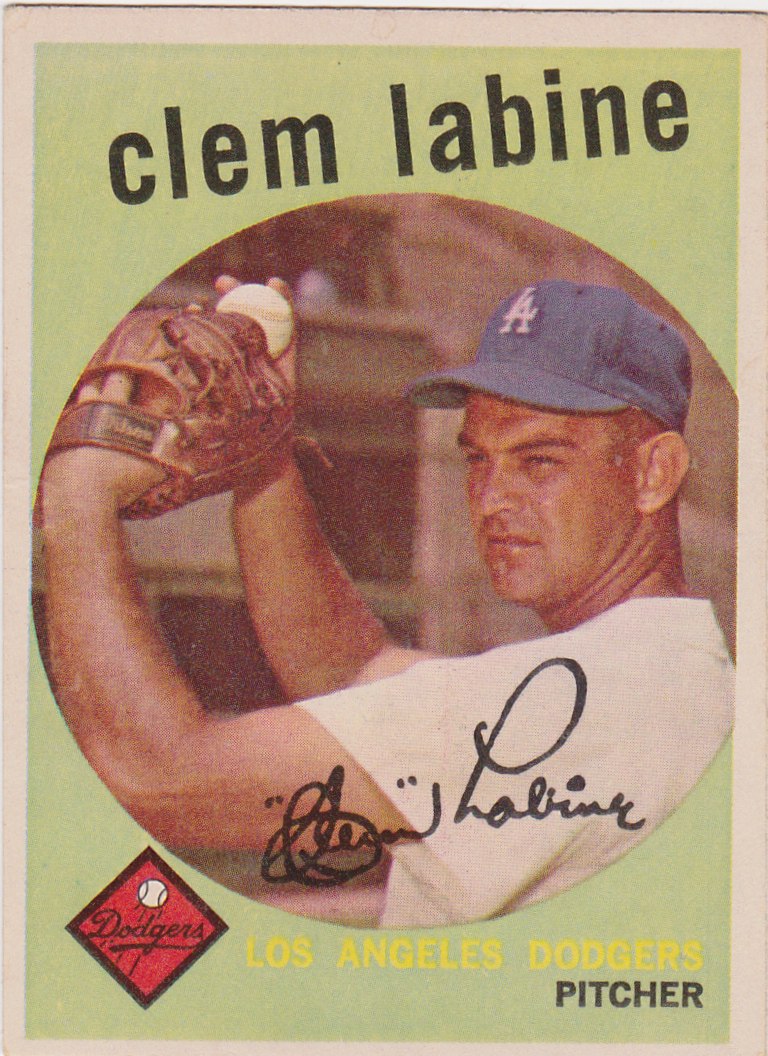
#403 Clem Labine


Gonna post this awesome Clem Labine without doing too much research. I've been in NYC for awhile and am currently knee deep in projects to catch up on.

So, here's Clem who is the child of Canadian immigrants and spoke only French until the age of seven. He was a good enough athlete as a kid to catch the eye of the Dodgers organisation and he signed in 1944 after dropping out of high school.

He spent a year in the service and worked up thru the Dodger's chain until he debuted in 1950. Unlike many relievers of the day he was not a converted (or failed) starter. He led the league in saves twice and games pitched once. He appeared in five World Series, four with the Dodgers and he won two rings with them. He also pitched for the Pirates in the monumental slugfest that was the 1960 Series against the Yanks and he won a ring that year, too. His postseason numbers took a real hit in that Series.

He was 77-56 with 97 saves in twelve major league seasons. 70 of those wins and 86 of his saves were with the Dodgers. He hit three homers in the bigs, all in 1955 and those were the only hits he had all season in 31 at bats. That's a strange stat.

His New York Times obit from 2007 is a good read and this excerpt is really all you need to know about Clement Walter Labine:

Through those summers of the 1950s, Labine was a confident figure, relieving pitching mainstays like Erskine, Don Newcombe, Preacher Roe and Johnny Podres.
“If you had a lead, there was this thing where about the seventh or eighth inning, where he’d get up, sort of a ritual, and walk down to the bullpen,” the former Dodgers pitcher Roger Craig told Bob Cairns in “Pen Men,” an oral history of relief pitching. “Clem was kind of a cocky, arrogant type, which was good. I liked it. He’d fold his glove up and put it in his pocket. I can see him now, strutting down to the bullpen and the fans cheering.”
The Dodgers website and the L.A. Times have more on Labine. Love the expression on his card and the seafoam green frame is sweet. Sorry Clem, you deserve a better post that this.

Wednesday, March 6, 2013

#107 Norm Larker


Norm Larker began as a pro in 1949 in his hometown of Hazleton, Pennsylvania and caught the eye of Brooklyn scouts who signed him for the 1950 season. Larker began a long trek through the loaded Dodger system as an outfielder before he finally emerged with the now-Los Angeles Dodgers in 1958.

In his rookie season he batted .277 in 99 games. The following year, 1959, he played mostly first base and picked up a World Series ring playing in all six games and hitting .188. In 1960 he moved to first base spelling Gil Hodges and had by far his best season. Hitting .323 he finished 2nd in the batting race and made the NL All Star squad.

His production and playing time declined in 1961 and he was drafted by the expansion Houston franchise for which he played one year. He was traded to the Braves and then to the Giants late in 1963. That was his last season in the majors although he played some minor league ball and also played in Japan through 1966.

Pretty standard card for this set. That's the LA Coliseum in the background.

The September 10, 1962 issue of Sports Illustrated featured a bit of by-play that included both Norm Larker and a player whose card was featured a week or so ago, Hal Woodeshick:

The Houston Colts put on quite a show for early arrivals in Cincinnati's Crosley Field recently. First, Pitcher Hal Woodeshick and Catcher Jim Campbell almost had a fight when Campbell tried to hurry his teammate out of the batting cage. Woodeshick refused to be hurried, saying, "I'm taking my cuts." "What for?" said Campbell. "You're never around long enough to bat." Woodeshick went for Campbell and the two had to be separated.
Then Infielder Bob Aspromonte, upset because First Baseman Norm Larker wouldn't let him use one of his bats, threw it the length of the dugout and broke the knob end. Then he pulled all of Larker's bats out of the rack onto the concrete floor. Larker didn't go for Aspromonte—just for Aspromonte's bats, pulling them out of the rack and flinging them to the floor, too. When none broke, he took one and started hitting it against the concrete steps.
"What in hell is going on here?" suddenly roared Manager Harry Craft, and an uneasy peace settled over the Houston Colts.

Thursday, December 27, 2012

#244 Dick Gray


Infielder Dick Gray signed with the Brooklyn Dodgers in 1950 and began a long climb to the big leagues with a military service detour during the Korean Conflict. He debuted in 1958 as a 27 year old rookie with the newly transferred Los Angeles Dodgers as their opening day third baseman. In the second game of the season he became the first Los Angeles Dodger to hit a homer (or collect an RBI for that matter... they'd been shutout on Opening Day). Two days later be became the first Dodger to hit a home run in the city of Los Angeles. The Giants' Hank Sauer had become the first major leaguer to homer there earlier in the game.

Gray ended up splitting that season between the Dodgers and the minors. He returned to the bigs for 1959 but was traded to the St. Louis in June so he missed out on the Dodgers' title run that year. He stayed with the Cardinals until may of 1960 when he was dealt to Pittsburgh but he never made it out of their chain and retired in 1962. Looking back a few posts it appears Gray followed the same Dodgers-->Cardinals-->Pirates trail blazed by Gino Cimoli in the 1958 thru 1960 seasons. But all the moves look to be separate transactions.

Gray had a career .239 average in 124 games with a dozen homers. He worked for the Buena Park, California school system after his baseball days.


Saturday, December 22, 2012

#418 Gino Cimoli


Gino Cimoli was a ballplayer of Italian decent out of the San Francisco Bay area. So was Joe DiMaggio. And although Cimoli had a nice career the comparison stops there. After signing with the Dodgers in 1949 he spent about half a decade in their chain putting up good numbers for the most part but unable to crack the star laden major league roster. Of course getting to play four seasons in Montreal, one of the world's greatest cities (IMHO) isn't a bad way to enjoy your minor league time.

According to at least one blog Cimoli, who had garnered a reputation for being a hothead who didn't work very hard, apparently received a jolt when his wife and kids were involved in a car wreck in 1955. He made the Dodgers in 1956 but was used sparingly before he grabbed a regular outfield slot in 1957.  That year he made the NL All Star team while hitting .293 with 10 dingers.

In 1958 he found himself with the Dodgers in LA and he became the first major league hitter to bat with a West Coast team. The Dodgers opened that first season in California against the Giants at Seals Stadium in San Francisco. Cimoli struck out against the Giants' Ruben Gomez to lead off the game.

He was traded to the Cards for 1959 (he missed the Dodgers' World Series season) and then on to the Pirates for 1960 where he won himself a championship while being used as the 4th outfielder. During the '61 season Cimoli was dealt to the Braves and he went on to play for the A's, Orioles and Angels before retiring after 1965. In 1962 he had led the AL in triples. After his retirement from baseball he drove for more than two decades for UPS.

Looks like Cimoli had a Cards' cap logo airbrushed on for this card. It's a pic taken at the LA Coliseum and the Dodger lettering on his jersey can be seen peeking out. Nice card anyway. Blue Cardinal cards are pretty sweet.


Tuesday, December 4, 2012

#321 Bob Giallombardo


Quick quiz: Name a player who was a hard throwing lefthanded pitcher out of Brooklyn's Lafayette High School who was signed by the Dodgers in the mid 1950s. If you said "Sandy Koufax" you'd be right. If you said "Bob Giallombardo" you'd also be right (and you'd be looked at strangely).

Giallombardo was indeed a schoolmate of Koufax at Lafayette. But the two were never on the same staff due to what the coaches considered Giallombardo 'not being ready'. The story, and a whole lot more about this interesting player, can be found in this examiner.com article.

In that article Giallombardo discusses the shoulder injury he incurred in winter ball following the '58 season that cost him a lot of his arm strength and essentially finished his chances as a major leaguer. His big league career consisted of five starts and a relief appearance in a months time in the middle of the '58 season. The highlight was his only big league win in the second game of a doubleheader in the L.A. Coliseum on July 13th against the Reds. Giallombardo pitched into the ninth and yielded to Clem Labine for the final two outs in a 3-2 win.

Giallombardo had an interesting life after baseball managing the Gil Hodges Bowling Lanes in Brooklyn, selling insurance, and as a supervisor of roofers for the New York Housing Authority for twenty years. He then retired to Waxhaw, a small village some 20 miles south of Charlotte, NC to be near his daughter and her family.

The yellow framed cards of Dodgers taken in the Coliseum combining the sharp home duds and Dodger logo to produce some sweet visuals. This one is no different. The 'optioned' notation on the reverse is a variation. It's more common than the #321s without it. I have both but the other one, the one without the 'optioned' line is in poor condition.


Tuesday, November 6, 2012

#278 Chuck Essegian


Six big league teams employed outfielder Chuck Essegian in six big league seasons. And in only one season, 1962 with the Indians, was he anything close to being a regular. But there is more to Essegian than that. He had a big moment in the sun during the 1959 World Series as a Dodger.

In that Series he pinch hit a pair of homers, the second of which came when he hit for Duke Snider. Essegian tells that story (and a lot more) in this L.A.Times article from 1995. He'd been with the Dodgers for only six weeks before that fateful Series. He had come over in a mid-season deal from the Cardinals and then was in the minors for a few months before being called up.

In a lot of the stuff I dug up on Essegian he seemed to have put baseball completely behind him once his career ended. But during his second career, as a lawyer in California, he seems to have mellowed. Again the L.A. Times relays a story about Essegian and a young fan with whom he reconnected many years later. Yet another L. A. Times article, this one from 2006, elaborates on Essegian's times with the Dodgers.

As a football player at Stanford before his baseball days Essegian played in the Rose Bowl and remains one of very few players to have appeared in that game and a World Series. Essegian's contemporary Jackie Jensen is another other as is Jackie Robinson.

As noted Essegian rarely had a full-time spot with any club but he certainly had a good year in 1962 when he knocked out 21 homers in just under 400 at bats. That was as close as he ever came to matching the power he flashed in his minor league career.

Nice portrait on Essegian on this card. The smile is in contrast to the reputation he had as a glum and dour personality. Obviously an airbrushed logo on his cap. Looks like Connie Mack Stadium behind him. He played in Philadelphia in 1958 and by blowing up the card I could barely make out pinstripes on Essegian's jersey.

Sunday, October 21, 2012

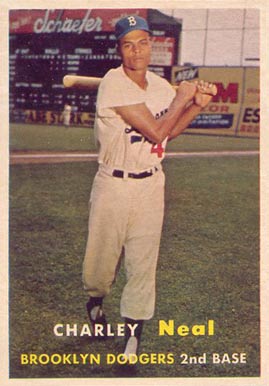
#427 Charlie Neal


The '59 Charlie Neal card was issued during his best season in the majors. Not only was he a member of the World Champion Dodgers, hitting .373 with two dingers, but he was an All Star, led the NL in triples, won a Gold Glove and scored 103 runs. Oh, yeah... his homer in Game Two of the '59 series was the shot that led to poor Al Smith getting a beer shower. We've looked at that before.

Neal's first pro baseball experience was as a member of the Negro Leagues. He signed with the Brooklyn Dodgers in 1950 and spent six seasons clawing his way up the talent-rich Dodger system. He debuted in 1956 as a second baseman hitting .287 in 62 games. He played with the Dodgers in the World Series that season.

In '57 he took over as the club's regular shortstop. He moved back to second when the team went west in 1958 and he made the All Star team that year. After that eventful 1959 season Neal's hitting and playing time diminished. A Sports Illustrated story that was published after his death mentioned that Neal was never the same after 1959. From that story:
But Neal never hit well again. Plagued by injuries and, perhaps, lethargy—"I quit on myself," he said after batting .235 in 1961—Neal was traded to New York in December 1961, where in his last hurrah he helped the Mets lose 120 games. 
As mentioned Neal was traded to the fledgling Mets and after '62 was passed on to the Reds where he finished his career after 1963.

As I read about Neal I didn't see his fielding prowess mentioned until I read that SI article.
Hall of Famer Billy Herman often said that one of his successors as second baseman for the Brooklyn Dodgers, Charlie Neal, made the double play better than any man who ever lived, and to be sure, Neal turned the pivot with a godsent grace.
That's pretty high praise.

Nothing special about this card, though. Looks like the LA Coliseum in the background. My copy has nice corners but is seriously off center. As far as Neal cards go I'd pick his '57 as my favorite. Love the Ebbets Field rightfield scoreboard and wall in the background.


Friday, October 5, 2012

#457 Los Angeles Dodgers


Yup, it's the World Champs! Or to be precise the 1959 World Champs as seen on their 1958 team photo. But let's not get technical, ok?

The '59 Dodgers went 88-68 under Walt Alston, finishing 2 games in front of the defending NL champion Braves and 4 ahead of the rival SF Giants. Alston was in his sixth year of managing the Brooklyn/Los Angeles club and '59 was his second world title and third pennant. He was less than one third the way into his 23 season reign as Dodger manager.

The club's .257 average was below the league average but they scored more runs than the league average and they led the NL in stolen bases even though Maury Wills was a rookie part-time player a year away from displaying his base stealing skills.

On the mound Don Drysdale led the club with 17 wins. Sandy Koufax was still a rather raw 23 year old honing his craft. He went 8-6. The Dodgers' team ERA ranked third in the NL behind both the Braves and Giants. They had the most strike outs as a staff, easily.

The Dodgers were in third place on September 15 when the launched a 7-2 run over the last 9 games to surge past the Giants and tie the Braves. The swept a best of three playoff with Milwaukee to earn the right to face the White Sox in the 1959 World Series. They won the Series in six games and reliever Larry Sherry was named Series MVP.

The '59 Series is among the first ones I have clear memories of paying attention to. I know I rooted for the White Sox. I was an A.L. guy and my father had no use for the Dodgers or Giants back then.

In general I'm not a fan of the team cards in the '59 set. I don't like the color circle being used in place of the natural background as is the case with the base cards. But there is something about this Dodgers team card that just works. Despite the fuzzy photo and it being so mis-cut this is a really cool card.

Saturday, August 18, 2012

#133 Bob Lillis The Sporting News Rookie Star


Bob Lillis might have been a "Rookie Star" in 1959 according to the Sporting News but he was no fresh faced kid. Lillis had been drafted by the Dodgers in 1951 and prior to that he'd been a multi-sport athlete at USC (where, if you are to believe the cartoon, the chicks really dug him). Lillis spent most of the decade in the Bums' minor league chain and serving in the military. That'll happen when you have Pee Wee Reese ahead of you in the organisation's food chain.

When he finally had a shot at starting in 1958 he got hurt and the job went to Maury Wills. Lillis was soon traded to St. Louis and then was drafted by the expansion Colt 45s. He was that club's MVP in their first season hitting .249. Lillis remained the team's infield anchor until the young duo of Joe Morgan and Sonny Jackson claimed the middle infield for Houston. Lillis retired as a player after the '67 campaign.

He went on to fill a number of front office roles for the Astros and served as a coach and finally manager in the mid 80s. He was runner-up in the Manager of the Year vote in 1983. He later coached on the San Francisco staff for more than a decade.

.


Wednesday, July 18, 2012

#495 Johnny Podres


Lefty Johnny Podres will forever own a spot in Dodger fans' hearts. Particularly those fans with an interest in the history of the franchise. In 1955 Podres had gone 9-10 in his third year as a Dodger starter. Podres won both the 3rd and 7th game of that '55 Series and was named Series MVP for pushing the Boys of Summer to their only title. 

Podres also pitched for four other Dodger World Series clubs, in '53 for the Brooklyn version and in '59, '63 and '65 (he didn't pitch in the 1965 Series) and was a combined 4-1 in postseason starts.

From his debut in 1953 through being dealt to the Tigers early in 1966 he won 136 games and lost 104 for the Dodgers with a 3.66 ERA. He added a dozen win for the Tigers and fledgling San Diego Padres before retiring after the 1969 season. 


Sidebar: Podres was born in upstate New York. I was there (and all over that state) recently and it's one of my favorite places. History plus natural beauty. Some day if I'm lucky I'll retire to a spot in the Adirondacks. 

Podres is also featured on one of my favorite cards ever, one I keep an eye peeled for online all the time. 1963 Topps #412 Dodgers' Big Three.


Read his NY Times obit for some nice Podres info. And check his website for additional pics.

Thursday, April 19, 2012

#306 Jim Gilliam


Jim 'Junior' Gilliam peers out of a pink framed '59 Topps in a picture taken during the Dodgers' first year on the West Coast. Gilliam was a Tennessee native who, after some semi-pro and Negro 'minor' league experience,  began his major pro career with the Baltimore Elite Giants in 1948. He played three seasons in Charm City, learning to switch hit, and making the All Star squad each time. Prior to the 1950 season Gilliam had been given a 'look' by the Cubs but he returned to the Elite Giants.

The young infielder was purchased by the Dodgers and played in Montreal for a couple of years putting up numbers that are very much like those he'd post with the Dodgers. He debuted with the Dodgers in Brooklyn in 1953 and promptly made his presence felt. 

Phil Gurnee of True Blue L.A. list some of Gilliam's highlights:
  •     Won NL Rookie of the Year and Sporting News Rookie of the Year 1953
  •     Led the league in triples and scored 125 runs that same year
  •     scored over 100 runs in each of his first 4 years
  •     batted .300 and made the All-Star team in 1956
  •     led the NL in putouts and fielding percentage in 1957
  •     led the NL in walks and again was an All-Star in that year

Gilliam was part of the Boys of Summer era and also the pitching strong Dodger clubs following their move to L.A. Gilliam went on to play on 7 National League champion teams and won four World Series rings. He played with the Dodgers until his retirement after the 1966 season. He had made two All Star teams and twice was among the top six in MVP voting. He coached for the Dodgers following his playing career using the experience he gained while serving as a player/coach in the final active years of his career. In all Junior Gilliam spent half his life in a Dodger uniform. 

I just can't do justice to Junior Gilliam in a hurried blog post. There are some 'must reads' for anyone with an interest in his career both here on the SABR site and here in an ESPN feature..

From that ESPN site I loved this excerpt from a column by the great Jim Murray:
 ... You might say Jim is with the Dodgers but not of them. The distinction is important. He starts every season in the dugout. He sleeps every night with his bag packed at his feet and rumors of a trade swirling around in his dreams. He lives his life in a kind of limbo midway between the Dodgers and the rest of the National League. 
Then the season starts and some "phenom" begins to leak at the seams, the stuffing oozing out of him at every trip to the plate. The manager sets a hysterical search amid the bat bags, locker room towels and press clippings of his wunderkind — and there sits Jim Gilliam, waiting. ... 
When the Dodgers came to L.A., they brought Jim along with all the enthusiasm of a man asking his mother-in-law on the honeymoon. They had a hot-shot third baseman named Dick Gray, and began to offer Gilliam around like a claiming horse until Gray began to leak like a sieve in the field and strike out on balls the catcher couldn't get his glove on. 
Gilliam became a third baseman and the Dodgers became World Champions ...
The full column is found here in the LA Times historical city blog.  Other notable facts on Junior Gilliam.... He's the only Dodger to have his number retired who is not a Hall of Famer. He hit two homers in the '53 World Series even though he wasn't known for power. His favorite baseball card color was pink. (OK, that's bullshit)

His son Darryl played briefly in the Dodger minor league system in the mid 80s. Here is an LA Times interview with Darryl.

Wednesday, July 27, 2011

#387 Don Drysdale


In 14 season with the Dodgers, stretching from 1956 in Brooklyn to his retirement following the 1969 season in L.A., Don Drysdale won 209 games. But he did much more than that. He established himself as a workhorse by leading the NL four times in starts and twice in innings pitched. He cashed in on his 'made for Hollywood' looks and made numerous TV and a few movie appearances. He led the NL in strikeouts three times, won a Cy Young (1962 when he had 25 wins), won three World Series titles and three World Series games and made eight All Star teams. In 1968 (his next to last season) he established the record for consecutive scoreless innings with 58 and 2/3 covering six games.

But what liked best about Drysdale was his reputation as a certified bad ass on the mound. If you dug in at the plate Drysdale was likely to knock you on your butt. He led the league in hitting batters five times and was second four more times. That's bad ass. Him and fellow bad ass Sandy Koufax famously held out together in 1966. It was a really big deal at the time.

Drysdale was also a pretty fair hitter and not just among pitchers. He had 29 homers in his career, twice hitting seven in a season. He frequently would bat eighth in the order for the Dodgers. After his retirement as a player he entered into a broadcasting career that included stints in ABC's national booth and with several teams including the Dodgers. He showed his versatility by working numerous non-baseball assignments including LA Rams broadcasts alongside Dick Enberg. 

Don Drysdale was elected to baseball's Hall of Fame in 1984. This is no Hall of Fame copy of his '59 card. Severely miscut and a touch worn overall. But don't mention it to Drysdale, he'll knock you on your ass.

Saturday, July 16, 2011

#262 Hitters' Foes


These three Dodger 'musketeers' must have known how the 1959 season would end for them, with a World Series title.

The trio entered the season deserving of an appearance on a special card like this. Don Drysdale was coming into his own with a 39-22 mark over his first two seasons as a full fledged member of the rotation. He's led the league in K's in '58.

Johnny Podres, while only 25-24 since returning from a 1956 Navy stint, was still basking in the glow of his '55 World Series heroics and had hurled six shutouts in 1957 to go with a 2.66 ERA.

And Clem Labine, at this point a wily vet, had compiled a 52-36 record in his previous five years with the Dodgers and racked up 73 saves in a time that saves ere not as common as they are now.


Friday, April 22, 2011

#206 Carl Furillo


It's not quite Ted Kluszewski as a Pirate or Roger Maris on the A's but Carl Furillo is one of the 'Boys of Summer' and just doesn't look right on an "L.A." Dodger card. He needs the distinctive Brooklyn Dodger "B" on that cap. And the view of the vast L.A. Coliseum bleachers just doesn't say "Carl Furillo" to me. Where's the 'GEM Razor' sign? So to me the severe 'off-centeredness' of this card isn't the only thing 'wrong' with it.

Furillo (aka "Skoonj") was known for his powerful arm, ability to play the quirky rightfield corner in Ebbetts Field and his consistent work with the bat. He won the 1953 batting title in the NL with an average of .344 and hit at least .290 in nearly every season he was a regular. Furillo finished with a career .299 average and nearly 200 homers as well. Like a lot of players of his generation Furillo lost several potential major league seasons serving in World War II.

He saved a lot of his best work for the seven World Series' in which he participated. His spectacular catch of a blast off the bat of Johnny Mize (who already had hit three homers in the Series) saved the Game 5 6-5 Dodger victory in the 1952 Series against the Yankees. He hit a pinch single drove in two runs in the Los Angeles Dodgers' 3-1 win over the White Sox in Game 3 of the '59 Series.

Furillo's career ended the following season when he was released by L.A. while injured and Furillo later sued over his release, winning a reported $21,000. Though the allegation was denied by baseball Furillo always maintained he was blackballed by the sport due to that lawsuit.

Carl Furillo went on to own a Queens, N.Y. deli and worked for Otis Elevator. He worked as a foreman on the installation of the elevators in the World Trade Center.


Wednesday, March 30, 2011

#125 Ron Fairly


That baby-faced Dodger smiling on the card above had a lot of baseball in his future. Ron Fairly broke in with LA in 1958 and spent 21 years as a solid major leaguer and 27 years as a broadcaster. That totals over 7000 games. Now that is a full life in the game!

He won 3 World Series rings in four chances with the Dodgers and really performed in the '65 Series against the Twins batting .379 with eleven hits including a pair of homers.

Most interestingly Fairly appeared to be winding down and easing into retirement in 1977 when, after five seasons as a platoon/bench player with four clubs, he grabbed a full time spot in the Blue Jays' outfield and made the A.L. All Star team.

My copy of this Sporting News Rookie Stars card has really nice corners but displays the off centered look that seems to become common in my collection.