Showing posts with label 1960 World Series. Show all posts

Thursday, March 13, 2014

#478 Roberto Clemente


This is the last card to be posted from my 1959 Topps set. And this Roberto Clemente is one of my favorites. It doesn't show him an any sort of action pose which might reflect his skills but maybe more fittingly it's a portrait that has him with a half-smile focused off-camera. It's in 'fair' condition at best but given what they go for I think I'll pass up a chance to upgrade it. Hard to say where the shot was taken. Many Pirate cards have pictures from Seals Stadium in San Francisco but I get a vague 'L.A. Memorial Coliseum vibe' with this one.

You may have noticed that the card shows Roberto Clemente's first name as 'Bob'. I've always referred to as 'Roberto' so I'll go against my 'use what the card uses' convention and call him 'Roberto' here. I know Bob Prince called him 'Bobby' but... Bob Prince, well.... the less said the better. I understand that early in his career he was frequently referred to as 'Bob' but I have read that he didn't like it.

Just about anything I can say about the career and life of Roberto Clemente has been said in many places already by far, far better writers than me. Here are just a few highlights and a few memories of him.

From Clemente's Baseball Reference Bullpen page:

Notable Achievements

  • 12-time NL All-Star (1960-1967 & 1969-1972)
  • NL MVP (1966)
  • 1971 World Series MVP
  • 12-time NL Gold Glove Winner (1961-1972)
  • 4-time NL Batting Average Leader (1961, 1964, 1965 & 1967)
  • 2-time NL Hits Leader (1964 & 1967)
  • NL Triples Leader (1969)
  • 20-Home Run Seasons: 3 (1961, 1966 & 1967)
  • 100 RBI Seasons: 2 (1966 & 1967)
  • 100 Runs Scored Seasons: 3 (1961, 1966 & 1967)
  • 200 Hits Seasons: 4 (1961, 1964, 1966 & 1967)
  • Won two World Series with the Pittsburgh Pirates (1960 & 1971)
  • Baseball Hall of Fame: Class of 1973
I'm not sure what else there is to say after reading that list. I won't try to sing Clemente's praises but rather I'll recall my three most powerful memories of him.

In the summer I moved to Houston I saw the Pirates in the Astrodome a few times. One night (and I can't find the exact game) Clemente grabbed a fly with a runner on second and threw the ball on an absolute rope to third to keep the runner from moving up. Sounds routine but to see that throw and hear the crowd buzz, well, you knew that Clemente was just special.

Next is a catch he made in 1969 at Shea Stadium. In a game that was to be the only no-hitter I've ever witnessed in person he went full speed across the right-field line as he grabbed a shot by the Met's Wayne Garrett in the 6th inning. I remember him hitting the railing along the stands after the catch.

And finally I remember how he just whipped the Orioles in the 1971 World Series. I was so happy when the O's came back to tie the Series up in Game Six in Baltimore. I figured my Birds had it won with ace Mike Cuellar starting on Sunday at home. But when Clemente homered to put the Bucs ahead I got a bad feeling that he was destined to have another World Series ring. And I was right.

Here is his Hall of Fame bio:
Roberto Clemente Walker's pride and humanitarianism won him universal admiration. Despite an unorthodox batting style, the Pirates great won four batting crowns and amassed 3,000 hits. He was equally brilliant in right field, where he displayed a precise and powerful arm. Clemente earned National League MVP honors in 1966, but achieved his greatest fame in the 1971 World Series, in which he batted .414. Tragically, Clemente's life ended at age 38 -- the victim of a plane crash while flying relief supplies to Nicaraguan earthquake victims.
Some other Clemente related links of interest:
Some Clemente pics from Corbis' Clemente page:


That's the last card, but not the last post on this blog. I'll have a wrap-up tomorrow and maybe a few things brewing down the road. As always, thanks for reading!

Thursday, March 6, 2014

#536 Dan Kravitz


Born to Russian immigrant parents, Danny Kravitz was signed out of Lopez, Pennsylvania by the Pirates in 1949. He hit well, especially for a catcher of that era and climbed up through the Bucs' system with a two year detour to play ball while serving Uncle Sam in the U.S. Marines.

He made the Pirates' roster as back-up receiver in 1956 and debuted in the second game of the season against the Giants in New York. He went hit-less but doubled and drove in a run the next day. He was sent back to the minors that June but again made the team in 1957 only to find himself back in the minors for most of the year.

Kravitz was with the Pirates for all of the next two seasons as a reserve and began the 1960 season with them as well but he was traded to the Athletics on the first of June and he played more in half a season in KC than he had in any previous year with Pittsburgh. But while by being traded he saw the most action of his career he also missed out on that fall's World Championship run by the Pirates.

That 1960 season was to be his last in the majors as he was traded to the Reds that winter and then moved on to the Orioles' and Yankees' systems but he never again played in a big league uniform. He retired after the 1963 season. His obituary states that he moved 32 times during his baseball career. That's a lot of box packing. Kravitz worked for GTE-Sylvania until his retirement in 1995.

Kravitz passed away in 2013. He was preceded in death by seven brothers. All eight of the Kravitz boys had served in the U.S. military. Good for them!!

There are now only five 
more cards to go before we put it to bed.

Sunday, March 2, 2014

#525 Jim Coates


The back of Jim Coates' '59 card states he was a 'high school sensation' in Farnham, Virginia. That may very well be true but it doesn't tell the same story that Coates himself does in his memoirs, "Always a Yankee: A Pitcher's Story". Fact is that Coates dropped out of high school at 16 to work cutting trees and pitch in a semi-pro league against older and more experienced competition.

His skills earned him a Yankee try-out and later a contract offer. So in 1951 the tall, thin righthander found himself beginning to pitch his way up the Yankee chain. He spent five seasons in the minors and finally got a two game peek in 1956 before returning to the minors for '57 and suffering a broken arm which cost him most of the 1958 season.

Coates made the Yankee staff in '59 and won six games while showing his versatility by filling roles as short man, long reliever and starter. He hit his stride in 1960 and won 13 games against three losses in 35 games, 18 of them starts. He was named to his only AL All Star squad and pitched a couple of innings in that year's first of two ASGs. Along the way he picked up his nickname of 'Mummy' for his mound appearance which has been described as 'funereal'. 

He gained some unwanted notoriety during the 1960 World Series against the Pirates. In the deciding seventh game of that wacky Series he failed to hold a lead in the eighth inning. He had relieved Bobby Shantz following the "pebble grounder" that hit Tony Kubek in the throat. Coates, entering with two runners on and none out got two outs and forced Roberto Clemente to top a roller towards the right side of the infield but Clemente beat the play at first. Coates has been blamed, probably unfairly as has been shown, for failing to cover the bag on a play that would have ended the inning with the Yanks still ahead. Hal Smith then followed with a home run that put the Pirates up two and chased Coates.

The Yanks managed to tie the game up in the ninth but Bill Mazeroski's homer sent the city of Pittsburgh into delirium. Coates survived and pitched as well or better in 1961 and he picked up World Series rings with New York that year and the next. This blog page has an interesting account of that 1960 Series' 7th Game including a couple of video clips.

In the spring of 1963 the Yanks traded Coates to Washington. After a season there he went to the Reds and then the Angels.  He never matched his Yankee success but pitched through 1970 in the Angels' system before retiring to work as an electrician.

He was referred to quite a bit in Jim Bouton's book Ball Four. Bouton said "Coates could pose as the illustration for an undertaker's sign. He has the personality to match..." Coates' grandson, Aaron Pribanic, was a minor league prospect for the Mariners and Pirates who pitched for the University of Nebraska-Lincoln. 

Sunday, February 2, 2014

#446 Rocky Nelson


Glenn 'Rocky' Nelson had such a varied and interesting career I hardly know where to start, so let's try the beginning. Nelson signed with the St. Louis Cardinals as a 17 year-old first baseman in 1942. After a year in the minors Uncle Sam called and he spent three years in the Army during WWII. My usual sources don't provide many details but it's a good bet he was overseas during that time.

Upon re-entering baseball Nelson had three seasons in the well stocked Cardinals chain hitting over .300 in each of them. He made his big league debut with the Cards in 1949 but, in what became the story of his career, he just didn't approach his minor league numbers. He split the next season between the majors and minors (hitting over .400 at AAA in almost 50 games!) and in 1951 was traded to the Pirates for his first stint with the Buccos.

He finished the 1951 season with the White Sox after being waived and then was traded to the Dodgers after the season. That deal meant that Nelson had been the property of four different franchises within 9 months! The Dodgers won the NL pennant in 1952 and Nelson, having been recalled from the minors in August, got into the '52 Series with a handful of pinch hit opportunities.

He spent '53 and most of '54 with the Montreal Royals, the Dodgers' AA club and had a monstrous run. Particularly impressive was Nelson's 1953 season when he hit .308 with 36 homers and 131 RBIs and won the International League MVP award. The Dodgers, with Gil Hodges holding down first base, had no room at the top for the minor league slugger. They had traded him to the Indians after that remarkable '53 year but bought him back in May and watched him tear up the IL again.

Back with the Royals in 1955 Nelson won his second of three IL MVPs with impressive ease and was threatening to repeat in '56 when the Dodgers recalled him in June. He struggled for two months in Brooklyn and was traded to the Cardinals for his second run in St. Louis.

He played for Toronto, the Cards' AA club for two years and again excelled. He won the 1958 IL MVP and for that he was rewarded by being drafted away by the Pirates. Finally, at 34 years old, Nelson managed to get himself a steady big league gig. He played as a platoon first baseman for Pittsburgh for three seasons, putting together productive years in '59 and 1960. He played a part in the '60 Series against the Yanks. I'll let his Baseball Reference Bullpen page recount that:
Nelson started Game 2 of the 1960 World Series and had 2 singles against the New York Yankees' Bob Turley. But Stuart, who led the Pirates in home runs that year, started games 1, 3, 4, 5 and 6. With the series tied at 3 wins apiece and Stuart struggling with just 3 singles in 20 at-bats and no RBIs, manager Danny Murtaugh started Nelson at first base in Game 7, as the Yankees again started Turley. Nelson responded with a two-run home run in the 1st inning to stake the Pirates to an early lead. But he was also involved in a strange play that allowed the Yankees to tie the game 9-9 in the top of the 9th inning of that game. With the Pirates leading 9-8, Yogi Berra at bat, Gil McDougald on third base and Mickey Mantle on first, Berra hit a hard shot at Nelson. Nelson fielded the ball inches from first base and stepped on the bag for the second out as McDougald raced for the plate with the tying run. Mantle, with a short lead off first base, hesitated when the ball was hit, possibly unsure if Nelson caught it in the air. But although the ball had not been caught in the air, Mantle was not forced to advance to second base because Nelson had already eliminated the force when he stepped on the first base bag. Nelson turned to throw to second base, expecting Mantle to be advancing. But Mantle dove back toward first base. Nelson then dove at Mantle and missed. With both players sprawled on the ground and Mantle safely back at first base, McDougald scored the tying run to make the score 9-9. However, that changed quickly when Bill Mazeroski led off the bottom of the 9th inning with a home run against Ralph Terry to win the game, 10-9, and give the Pirates the championship. Stuart, who was on deck to pinch-hit for winning pitcher Harvey Haddix, did not appear in the game. At age 35, Nelson had his finest season in the majors and finished it by homering as the cleanup hitter in a championship game. Nelson hit .333 (3 for 9) in the World Series.
His bat finally failed him in 1961 and in '62 he kicked around the minors with three clubs before he retired. He finished his big league career with 31 homers but in the minors he hit 234 and in 1960 he was named to the International League Hall of Fame. Given that his huge seasons came with Montreal and Toronto it's little wonder he is also a member of the Canadian Baseball Hall of Fame. Along the way he played on four pennant winning teams, the '52 and '56 Dodgers, the '54 Indians and of course the 1960 Pirates.

Lots of interesting Nelson internet resources. The Hardball Times has a detailed and entertaining Rocky Nelson career retrospective. The official MiLB site has a page with emphasis on his minor league exploits.

The card has one of those 'painted over' portraits that makes it difficult (ok, impossible) to determine where it was taken and what uni Nelson is actually wearing.


Thursday, November 7, 2013

#110 George Witt


George 'Red' Witt took seven minor league seasons and a year in the service after signing with the Dodgers in 1950 to make it to the big leagues. When he got there on September 21 of 1957 with the Pirates he was treated pretty harshly. That day he got a start against the New York Giants at Forbes Field and he didn't make it past the second inning. He was shelled for six earned runs in an inning and a third.

But in the spring of 1958 he was ready and that season he went 9-2 with a sterling 1.82 ERA and he had three shutouts among his five complete games in 15 starts. He had two wins over the Champion Milwaukee Braves one was a two hitter and the other a ten inning shutout. His 1959 season sadly saw a reversal in his fortunes as he went 0-7 due in large part to elbow issues. In fact Witt won only two more games over the course of the next three partial seasons he spent in the majors in Pittsburgh as well as stops with the Angels and Colt 45s.

But Witt did win a ring with the 1960 Pirates. In fact he was the only one of the ten pitchers used by the Bucs who did not give up an earned run in the World Series. He was out of baseball after a 1963 season spent in the minors and he went on to earn a Masters of Education at Cal State-Long Beach and had a long teaching and coaching career at Tustin High School in California. After he retired from that noble profession he pursued an amateur singing career with various Christian groups.

George Witt died earlier this year at the age of 81. Certainly for him a life well led.

Here is a tribute to him played at his services I found on YouTube:


Thursday, July 25, 2013

#415 Bill Mazeroski


Hall of Famer and Ohio native Bill Mazeroski was about 21 when this picture was taken. He looks about 16. He was a few years away from his great moment in the sun....the famous World Series winning homer off Ralph Terry to win the 1960 World Series for the Pirates.

Maz is a Hall of Famer having been elected 12 years ago by the Veterans' Committee. There was talk at the time that he wasn't deserving due to his batting numbers. But for me there needs to be some recognition of the part that defense plays in the game. And besides, if Pop Haines can be in the Hall, Maz should be there as well. Hell, if Pop Haines can be in the Hall so should Mike Cuellar, Dennis Martinez, Virgil Trucks and about 150 other pitchers I can name off the top of my head. But I digress.

Maz was signed by the Pirates in 1954 and debuted with the Bucs in 1956. A year later he took over a 2nd base job that he held for 12 seasons. He was a seven time All Star and won seven Gold Gloves. While never know for his stick it's not like he was an automatic out. He had a .260 career average which is pretty respectable given the era he played in. And he hit 138 homers, six times totalling in double digits. His postseason batting average of .323 is something to be proud of as well. This is Maz' second appearance here, his All Star card in this set was posted almost a year ago.

Maz has two World Series rings. Although he was close to the end of his career and was no longer an everyday player he did help the '71 Bucs to a title.

Interesting article posted here that compares the careers of Maz and another fine fielding second baseman, the Royals' Frank White. The author makes the case that Maz and White had similar careers but Maz made the Hall based on his WS homer.

Sports Illustrated looked back at the 1960 World series with a 40 year anniversary story in 2000. I have not read it all but it looks interesting.

Hard to imagine anyone not having seen this before but here is the late, great Chuck Thompson's call of the Maz homer.


Here is a 10 minute newsreel report of the final game of the Series.


Tuesday, July 23, 2013

#569 Bob Friend The Sporting News All Star


Poor miscut, badly scanned Bob Friend. Seems his '59 All Star card can't catch a break. This is his third and final appearance in this set. He had his regular card featured here in 2011 and then he showed up on a special multi-player card, Buc Hill Aces, with Ron Kline, Vern Law and Roy Face last year.

Friend made the NL All Star team in 1956, '58 and '60. He started in 1956 and 1960 (first of two games) and got the win both times. He didn't allow a run in either of those games going three inning both times. In 1958 he came out of the bullpen and went 2 1/3, allowed four hits and two walks taking the loss.

I hadn't realized that he started the fateful ninth inning in Game 7 of the 1960 Series. He came in with a shot to close it out but quickly allowed two hits before he was replaced by Harvey Haddix. Haddix allowed those runners to score and the Yanks to tie the game at 9-9. We all know what happened in the bottom of that inning. The card of the central figure in that dramatic game is queued to post in a few days.

As is the case with most of the Pirates photographed around this time, Friend is shown wearing a batting helmet. The batting helmet was designed by Charlie Muse, an executive of Branch Rickey's company and Rickey, at the time the Pirates' president, decided that all his players would wear one both at bat and in the field.

Wednesday, June 19, 2013

#64 Joe DeMaestri


Welcome to "Joe Week" here at '59 Topps.

A California kid, Joe DeMaestri signed with the Boston Red Sox in 1946. He spent several years in their system, was drafted away by the White Sox and debuted with them in 1951. He was traded to the Browns for 1952 and then back to the White Sox who, in that same off-season, shipped him to the Philadelphia A's in time for the 1953 season.

It was in Philadelphia that DeMaestri earned a starting shortstop job and he held it for seven seasons. If you look at his numbers over his tenure with the A's you see a pretty consistent if not very spectacular run. He always seemed to hit around .245, knock out 6 to 8 homers and drive in 30 to 40 runs.

His hitting numbers were not what kept him in the lineup though. DeMaestri was among the top fielding shortstops of the 50s, usually finishing at or near the top of several defensive categories. He made the AL All Star team in 1957 but didn't play in the game.

In December of 1959 he was dealt to the Yankees (let's all act surprised) along with Roger Maris and Kent Hadley for Hank Bauer, Don Larsen, Norm Siebern and Marv Throneberry. As part of the Yanks in 1960 and '61 he played on a couple of pennant winners. He played in the 1960 Series but not in the '61 Series. He may not have been included on the Series roster for the Yanks that year. No way to know if he received a ring but he likely got a share of the winner's money as he had been with the Yanks all season.

If you scroll down to the bottom of this Sports Illustrated article from the Baseball Preview issue of 1961 you'll find a story about the 'pebble grounder' that hit Yankee shortstop Tony Kubek in the throat in Game Seven of the 1960 Series. Apparently DeMaestri was going to enter the game as part of a defensive switch for Kubek prior to the inning. Casey Stengel had a change of heart and DeMaestri remained on the bench and saw Bill Virdon's grounder to short play a key role in the Series outcome.

DeMaestri owned a beer distributorship for many years after he retired following the 1961 season.


Thursday, March 21, 2013

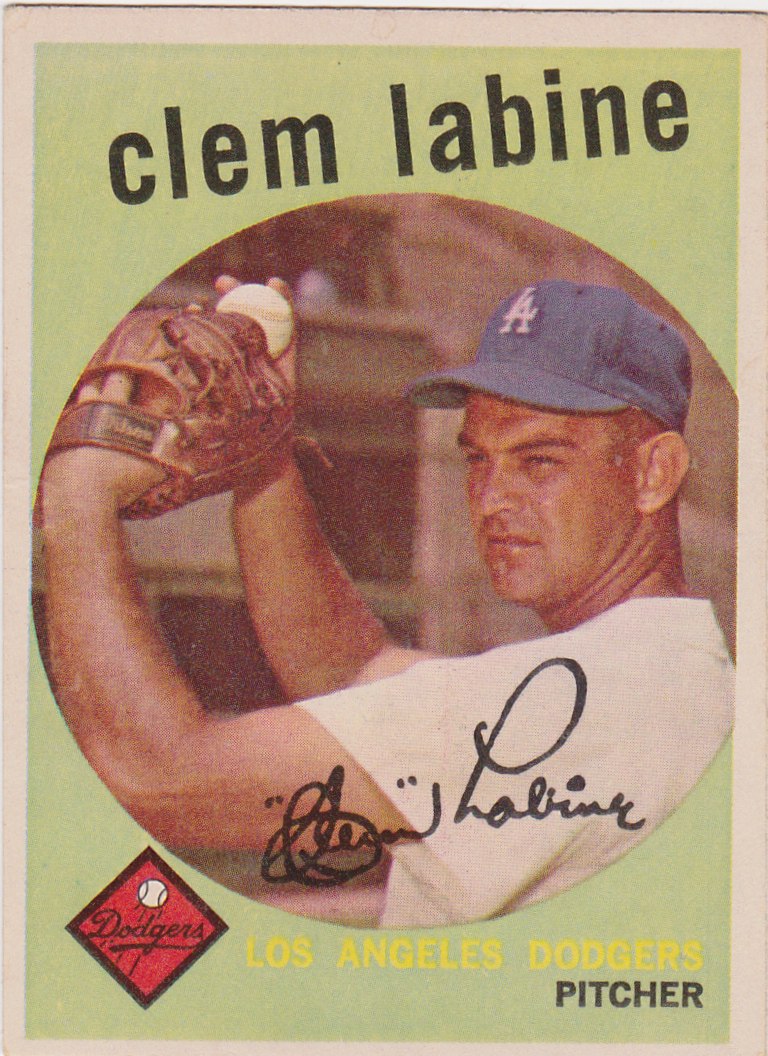
#403 Clem Labine


Gonna post this awesome Clem Labine without doing too much research. I've been in NYC for awhile and am currently knee deep in projects to catch up on.

So, here's Clem who is the child of Canadian immigrants and spoke only French until the age of seven. He was a good enough athlete as a kid to catch the eye of the Dodgers organisation and he signed in 1944 after dropping out of high school.

He spent a year in the service and worked up thru the Dodger's chain until he debuted in 1950. Unlike many relievers of the day he was not a converted (or failed) starter. He led the league in saves twice and games pitched once. He appeared in five World Series, four with the Dodgers and he won two rings with them. He also pitched for the Pirates in the monumental slugfest that was the 1960 Series against the Yanks and he won a ring that year, too. His postseason numbers took a real hit in that Series.

He was 77-56 with 97 saves in twelve major league seasons. 70 of those wins and 86 of his saves were with the Dodgers. He hit three homers in the bigs, all in 1955 and those were the only hits he had all season in 31 at bats. That's a strange stat.

His New York Times obit from 2007 is a good read and this excerpt is really all you need to know about Clement Walter Labine:

Through those summers of the 1950s, Labine was a confident figure, relieving pitching mainstays like Erskine, Don Newcombe, Preacher Roe and Johnny Podres.
“If you had a lead, there was this thing where about the seventh or eighth inning, where he’d get up, sort of a ritual, and walk down to the bullpen,” the former Dodgers pitcher Roger Craig told Bob Cairns in “Pen Men,” an oral history of relief pitching. “Clem was kind of a cocky, arrogant type, which was good. I liked it. He’d fold his glove up and put it in his pocket. I can see him now, strutting down to the bullpen and the fans cheering.”
The Dodgers website and the L.A. Times have more on Labine. Love the expression on his card and the seafoam green frame is sweet. Sorry Clem, you deserve a better post that this.

Saturday, March 16, 2013

#115 Mickey Vernon


Slick fielding first-baseman Mickey Vernon, like the recently featured Gene Woodling, was a very good player for a very long time. In a career that stretched from his debut with the Washington Senators in 1939 through his final games, as an activated coach for the Pirates during the 1960 pennant chase, Vernon won two batting titles, three times led the AL in doubles, made seven All Star squads and finished in the top five in MVP voting three times.

Signed out of Villanova University in 1937 Vernon put together some impressive minor league numbers before his 1939 debut in which he totaled more than 300 plate appearances and hit .257. He spent most of the next season in the minors but when he returned to the Nats in 1941 he was ready, hitting .299 and driving in 93 runs. He continued to put up some exceptional numbers in Washington through 1955 with a side trip to the Pacific for two years during WWII and a year plus stint with the Indians along the way.

Vernon had his arguably best season in 1946 when he was fresh out of the service. He hit .353 while collecting 51 doubles among his 207 hits. His 43 double, 15 homer, 115 RBI, .337 season in 1953 wasn't too bad either.

Traded to Boston for the 1956 season Vernon played for the Sox for two years before being obtained for a second time by the Indians for 1958. He was a member of the Milwaukee Braves by the time this card was issued in '59 (a year too late for the Braves' Series against the Yanks). He retired after that and was coaching with the Pirates when he was activated and 'unretired' in September of 1960 in time to pinch hit nine times for the Bucs. His Championship ring from that season represents the only postseason experience he enjoyed in his long and otherwise successful career,

He managed the 'new' Washington Senators during the first two+ years of the expansion club's existence ('61-'63) and then spent many years coaching at the big league level, managing in the minors and serving as a hitting instructor in several teams systems. He passed away in 2004. He is commemorated with a Little League named in his honor in his native Pennsylvania. He also is the focus of the Mickey Vernon Sports Museum.

His SABR bio is a fun read but Chrome issued a malware(!) alert when I went to it so I'll back away for a day or so.

That of course is Yankee Stadium behind Vernon on his orange framed card. From all accounts his smile was as much a part of his career as his bat. The cartoon-less, 'wall of text' cardback says "This guy was doing something right!" That all makes this a pretty nice card, don't you think?

Friday, February 8, 2013

#432 Smoky Burgess


Good Ol' Smoky Burgess. As kids we thought it was cool because he looked like everyone's quiet Uncle Phil yet was playing baseball. He always reminded me of the school crossing guard who was planted at the corner of Centre St. and St. Mary's Place in Nutley, New Jersey where I was a kid.

Burgess had a reputation as a great pinch hitter, it was a well deserved reputation but it came later in his career. After signing with the Cubs in 1944 he put together a playing career which lasted through the 1967 season.

In his prime Burgess was a solid semi-regular catcher with the Phils, Reds and Pirates. His best season was probably 1955 when he hit 21 homers to go along with 78 RBIs and a .301 average. He had been traded from the Phils to the Reds three weeks into the season and then made his second of six All Star clubs.

He won a World Series title with the 1960 Pirates going 6 or 20 against the Yanks. He was dealt to the White Sox in 1964 and led the American League in pinch hits in 1965 and 1966. In 1966, he set a dubious record: most at-bats in a season (67) without scoring a run and also had the most hits in a season (21) and most RBI (15) without scoring

He retired following the 1967 campaign with a .295 career average and the record for lifetime pinch hits (195). That record has since been surpassed. After his playing days he had a car dealership in his native North Carolina and spent many years managing and coaching at various levels of the Braves organization

Smoky got the 'airbrush' treatment on his '59 card. He was likely wearing Reds' gear when the picture was snapped in Los Angeles. Over his shoulder we see a figure that appears to be either: an usher, another air-brushed Reds player, or the ghost of Shoeless Joe Jackson. 


Saturday, December 22, 2012

#418 Gino Cimoli


Gino Cimoli was a ballplayer of Italian decent out of the San Francisco Bay area. So was Joe DiMaggio. And although Cimoli had a nice career the comparison stops there. After signing with the Dodgers in 1949 he spent about half a decade in their chain putting up good numbers for the most part but unable to crack the star laden major league roster. Of course getting to play four seasons in Montreal, one of the world's greatest cities (IMHO) isn't a bad way to enjoy your minor league time.

According to at least one blog Cimoli, who had garnered a reputation for being a hothead who didn't work very hard, apparently received a jolt when his wife and kids were involved in a car wreck in 1955. He made the Dodgers in 1956 but was used sparingly before he grabbed a regular outfield slot in 1957.  That year he made the NL All Star team while hitting .293 with 10 dingers.

In 1958 he found himself with the Dodgers in LA and he became the first major league hitter to bat with a West Coast team. The Dodgers opened that first season in California against the Giants at Seals Stadium in San Francisco. Cimoli struck out against the Giants' Ruben Gomez to lead off the game.

He was traded to the Cards for 1959 (he missed the Dodgers' World Series season) and then on to the Pirates for 1960 where he won himself a championship while being used as the 4th outfielder. During the '61 season Cimoli was dealt to the Braves and he went on to play for the A's, Orioles and Angels before retiring after 1965. In 1962 he had led the AL in triples. After his retirement from baseball he drove for more than two decades for UPS.

Looks like Cimoli had a Cards' cap logo airbrushed on for this card. It's a pic taken at the LA Coliseum and the Dodger lettering on his jersey can be seen peeking out. Nice card anyway. Blue Cardinal cards are pretty sweet.


Tuesday, September 25, 2012

#117 John Blanchard The Sporting News Rookie Stars


The Yankees signed 3-sport schoolboy star Johnny Blanchard out of Minneapolis in 1951 and he proceeded to take a rather long road to the majors. He moved up through the Yankee chain, took a couple of years off to serve in Korea, got a one game trial in 1955 and finally landed with the Bronx for good in 1959.

He had been a third baseman (and basketball star, good enough to get a pro offer) in high school but the Yanks converted him into a catcher and he spent his career alternating between that and playing the outfield with some first base work thrown in.

Blanchard was never an every day player but he did play an important role for New York as a platoon option and a strong bat off the bench. He appeared in five World Series with the Yanks and won a couple of rings. He batted .345 in his Series at bats and belted two homers in the 1961 Series. That year was also his best in the majors as he hit .305 with 21 homers in only 243 at bats,

He was behind the plate when Bill Mazeroski homered to end the 1960 Series and talks about his role and that fateful game in this SABR article. In Blanchard's final season, 1965, he played for the Yanks, Athletics and Braves.

Blanchard somehow makes this rookie card look less wonky than most in this subset. I always think of him as 'Big' Johnny Blanchard because that's how I recall the Yankee broadcasters referring to him. But he wasn't a particularly big guy.