Saturday, September 29, 2012

#353 Robin Roberts


From 1950 through 1955 Robin Roberts was a truly dominant force in the National League. He won 138 games over that six year stretch, made the All Star game each season and finished in the top 7 of MVP balloting five times.

Not that he was slouch for the rest of his 19 year Hall of Fame career but on the mound during the first half of the decade he was damned impressive.

From his Baseball Reference Bullpen page:

  • 7-time NL All-Star (1950-1956)
  • 4-time NL Wins Leader (1952-1955)
  • 5-time NL Innings Pitched Leader (1951-1955)
  • 2-time NL Strikeouts Leader (1953 & 1954)
  • 5-time NL Complete Games Leader (1952-1956)
  • NL Shutouts Leader (1950)
  • 15 Wins Seasons: 10 (1949-1956, 1958 & 1959)
  • 20 Wins Seasons: 6 (1950-1955)
  • 25 Wins Seasons: 1 (1952)
  • 200 Innings Pitched Seasons: 14 (1949-1960, 1963 & 1964)
  • 300 Innings Pitched Seasons: 6 (1950-1955)
  • Baseball Hall of Fame: Class of 1976

After signing with the Phillies in 1948 Roberts pitched a very strong half season in Class B Wilmington before a call-up in June of that year. He had decent results but he didn't quite show any sign of what was to come. A 15-15 year in 1949 led to a 20 win season in 1950 as the 'Whiz Kids' made it to the World Series where they fell in four to the Yankees. Roberts pitched a 10 inning Game Two and lost a 2-1 decision to a Joe DiMaggio homer.

Roberts never made it back to the postseason but he did make it to Cooperstown after nearly two decades in baseball. After 14 years with the Phils Roberts had stints in Baltimore (four years), Houston and Chicago with the Cubs. He finished with 286 wins while pitching for some pretty sad teams.

After his final major league game in 1966 Roberts pitched for the Reading Phillies in 1967. He later coached for nearly a decade at the University of South Florida.

Little known Robin Roberts facts: He was sold to the Yankees for 1962 and was on their roster but didn't appear in a game before being released and signed by the Orioles in late May. He's the only pitcher to have beaten the Braves in Boston, Milwaukee and Atlanta. He had a traveling basketball troupe during the baseball off-seasons and frequently faced the Globetrotters. His hometown of Springfield, Illinois has a stadium named for him.

Roberts poses here in a shot taken at Connie Mack Stadium. Nice break from the Yankee Stadium shots that dominate this set. 

Thursday, September 27, 2012

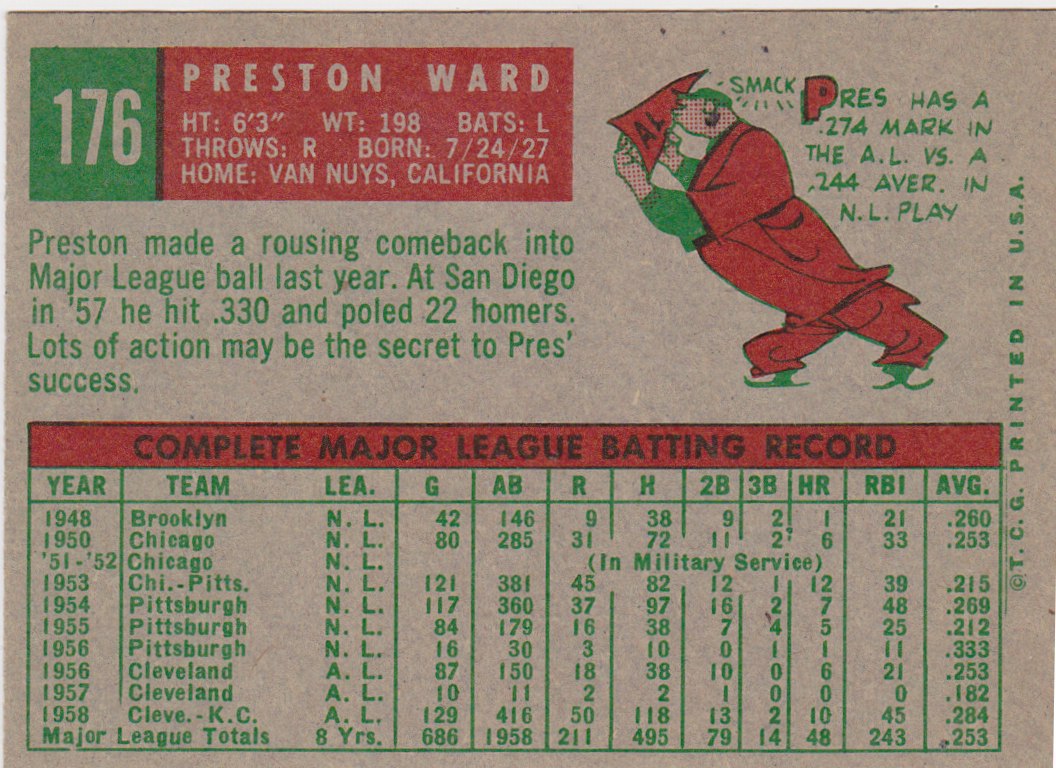
#176 Preston Ward


Handy but light hitting Preston Ward was signed by the Brooklyn Dodgers in 1944 and climbed through their loaded minor league system before getting a shot with them in 1948. He hit a respectable .260 in 62 games but was back in the minors the following year and then sold to the Cubs.

He was a semi-regular with Chicago in 1950 but his baseball career was put on hold with a military stint in '51/'52. When he returned the Cubs dealt him to the Pirates and, after a few years as a platoon 1B/outfielder he moved on to the Indians in '56 and Athletics in 1958. His numbers in 1958 reflect his best season as he hit .281 with 10 homers in 400+ at bats splitting tine between the Indians and A's. 1959 was his last shot in the majors.

Ward was another of the many ballplayers in the '59 set that left a basketball career in the dust to sign a major league contract. Ward was a captain and All-Conference selection at Missouri State in the late 40s.

Tuesday, September 25, 2012

#117 John Blanchard The Sporting News Rookie Stars


The Yankees signed 3-sport schoolboy star Johnny Blanchard out of Minneapolis in 1951 and he proceeded to take a rather long road to the majors. He moved up through the Yankee chain, took a couple of years off to serve in Korea, got a one game trial in 1955 and finally landed with the Bronx for good in 1959.

He had been a third baseman (and basketball star, good enough to get a pro offer) in high school but the Yanks converted him into a catcher and he spent his career alternating between that and playing the outfield with some first base work thrown in.

Blanchard was never an every day player but he did play an important role for New York as a platoon option and a strong bat off the bench. He appeared in five World Series with the Yanks and won a couple of rings. He batted .345 in his Series at bats and belted two homers in the 1961 Series. That year was also his best in the majors as he hit .305 with 21 homers in only 243 at bats,

He was behind the plate when Bill Mazeroski homered to end the 1960 Series and talks about his role and that fateful game in this SABR article. In Blanchard's final season, 1965, he played for the Yanks, Athletics and Braves.

Blanchard somehow makes this rookie card look less wonky than most in this subset. I always think of him as 'Big' Johnny Blanchard because that's how I recall the Yankee broadcasters referring to him. But he wasn't a particularly big guy.

Sunday, September 23, 2012

#250 Billy O'Dell


Been awhile since I've posted an Oriole. Billy O'Dell is one of those guys I always associate with the O's but actually had a bigger impact with another team or teams. He was a 1954 bonus signee of the Orioles and never pitched in the minors.

A couple of brief turns with the Orioles bracketed a military service stretch and in 1957 he gained a semi-regular job on the Oriole staff pitching in 35 games. He was a front liner with the club the next two seasons and made the All Star Game both years. But manager Paul Richards had O'Dell shuffling between a starting slot and the bullpen and O'Dell wanted a job doing one or the other, not both.

He was dealt to the Giants after the 1959 season and pitched for five seasons on the West Coast, mostly successfully. He won 19 games for the pennant winning Giants in 1962. That year he got his only post-season work with a start and two relief appearances in the World Series. He started and lost Game One of the Series, picked up a save in Game Four and nearly was the winner in the final game as he closed out the game and watched Willie McCovey's line drive rocket into Bobby Richardson's glove. Maybe a foot either way and Willie Mays scores on a single and O'Dell has a win and a ring. O'Dell discusses the Series, that 7th game and much more in an interview on the Baseball Savvy blog.

After a couple more seasons of slowly declining numbers with the Giants he was traded to the Braves and then finished with the Pirates before retiring after the 1967 season.

This card is (all together now) seriously mis-cut but to me it is a classic '59 Topps with the wind-up pose and the unmistakable Yankee Stadium facade in the background.

Friday, September 21, 2012

#57 Al Cicotte


Al Cicotte (he pronounced it 'SEA-kott' was the great-nephew of Eddie Cicotte (he pronounced it cy-KOTTY) of Chicago Black Sox fame (shame?). Was Al trying to distance himself from his great-uncle? If so he wasn't shy about speaking about their relationship in the March 1953 interview that ran in the Sporting News. Al Cicotte was a Yankee farmhand at the time, fresh off four years of combining minor league baseball and a couple of service stints.

Cicotte continued to bang around the Yankee chain before finally getting a shot in 1957 when he went 2-2 in 20 games for the Bombers. He was sold to the Senators and pitched for them and the Tigers in 1958. Dealt to the Indians Cicotte spent the 1959 season in Cleveland, 1960 in the Indians' minor league chain (he piitched an 11 inning no-hitter that year for Toronto), 1961 with the Cardinals and 1962 with the Colt 45s and the Houston minor league club in Oklahoma City.

He retired with a 10-13 record in just over 100 games. He died twenty years later in 1982. I was going to make a snarky comment about the cartoon on the back of this card but I read the '53 interview and saw that Al's uncle Eddie was the one who urged him to constantly work on his control.

Al Cicotte was known as 'Bozo'. I haven't figured out why.

Wednesday, September 19, 2012

#305 Curt Raydon


Curt Raydon had one year in the majors, 1958. It was a very promising season that saw him go 8-4 on 20 starts and post a tidy 3.62 ERA in 31 total appearances. But he never made it back to the bigs. Plagued by hand and shoulder injuries he had some good numbers in the Pirates system but never was able to make the club in the spring. Topps thought enough of him to put in on a 1960 card despite him spending '59 in the minors.

He became a police officer after he retired in 1962.

I believe (but I wouldn't swear to it) that this pic was taken in Seals Stadium in San Francisco. Color pics of the place are hard to find but I've seen some and I recall the red railings. Note the politically incorrect cartoon on the back and the note in the write up that mentions a two hit shutout he threw in '58.


Monday, September 17, 2012

#30 Nellie Fox


In October of 1949 Nellie Fox was traded by the Philadelphia A's to the Chicago White Sox for catcher Joe Tipton. I'm sure Tipton was a nice enough guy so I won't disparage his career. After all, the closest I've ever come to the big leagues was buying a ticket for a box seat. But when you look at his numbers and then look at Nellie Fox' numbers you realize that someone deserved to lose a job when they OK'd that deal.

Mull over these Nellie Fox facts from Baseball Reference's Bullpen page:


  • 12-time AL All-Star (1951-1961 & 1963)
  • AL MVP (1959)
  • 3-time Gold Glove Winner (1957/ML, 1959/AL & 1960/AL)
  • 5-time AL At Bats Leader (1952, 1955, 1956, 1959 & 1960)
  • 4-time AL Hits Leader (1952, 1954, 1957 & 1958)
  • 8-times AL Singles Leader (1952 & 1954-1960)
  • AL Triples Leader (1960)
  • 100 Runs Scored Seasons: 4 (1954-1957)
  • 200 Hits Seasons: 1 (1954)


His 1959 World Series with the Sox was his only taste of the post season but he made the most of it going 9 for 24. Pretty darn impressive credentials. So impressive that I can't help but wonder why his Hall of Fame admission took so long to come to pass. Fox defined 'hustle' and scrappiness' before Pete Rose came along to turn those attributes into a cottage industry. He was tough to strike out. Whitey Ford claimed he only fanned Fox once and that was because of an ump's bad call. Fox finished his career with a season and a bit more in Houston as a member of the Colt 45s/Astros.

Fox coached for the Astros and Rangers after his playing days. Supposedly his tobacco chewing habit caused a problem in the Astrodome. Judge Roy Hofheinz, owner of the Astros and builder of the Dome didn't like tobacco juice stains on his 'rug' and sent down word to Fox in the dugout one day that he should quit spitting on the turf.

Fox certainly looks thoughtful on his '59 Topps card. It's a different pose for sure and makes this card stand out. Nellie Fox died of cancer at the age of 47 in 1975.

I found this video of the 1959 White Sox highlights while googling Fox. Pretty neat.