Tuesday, October 30, 2012

#425 Del Crandall


California's Del Crandall played 16 seasons in the Major Leagues, including 11 years with the Milwaukee Braves from 1953-63. He began his career with the Boston Braves in 1949. Crandall spent two years in the military from 1951-52 before joining the Milwaukee Braves. He was an eight-time All-Star and four-time Gold Glove winner as a catcher. 

As a Brave he played in the 1957 and 1958 World Series and hit a homer in each. 

Following 11 seasons in Milwaukee, he spent aseason each with the Giants, Pirates and Cleveland Indians. He had a .254 career batting average with 179 home runs and 657 RBI in 1,573 games. With the glove Crandall made a mark in the NL. He led the league in putouts three times, in assists six times, runners caught stealing five times. He also led the NL in Total Zone Runs six times. I have absolutely no idea what that means, and I don't really care that I don't.

Crandall was back in Milwaukee as manager of the Brewers from 1972-75, where he went 271-338. He also managed the Mariners, coached for the White Sox and managed in the minors. He was a White Sox broadcaster as well. The Milwaukee Journal-Sentinal has an interview with the former Braves star online.

Hard to say where this shot was taken. Polo Grounds? Yankee Stadium maybe (World Series time?). Dunno. What I do know is that any card with a close up of the spectacular Braves' "M" cap is a winner.

Monday, October 29, 2012

#178 Ruben Amaro


Ruben Amaro Sr. is the son of a Mexican League star and the father of the current Phillies GM as well as a couple of other budding ballplayers. Born to a Cuban father and Mexican mother Amaro came up through the Cardinals chain as a good fielding/fair hitting shortstop and made his debut with the Redbirds in 1958.

Traded to the Phillies after that season he spent a year plus in their chain and emerged again midway through 1960 as their regular shortstop. He remained with the Phils as a 'semi regular' through the 1965 season, spelling Bobby Wine at short and any number of other infielders.

((Semi-relevant sidebar))-->
Amaro was a member of one of my favorite non-Oriole teams, the 1964 Phillies who were famous for their challenge for the pennant that was derailed by Gene Mauch's use of his starting staff (or so goes the theory). That club featured Dick Allen (his remarkable rookie year), Johnny Callison, Wes Covington and a couple of one-time O's catchers, Gus Triandos and Clay Dalrymple. And on and on. They had a seven some odd game lead in August and ended up finishing a game back of the Cards. I saw them sweep two doubleheaders from the Mets at Shea that year!!!
<--((End semi-relevant sidebar))

Amaro won a Gold Glove for that 1964 club. He did it despite starting only 76 games in the field. Traded to the Yanks for the '66 season he was their regular shortstop in 1967 for a perfectly horrible ballclub. But his career was winding down and after a brief fling with the Angels and a stint back in the Phils minor league chain he was finished as a player after 1971. He remained in the game as a coach, scout and minor league manager. Amaro currently serves as a member of the board of the Baseball Assistance Team (BAT) an organization founded to help former Major League, Minor League, and Negro League players through financial and medical hardships.

Looks to be the Polo Grounds behind Amaro in the card's photo. The Phils logo is a nice accent to the red framed card. 

Saturday, October 27, 2012

#565 Wes Covington The Sporting News All Star


This subset carries the "'59 All Star Selection" label. I wish I could uncover the process used. Wes Covington was not a member of the NL All Star Squad in 1959 (or '58 or any other year for that matter). By looking at Covington's numbers it's apparent that The Sporting News chose the players based on previous seasons. In 1958 Covington hit .330 with 24 homers. He did that in less than 300 at bats.

And I guess The Sporting News held strictly to position because Covington did have the best numbers of any left fielder who started over 75 games. So there ya go.

Coincidentally Night Owl showed off his 'new' '61 Topps Covington in a recent post. I'm sure I was aware of this card at some point but I didn't remember it. It's pure baseball card art! I saw it and just knew I had to go find myself a copy. When I pick it up I may have to add it to my 'Favorite Non-Oriole Baseball Card' page. In the meantime enjoy an image of it I found online.


The bat rack, shoulder patch, cap, stirrups, the kids in the background, Covington's pose.... great stuff. 

Thursday, October 25, 2012

#158 Walt Dropo


Big Walt Dropo had a fabulous rookie season in 1950. The Connecticut native had signed with the Red Sox in 1947 and got a taste of the bigs in 1949. He took over at 1B for the Sox in '50 and hit .322 with 34 homers and 144 RBIs. He was elected as Rookie of the Year, made the AL All Star team and finished sixth in MVP voting.

Unfortunately Dropo spent the next twelve seasons trying to recapture that rookie magic. It didn't happen. Whether or not that was due to the fractured wrist he suffered in 1951 is open for conjecture. He had a couple of good years. He hit .290 with 29 homers and 94 RBIs in 1952 and came back with 96 RBIs the next year. But nothing ever approached that rookie year. He spent time with the Tigers, White Sox, Reds and Orioles before he retired after the 1961 season.

Dropo had been a star at UConn playing baseball, basketball and football. He had pro offers from teams in all three sports and chose baseball. He remains the holder of the second highest scoring average as a UConn hoops player. That's pretty impressive considering the strength of that program. And at the SI Vault site there is a nice retro story/interview with Big Walt.

From his New York Times obit:
After baseball, he worked in insurance, investments, his family’s fireworks business and in the land-development business. He remained active in UConn alumni affairs, and his family established the university’s first fully endowed scholarship.
I sure like the black framed cards in the 1959 set. The portrait of Dropo is pretty routine though. He seems to be asking the 'man above' why he never could replay that dream season of 1950. Still a nice card. Looks like the Los Angeles Coliseum in the background.

Tuesday, October 23, 2012

#155 Enos Slaughter


Pictured here with the Yankees, Enos 'Country' Slaughter made his name as a member of the St. Louis Cardinals. He played for the Cards for 13 seasons beginning in 1938 with a three year break for military service during WWII. During his tenure in St. Louis Slaughter made 10 NL All Star squads and finished in the top ten in MVP voting several times.

He hit .305 for the Cards and thought he was going to remain with them for his entire career. He was extremely disappointed (to the point of tears it seems) when he was dealt to the Yanks just prior to the 1954 season for three players including a young Bill Virdon. After a disappointing '54 season in pinstripes he was traded to Kansas City in May of 1955 but came back to the Yanks via waivers in 1956. (There's that Yankees-Athletics underground railroad again.)

His days as a regular over, Slaughter played part time for the Yanks until he was waived and claimed by the Braves for the final weeks of the '59 season. That was his last fling on the ball field.

During his long career Slaughter played in five World Series, winning one with the Cards and three with the Yankees. He compiled a .291 post season average. In the 1956 Series win over the Dodgers Slaughter went 7 for 20 with a homer and four RBIs. At one time or another during his Cardinals career he led the league in hits, doubles, triples, extra base hits, outfield assists, fielding % as an outfielder and RBIs. In 1959 he was the oldest player in either league.

In the 1946 Series his Game Seven 'Mad Dash' accounted for the deciding run in the Cards' win over the Red Sox. The video is below.


Slaughter was elected to the Hall of Fame in 1985. There is speculation that his election wasn't done sooner because of the reported issues he had with Jackie Robinson debuting with the Dodgers. Slaughter was said to have led (along with teammate Terry Moore) a movement to strike in protest of Robinson's playing. Slaughter always maintained he had no part in that and that the on the field incident (a hard slide) was just a routine part of playing his no holds barred game. That aspect of his career, and a lot more, is detailed here. As usual a great bio of Slaughter can be found on the SABR site.

In his 1959 Topps picture Slaughter looks like he's still upset at being traded off by St. Louis. Standard Yankee Stadium backdrop in a red frame makes this a nice card of a Hall of Famer. I believe it's his last regular Topps card. I'm sure one of the three readers on this blog will correct me if I'm wrong on that.

Sunday, October 21, 2012

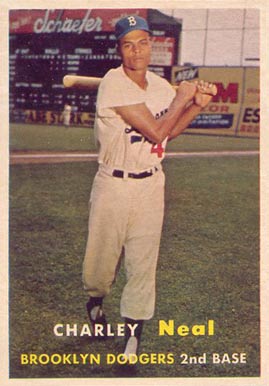
#427 Charlie Neal


The '59 Charlie Neal card was issued during his best season in the majors. Not only was he a member of the World Champion Dodgers, hitting .373 with two dingers, but he was an All Star, led the NL in triples, won a Gold Glove and scored 103 runs. Oh, yeah... his homer in Game Two of the '59 series was the shot that led to poor Al Smith getting a beer shower. We've looked at that before.

Neal's first pro baseball experience was as a member of the Negro Leagues. He signed with the Brooklyn Dodgers in 1950 and spent six seasons clawing his way up the talent-rich Dodger system. He debuted in 1956 as a second baseman hitting .287 in 62 games. He played with the Dodgers in the World Series that season.

In '57 he took over as the club's regular shortstop. He moved back to second when the team went west in 1958 and he made the All Star team that year. After that eventful 1959 season Neal's hitting and playing time diminished. A Sports Illustrated story that was published after his death mentioned that Neal was never the same after 1959. From that story:
But Neal never hit well again. Plagued by injuries and, perhaps, lethargy—"I quit on myself," he said after batting .235 in 1961—Neal was traded to New York in December 1961, where in his last hurrah he helped the Mets lose 120 games. 
As mentioned Neal was traded to the fledgling Mets and after '62 was passed on to the Reds where he finished his career after 1963.

As I read about Neal I didn't see his fielding prowess mentioned until I read that SI article.
Hall of Famer Billy Herman often said that one of his successors as second baseman for the Brooklyn Dodgers, Charlie Neal, made the double play better than any man who ever lived, and to be sure, Neal turned the pivot with a godsent grace.
That's pretty high praise.

Nothing special about this card, though. Looks like the LA Coliseum in the background. My copy has nice corners but is seriously off center. As far as Neal cards go I'd pick his '57 as my favorite. Love the Ebbets Field rightfield scoreboard and wall in the background.


Friday, October 19, 2012

#78 Pedro Ramos


My Dad called him 'Pistol Pete' for no reason I can discern. Pedro Ramos was a Cuban born righthander who broke in with the Washington Senators in 1955. As a starter he led or tied for the AL lead in losses four straight years before the end of the decade pitching for some brutal Nats teams.

The Nats became the Twins and in 1962 they traded Ramos to the Indians with whom he began transitioning to the bullpen. Late in 1964 the Yanks dealt for Ramos and he had a terrific month down the stretch with 8 saves in 12 games as the Yanks won the pennant.

After a couple more good seasons in New York he began a whirlwind tour of the bigs pitching for the Reds, Phils, Pirates and finally found himself back in Washington with the Senators in his last big league stop in 1970. He pitched a bit in the minors before hanging up his glove.

The return to D.C. made him one of the few players to pitch for both the original and expansion Senators. In 15 seasons he went 115 and 160 with 55 saves and was an All Star in 1959. He missed his chance for the post season in 1964 because he was traded for by the Yanks after the deadline.

There are some 'interesting' stories floating around (one told in a book by David Halberstam) about Ramos and  Ted Williams and the signing of a baseball that Ramos used to whiff The Splinter. These don't seem to have any validity. But one story that can't be disputed is the fact that Mickey Mantle blasted a Ramos pitch off the Yankee Stadium facade in May of 1956. One of The Mick's more prodigious blasts for sure. (See the picture/diagram below.) The quote below comes from themick.com which is a page associated with the video bio of Mantle called The American Dream Comes To Life. 


"Pedro and I were friends. He used to challenge me to a foot race before games. In one game one of our pitchers, I don't remember who, knocked down one of the Washington players – you could tell it was a knockdown – and Ramos had to knock down one of our players to protect his guys."I was leading off the next inning and I didn't even think about the knockdown. Everybody on our bench and everybody on their bench and even some of the fans knew I was gonna get a knockdown, but I didn't even think about it."Sure enough, Pedro hit me with his first pitch. It didn't make me mad – he didn't try to hit me in the head or anything, you know, just in the butt – but after the game he came up to me and said, 'Meekie, I'm sorry I have to do that.' I said, 'That's okay. But the next time you do it I'm gonna drag a bunt toward first base and run right up your back.' He said, 'You would really do that?'"The funny thing about it was that the next time up was the time I almost hit one out of Yankee Stadium. It hit the façade. After the game he came up to me and said, 'I'd rather have you run up my back than to hit one over the roof!'"


Ramos' SABR page has a lot of great insight into the colorful Cuban including the story behind the All Cuban Triple Play. ESPN's Page Two has an article about the 'Cuban Senators'. It's a good read, stuff I had never given any thought to. Looks like Ramos is wearing the Nats' home pinstripes in this shot which makes this a rare non-Yankee Stadium shot among the '59 American League players' cards.