Showing posts with label Brooklyn. Show all posts

Saturday, February 22, 2014

#520 Don Elston


Ohio native Don Elston spent eight seasons as a starting pitcher in the Cubs' farm system after he signed with them in 1948. Those years were pretty impressive as a whole and one wonders what kept him 'down on the farm', especially in an organization as mediocre as the Cubs were at the time. The answer is likely his lack of control.

He did get a brief two game look at the end of the 1953 season and was banged around pretty hard. After pitching (and going 17-6) in the tough PCL as property of the Cubs in 1955 Elston was dealt to the Dodgers. Another season in AAA followed and then he made the Brooklyn staff in 1957.

That didn't last long however and after just a single one inning appearance in Ebbets Field in May he was traded back to the Cubs. He finished out that year as a starter/reliever on Chicago's North Side and then in 1958 he emerged as one of the better relief pitchers in the NL. He led the league with 69 appearances, had 10 saves (for a club with just 72 wins) and teamed with lefty Bill Henry to form an effective left/right closing combo.

In 1959 he made the NL All Star squad, pitched an inning and got the save in the first of the two ASGs played that year. He allowed a two out single to Nellie Fox in the top of the ninth at Forbes Field but got Harvey Kuenn to pop out to end it and preserve the NL's 5-4 win. that season he had career highs in wins (10) and saves (13). The save category for pitchers was reportedly created by Chicago newspaperman Jerome Holtzman as a way to show Elston's contributions. Holtzman saw Elroy Face getting wins after blowing leads with the Pirates and thought Elston's work as a reliever was better and deserved recognition.

Elston remained the club's workhorse for several more seasons although his numbers never again matched his '58/'59 run. After spending the 1965 season pitching in the minors Elston retired as an active player although he did manage briefly in the Cubs' system. He then spent the rest of his life in sales and working on behalf of Chicago area charities including the Chicago Baseball Cancer Charities organization for which he served as co-chairperson with another Chicago pitching standout, Billy Pierce.

Elston died at the age of 65 from heart failure in 1995. He had a long history of heart problems extending back to the beginning of his playing days, a fact he never shared with his teammates.

His Chicago Tribune obit has a lot of background and stories from his playing days. This big chunk of that work is worthy of being repeated here:
Don Elston, who died Monday at the age of 65, was like many pitchers of his time. He couldn't get Willie Mays out. Having exhausted his usual repertoire, Elston tried a spitter. Mays hit it over the fence in left center. Next time he threw a knuckler. Again, Mays connected-into the center-field bleachers, a few feet below the Wrigley Field scoreboard. "I don't know what we're going to do with him," catcher Dick Bertell told Elston."And Don said, `Tell him what's coming. He won't believe it, anyway.' "And so Bertell, when he went into his catcher's crouch, asked Mays: "What do you want to hit?"As Bertell recalled Wednesday, Willie didn't reply. "He just gave me a funny look. So I said, `It's going to be a curveball.' And for the rest of that at-bat, I called every pitch."Did Willie take Elston deep again?"No," Bertell replied. "He popped up. From then on, I wouldn't say Don had Willie in his pocket but he didn't get any more big hits off him."

Friday, February 14, 2014

#482 Russ Meyer


Ol' Russ Meyer looks benign in this, his last Topps card. But in his heyday he had a reputation for being more than just slightly 'off the wall'. He had issues with anger and an inability to keep himself out of trouble. Not legal trouble but, well, 'baseball trouble'. I mean his nickname was the 'Mad Monk'... and he got it as a schoolboy so that should tell you a little about him.


Pitching in his hometown of Peru, Illinois Meyer attracted scouts and he signed with his 'close to home' club, the White Sox, in 1942. After a season in the minors he was called to military duty and ended up on a service baseball team. He collapsed on the mound during one outing and was diagnosed with a burst appendix. Complications kept him in the hospital for months and got him a medical discharge.

Returning to civilian ball Meyer signed with the Cubs (apparently the White Sox had not listed his absence correctly) and moved up through their chain as a starter/reliever and got a quick big league look in 1946. That was enough to earn him a spot on the club in 1947 and he spent two years in the North Side winning 10 games in '48 after being given a spot in the rotation.

He was sold to the Phils after that and he won 47 games in four years including a 17-9 year in 1949. He pitched briefly in two games in the 1950 Series against that Yankees. He took the loss in Game Three when, after entering a 2-2 tie in the bottom of the ninth, he got two quick outs before allowing three straight hits and the Yanks' winning run.

Meyer was involved in a complicated four team deal prior to the 1953 season and found himself in Brooklyn pitching for the Dodgers. His antics no doubt amused the fun loving Brooklyn fans. From his SABR bio:

[Robin] Roberts in his autobiography recalled an incident in 1953, after the Phillies traded Meyer to the Brooklyn Dodgers. Pitching against the Phillies in Connie Mack Stadium, Meyer walked Richie Ashburn with the bases loaded, forcing in the go-ahead run. Meyer charged off the mound to protest to umpire Augie Donatelli. Meyer’s language got him ejected by Donatelli. But he returned to the mound and just refused to leave until manager Charlie Dressen came out to get him. Finally Russ stomped off the mound. As he stomped off the mound he flipped the rosin bag into the air with disgust. The rosin bag flew 30 feet in the air and came down directly on Meyer’s head. White powder flew everywhere, and even Monk had to laugh a little, Roberts said.Monk wasn’t through, however. When he got to the dugout, Roberts said, he yelled at Donatelli and grabbed his crotch. Unfortunately, the game was the television Game of the Week, and a camera in the dugout caught the whole episode and displayed it to the nation. The network switchboard lit up like a Christmas tree. For about the next ten years baseball had a “Meyer” Rule that forbade cameras in the dugout. And Meyer was fined and suspended for three days, one of at least three suspensions he received during his career.
With the Bums Meyer went 26-11 over his first two seasons but his other numbers don't look as impressive and the strong Brooklyn teams helped that win total. He won and lost World Series' with Brooklyn. In the '55 series he entered Game Five with the bases loaded in the third and promptly gave up a grand slam to Mickey Mantle.

Fresh off the '55 Series win he was traded to the Cubs and spent the next few seasons bouncing around the majors with three teams and had a minor league stint before leaving the game and not pitching in 1958. Meyer returned to pitch for the A's in 1959 and he is airbrushed into their cap for this card. He was released in July of that year after 18 appearances.

He went on to coach for the Yankees in their minor league system and for a season as bench coach. He retired in 1992 to operate a bowling alley.

His N. Y. Times obit (he died in 1997) contains this interesting tidbit:
In June 1981, Meyer returned to Brooklyn with his former teammates Carl Erskine and Sandy Amoros to promote a quest to bring the Dodgers back from Los Angeles. But in renewing old times, he lost his treasured rewards from his Dodger days: He was held up at gunpoint and had his 1953 and 1955 Dodger World Series rings stolen. At least it did not happen in Brooklyn -- the scene of the crime was Lexington Avenue and East 25th Street.
Meyer's SABR bio is, as you might expect, an interesting read.

Dodger history fans might enjoy this photo archive site I stumbled across while looking for Meyer facts. Here is one photo and the text that accompanies it:


Close-up of manager and pitcher conferring, apparently on pitcher's mound, with manager pointing finger at pitcher's chest. Caption on verso: "Temper, Temper: Russ Meyer, left, newest Dodger and explosive right-handed pitcher, gets the word to straighten up and fly right from manager Charley Dresses at Vero Beach (Fla.), training camp."

Sunday, February 2, 2014

#446 Rocky Nelson


Glenn 'Rocky' Nelson had such a varied and interesting career I hardly know where to start, so let's try the beginning. Nelson signed with the St. Louis Cardinals as a 17 year-old first baseman in 1942. After a year in the minors Uncle Sam called and he spent three years in the Army during WWII. My usual sources don't provide many details but it's a good bet he was overseas during that time.

Upon re-entering baseball Nelson had three seasons in the well stocked Cardinals chain hitting over .300 in each of them. He made his big league debut with the Cards in 1949 but, in what became the story of his career, he just didn't approach his minor league numbers. He split the next season between the majors and minors (hitting over .400 at AAA in almost 50 games!) and in 1951 was traded to the Pirates for his first stint with the Buccos.

He finished the 1951 season with the White Sox after being waived and then was traded to the Dodgers after the season. That deal meant that Nelson had been the property of four different franchises within 9 months! The Dodgers won the NL pennant in 1952 and Nelson, having been recalled from the minors in August, got into the '52 Series with a handful of pinch hit opportunities.

He spent '53 and most of '54 with the Montreal Royals, the Dodgers' AA club and had a monstrous run. Particularly impressive was Nelson's 1953 season when he hit .308 with 36 homers and 131 RBIs and won the International League MVP award. The Dodgers, with Gil Hodges holding down first base, had no room at the top for the minor league slugger. They had traded him to the Indians after that remarkable '53 year but bought him back in May and watched him tear up the IL again.

Back with the Royals in 1955 Nelson won his second of three IL MVPs with impressive ease and was threatening to repeat in '56 when the Dodgers recalled him in June. He struggled for two months in Brooklyn and was traded to the Cardinals for his second run in St. Louis.

He played for Toronto, the Cards' AA club for two years and again excelled. He won the 1958 IL MVP and for that he was rewarded by being drafted away by the Pirates. Finally, at 34 years old, Nelson managed to get himself a steady big league gig. He played as a platoon first baseman for Pittsburgh for three seasons, putting together productive years in '59 and 1960. He played a part in the '60 Series against the Yanks. I'll let his Baseball Reference Bullpen page recount that:
Nelson started Game 2 of the 1960 World Series and had 2 singles against the New York Yankees' Bob Turley. But Stuart, who led the Pirates in home runs that year, started games 1, 3, 4, 5 and 6. With the series tied at 3 wins apiece and Stuart struggling with just 3 singles in 20 at-bats and no RBIs, manager Danny Murtaugh started Nelson at first base in Game 7, as the Yankees again started Turley. Nelson responded with a two-run home run in the 1st inning to stake the Pirates to an early lead. But he was also involved in a strange play that allowed the Yankees to tie the game 9-9 in the top of the 9th inning of that game. With the Pirates leading 9-8, Yogi Berra at bat, Gil McDougald on third base and Mickey Mantle on first, Berra hit a hard shot at Nelson. Nelson fielded the ball inches from first base and stepped on the bag for the second out as McDougald raced for the plate with the tying run. Mantle, with a short lead off first base, hesitated when the ball was hit, possibly unsure if Nelson caught it in the air. But although the ball had not been caught in the air, Mantle was not forced to advance to second base because Nelson had already eliminated the force when he stepped on the first base bag. Nelson turned to throw to second base, expecting Mantle to be advancing. But Mantle dove back toward first base. Nelson then dove at Mantle and missed. With both players sprawled on the ground and Mantle safely back at first base, McDougald scored the tying run to make the score 9-9. However, that changed quickly when Bill Mazeroski led off the bottom of the 9th inning with a home run against Ralph Terry to win the game, 10-9, and give the Pirates the championship. Stuart, who was on deck to pinch-hit for winning pitcher Harvey Haddix, did not appear in the game. At age 35, Nelson had his finest season in the majors and finished it by homering as the cleanup hitter in a championship game. Nelson hit .333 (3 for 9) in the World Series.
His bat finally failed him in 1961 and in '62 he kicked around the minors with three clubs before he retired. He finished his big league career with 31 homers but in the minors he hit 234 and in 1960 he was named to the International League Hall of Fame. Given that his huge seasons came with Montreal and Toronto it's little wonder he is also a member of the Canadian Baseball Hall of Fame. Along the way he played on four pennant winning teams, the '52 and '56 Dodgers, the '54 Indians and of course the 1960 Pirates.

Lots of interesting Nelson internet resources. The Hardball Times has a detailed and entertaining Rocky Nelson career retrospective. The official MiLB site has a page with emphasis on his minor league exploits.

The card has one of those 'painted over' portraits that makes it difficult (ok, impossible) to determine where it was taken and what uni Nelson is actually wearing.


Saturday, December 28, 2013

#364 Danny McDevitt


Danny McDevitt is the first Dodger that I've posted for quite awhile. Looks like a spring training shot that's been 'painted' over. Probably a Vero Beach photo.

McDevitt signed with the New York Yankees late in 1951 out of St. Bonaventure College and reported for work that September to the Yanks' low minor league clubs. He got into 7 games and was whacked around pretty good on the rare occasion he got the ball over the plate. Apparently the Yanks decided that they had made a mistake and released him.

McDevitt signed with the Dodgers that off season and had a much better year in their system but he still had control issues as evidenced by his 171 walks allowed in 199 innings. Then it was off to the military for a couple of years. When he returned in 1955 he began a two and a half season stretch during which he continued to struggle with control. His work in 1957 was good enough however to earn him a promotion to Brooklyn and secure him a spot in the rotation alongside Don Drysdale, Johnny Podres and Don Newcombe. In his first start on June 17 he pitched a complete game against the Reds allowing two runs on seven hits and fanning 11. He went on to a 7-4 record with a couple of shutouts that year.

One of those shutouts came in the very last game ever played in Ebbets Field. McDevitt handcuffed the Pirates that day on five hits. A brief video of that final Ebbets Field out was on You Tube and I've posted it here:


McDevitt's recollections of the game are featured in his L.A. Times obit:
"It was just another game, as far as I knew," McDevitt told Times columnist Jerry Crowe in 2007. "All the older guys – Pee Wee [Reese] and Duke [Snider] and those guys – seemed to know the facts, but I didn't know.
"I couldn't believe that after working my butt off to get to Brooklyn that I would be going back to another minor league town, which is what L.A. was then."

A brutal start to the '58 season earned McDevitt a demotion to the minors and when he was recalled in August he wasn't much better. 1959 was McDevitt's 'bounce-back' season as he went 10-8 in 39 appearances including 22 starts. He earned four saves as well. The Dodgers and Braves tied atop the NL standings that year and McDevitt drew the first playoff game assignment. He was KO'd in the second inning but the Dodgers won the playoff series and went on to win the World Series. McDevitt didn't pitch against the White Sox.

He continued his up and down trend with a poor 1960 season. He was sold to his original team, the Yankees that winter and was traded to the Twins in June. He pitched for the A's in 1962 and was out of baseball as an active player later that year. He went on to work as an umpire in the minors and later sold real estate among other jobs.

A Google search turned up a book on Cuban Winter League baseball that featured a story of an incident between McDevitt and an umpire that had some serious consequences. I also found a neat picture of McDevitt in Ebbets Field.


Tuesday, December 10, 2013

#253 Seth Morehead


On the last day of the 1957 season lefty Seth Morehead became the answer to two trivia questions: "Who was the last pitcher to face the Brooklyn Dodgers?" and "Who was the last pitcher to face Roy Campanella?"

In that game on September 29th, Morehead's first career start and first win, he hurled a tidy four hitter as the Phils won, 2-1. Campy pinch hit for Dodger starter Roger Craig in the top of the eighth and flied to center. (Side note... Sandy Koufax pitched the bottom of the eighth to become the last man to throw a pitch in a Brooklyn uniform.)

Up until that point in his rookie season Morehead had pitched 33 times in relief with a loss and a save. He finished the year with an ERA of 3.68 which was down from well over 6 in mid-July. Prior to that season he had spent five seasons as a starter in the Phillies' system following his signing out of Shreveport, Louisiana in 1951.

Morehead made eleven starts for the Phillies in 1958 and was treated pretty roughly by NL hitters. His '59 numbers were trending the same way when the Phils moved him to the Cubs in May. His work that year for the Cubs produced the similar results but in 1960 he improved significantly. Although he was only 2-9 on the North Side appeared in 45 games and had his best WHIP and his ERA was below 4.00 for the first time since his rookie year.

Traded to the Braves on the eve of the 1961 season, Morehead picked up an early season relief win but he was ineffective otherwise and by late May he was in the minors. One last appearance came in September of that year and then he was back in the minors for two seasons before retiring.

After baseball Morehead completed his degree at Baylor University and was in the finance/insurance business for 36 years before he retired for good. In this book excerpt writer Willie Morris tells a good story of meeting him at a banquet many years after Morehead had fanned him four times in a Louisiana youth league championship game.

Pretty neat card with Morehead shown at Connie Mack Stadium inside a black frame.


Tuesday, September 3, 2013

#174 Jim Pendleton


Jim Pendleton is cooler than you thought. Really, he is. Want proof?

1) He played every position on the field except pitcher and catcher in the majors.
2) He was the last WWII vet to play in the bigs when he played left field for the fledgling Houston Colt 45s on Opening Day, 1962.
3) He was a near-full time outfielder for the Braves in 1953 but got squeezed out by a hot rookie in 1954... Hank Aaron.
4) His nickname was 'Guv'nor'.
5) He was originally signed by the Brooklyn Dodgers and moved from the outfield to shortstop because of a logjam of OF talent, think Duke Snider.

Most of that and more comes from a wonderful tribute to Jim Pendleton written as an obit in 1996 by the terrific Houston writer and author, Mickey Herskowitz. It's a quick read and highly recommended. And it tells the tale of Jim Pendleton better than I can.


Tuesday, June 25, 2013

#394 Randy Jackson


Randy Jackson does his best in this shot to live up to his nickname of 'Handsom Ransom'. Yes, his given name is Ransom. I checked into that at Baseball Reference to see if Randy here is the only 'Ransom' to have a record in the game. Turns out that Bob Rush, longtime NL pitcher, has Ransom as his middle name and has a card in this '59 set. We'll see that one of these days. BTW, I've also seen Jackson's nickname spelled as 'Handsome'.

But the name is shared by four minor leaguers including two I felt compelled to mention, Ransom(e) Crisp and Ransom Pringle. Mr. Pringle played for the Celoron Acme Colored Giants based in Jamestown, New York in the Iron and Oil League way back in 1898. The IOL was around in a couple of different forms back in the 1890's. Honus Wagner and his brother Butts Wagner both played in it. The Celeron club was the only black team. How cool is all that!?!?

But back to Handsom Ransom. He's a native of Arkansas who attended the University of Arkansas, transferred to TCU and then to the University of Texas. I wonder if he left behind a string of broken hearts given how damn 'handsom' he was. He played football and baseball in college and led both the Longhorns and Horned Frogs to Cotton Bowls as a halfback.

Jackson was signed by the Cubs in 1947 and spent three seasons in the minors. But he got a chance to taste the majors with a 34 game trial in 1950. In '51 he took over the regular 3rd base job for Chicago and held it for five years. Over that period he batted .265 and made the NL All Star squad in both '54 and '55, getting an RBI single in the later of those two appearances.

He was traded to the Brooklyn Dodgers and played on their World Series club in '56 after sharing the hot corner spot with Jackie Robinson. That was his last year as a regular as he suffered knee injury in 1957. He spent the next three seasons shuttling between the Dodgers, Indians and Cubs (again).  For some reason his retirement announcement was noted in the Victoria (Tx) Advocate in 1959. I guess he was still a name in Texas based on his football days. Check out the story to the right of the Jackson blurb. Seems Dodger coach Charlie Dressen was fined $300 for 'acting up' during the '59 Series.

There is an interview with Jackson and more insights into his career on this webpage. I'll let Wikipedia supply some Randy Jackson tidbits, cuz I'm getting tired of typing:


  • 28 September 1957: Hit the final home run in Brooklyn Dodgers history before the team moved to Los Angeles for the 1958 season in a 8-4 victory over the Phillies.
  • Another unusual game occurred on June 29, 1956, he was playing for the Brooklyn Dodgers against the Philadelphia Phillies, who were leading 5-2 going into the bottom of the ninth inning. Pee Wee Reece(sic) was on second base when Duke Snider preceded Jackson with a home run which brought the game to 5-4. Jackson then hit a homerun to tie the game, and on the next pitch Gil Hodges hit another home run to win the game for the Dodgers. This was the only time in Major League history that a baseball game ended with three consecutive home runs.
  • 17 April 1954: With the wind at his back, he had four hits, including a home run that hit an apartment building on Waveland Avenue, across from Wrigley Field, in a NL record three-hour and 43-minute game against the St. Louis Cardinals. The Cubs won the game 23–13, the highest scoring game ever between these two rivals, and the two teams combine for 35 hits, including five homers and a 10-run Chicago 5th inning. Jim Brosnan is the winning pitcher over Gerry Staley.


Wednesday, June 5, 2013

#277 Turk Lown


Turk Lown has to be the 20th White Sox pitcher with a red framed card and a shot taken at Yankee Stadium with the 3rd base side grandstands in the background. OK, maybe not the 20th. But there have been several and they tend to run together and when you add in the nearly identical Detroit Tigers' pitchers' cards.... well, I am getting deja vu all over again.

Anyway, Turk Lown (real name Omar Joseph Lown) came out of Brooklyn and was signed by his home borough Dodgers in 1942. After a year in the minors he spent three years in the military and then returned to pitch his way up through the Dodgers' system. He had some pretty good years along the way. But the Dodgers being the Dodgers Lown had a hard time squeezing himself into a big league role and in 1951 the Cubs rescued him via the old Rule 5 draft.

With the Cubbies through May of 1958 (he spent part of 1954 and all of 1955 in the minors) Lown evolved from a spot starter/reliever into a closer, or at least a game 'finisher'. In '56 he pitched 61 times and in '57 he led the NL in appearances with 67. He had 47 games 'finished' in both of those seasons and saved 25 which was a lot back then. He moved to the Reds and then the White Sox in 1958.

He and Jerry Staley formed a formidable one-two bullpen punch in 1959 for the pennant winning Sox and manager Al Lopez gave them much of the credit for that clubs' success. Lown led the way with a league high 15 saves. He appeared three times in the World Series that year and allowed two hits and no runs in 3.1 innings.

Lown slumped in 1960, rebounded with a good year in '61 and after a decent year in 1962 he left the game. He'd been released by the Sox and turned down an invite to the Reds' spring camp. He took a job with the postal service in Colorado and worked there for many years.

I love the S-O-X caps the White Sox wore in the late 50's. And the touch of red on the cap's lettering was duplicated in the stirrups. Those road unis are pretty sweet. So, maybe having all the Sox pitchers in the same type shot isn't so bad. My copy is a replacement and it's still one of the lesser quality cards in my set. It looks better in person but the scan brings out the surface marks.


Monday, May 20, 2013

#336 Billy Loes


Billy Loes won 80 games in 11 seasons with the Dodgers, Orioles and Giants but he left behind a much bigger legacy as a character and 'eccentric'. The Long Island native was a Brooklyn Dodger signee in 1948 Loes had an impressive minor league season the next year and got a taste of the majors in 1950.

He spent '51 in the service and returned for begin a string of successful seasons in Brooklyn, going 50-25 in the course of four seasons. He pitched in three World Series for the Boys of Summer, winning a ring in 1955.

Sold to the Orioles in May of '56 he won 12 games in 1957 but never saw much success while hanging on through 1961 with the Giants. But as noted, Loes is remembered for his colorful and generally odd personality.

From a New York Daily News story published after Loes' death in 2010:


Dodgers Hall of Fame catcher Roy Campanella once said of Loes: "How can I say why he doesn't win 20 when I can't even tell what he's going to do from pitch to pitch."That was never more evident than in Game 2 of the 1955 World Series against the Yankees when Loes hurled three innings of shutout ball, striking out five and inducing three double play balls - only to suddenly get kayoed on five hits and four runs in the fourth. Said Campy: "He started thinking. He had 'em going on fastballs and curves for three innings when he suddenly decided to throw change-ups."Before the 1952 Series, Loes reportedly predicted the Yankees would beat the Dodgers in six games. Years later, however, he said he was misquoted. "I never said that," he insisted. "What I said was they'd beat us in seven games." Which they did.But perhaps the most infamous Loes episode occurred in Game 6 of the '52 Series at Ebbets Field when he claimed to have lost a ground ball in the sun. What happened was Yankee starting pitcher Vic Raschi hit a ball off Loes' leg that caromed into right field, scoring Gene Woodling from second and sending the Yanks to a 3-2 victory that tied the Series 3-3. They won it the next day. Everyone laughed when Loes insisted he'd lost Raschi's grounder in the sun, but as Dodger pitcher Carl Erskine later explained: "That's exactly what happened. At that time of the afternoon in Ebbets Field, the sun came through a space in the grandstand behind the plate and could blind you."


Billy Loes and his dog in 1954. 


Tuesday, May 14, 2013

#324 Don Demeter


Oklahoma native Don Demeter was a Brooklyn Dodger signee in 1953 and played eleven years in the majors, for five different teams. Never a star, he did have a career he can be proud of. But sometimes a dry recitation of stats, trades, accomplishments and the like just doesn't do a guy justice.

I found a wonderful video about Don Demeter. It was done, with much love obviously, by his grandson. The ballplayer-turned-preacher talks of his life and career. It's six minutes long and worth it.


If you are interested in more about this gem of a guy you can read his SABR page or a nice article written about his induction into the Oklahoma Sports Hall of Fame.

Thursday, March 21, 2013

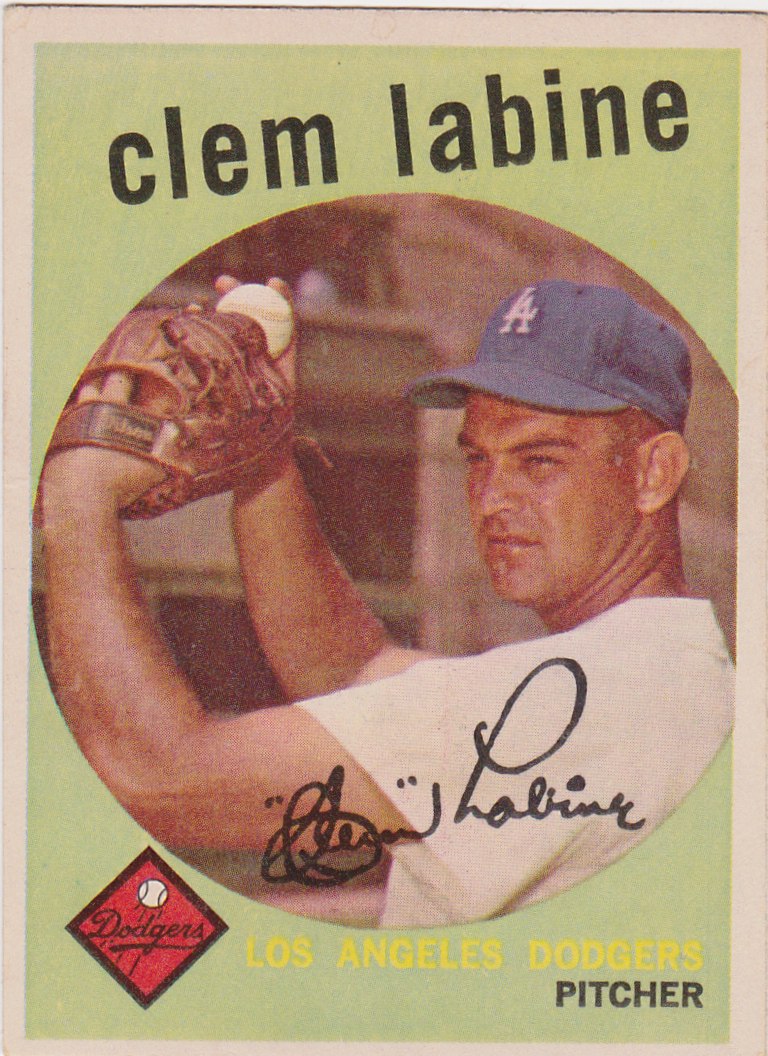
#403 Clem Labine


Gonna post this awesome Clem Labine without doing too much research. I've been in NYC for awhile and am currently knee deep in projects to catch up on.

So, here's Clem who is the child of Canadian immigrants and spoke only French until the age of seven. He was a good enough athlete as a kid to catch the eye of the Dodgers organisation and he signed in 1944 after dropping out of high school.

He spent a year in the service and worked up thru the Dodger's chain until he debuted in 1950. Unlike many relievers of the day he was not a converted (or failed) starter. He led the league in saves twice and games pitched once. He appeared in five World Series, four with the Dodgers and he won two rings with them. He also pitched for the Pirates in the monumental slugfest that was the 1960 Series against the Yanks and he won a ring that year, too. His postseason numbers took a real hit in that Series.

He was 77-56 with 97 saves in twelve major league seasons. 70 of those wins and 86 of his saves were with the Dodgers. He hit three homers in the bigs, all in 1955 and those were the only hits he had all season in 31 at bats. That's a strange stat.

His New York Times obit from 2007 is a good read and this excerpt is really all you need to know about Clement Walter Labine:

Through those summers of the 1950s, Labine was a confident figure, relieving pitching mainstays like Erskine, Don Newcombe, Preacher Roe and Johnny Podres.
“If you had a lead, there was this thing where about the seventh or eighth inning, where he’d get up, sort of a ritual, and walk down to the bullpen,” the former Dodgers pitcher Roger Craig told Bob Cairns in “Pen Men,” an oral history of relief pitching. “Clem was kind of a cocky, arrogant type, which was good. I liked it. He’d fold his glove up and put it in his pocket. I can see him now, strutting down to the bullpen and the fans cheering.”
The Dodgers website and the L.A. Times have more on Labine. Love the expression on his card and the seafoam green frame is sweet. Sorry Clem, you deserve a better post that this.

Wednesday, March 6, 2013

#107 Norm Larker


Norm Larker began as a pro in 1949 in his hometown of Hazleton, Pennsylvania and caught the eye of Brooklyn scouts who signed him for the 1950 season. Larker began a long trek through the loaded Dodger system as an outfielder before he finally emerged with the now-Los Angeles Dodgers in 1958.

In his rookie season he batted .277 in 99 games. The following year, 1959, he played mostly first base and picked up a World Series ring playing in all six games and hitting .188. In 1960 he moved to first base spelling Gil Hodges and had by far his best season. Hitting .323 he finished 2nd in the batting race and made the NL All Star squad.

His production and playing time declined in 1961 and he was drafted by the expansion Houston franchise for which he played one year. He was traded to the Braves and then to the Giants late in 1963. That was his last season in the majors although he played some minor league ball and also played in Japan through 1966.

Pretty standard card for this set. That's the LA Coliseum in the background.

The September 10, 1962 issue of Sports Illustrated featured a bit of by-play that included both Norm Larker and a player whose card was featured a week or so ago, Hal Woodeshick:

The Houston Colts put on quite a show for early arrivals in Cincinnati's Crosley Field recently. First, Pitcher Hal Woodeshick and Catcher Jim Campbell almost had a fight when Campbell tried to hurry his teammate out of the batting cage. Woodeshick refused to be hurried, saying, "I'm taking my cuts." "What for?" said Campbell. "You're never around long enough to bat." Woodeshick went for Campbell and the two had to be separated.
Then Infielder Bob Aspromonte, upset because First Baseman Norm Larker wouldn't let him use one of his bats, threw it the length of the dugout and broke the knob end. Then he pulled all of Larker's bats out of the rack onto the concrete floor. Larker didn't go for Aspromonte—just for Aspromonte's bats, pulling them out of the rack and flinging them to the floor, too. When none broke, he took one and started hitting it against the concrete steps.
"What in hell is going on here?" suddenly roared Manager Harry Craft, and an uneasy peace settled over the Houston Colts.

Sunday, January 27, 2013

#16 Joe Pignatano


Catcher Joe Pignatano was signed off the streets of Brooklyn in 1948. Debuting for the Dodgers that very year was a guy named Roy Campanella. If Joe had only known. And he nearly didn't make a career of it according to his SABR bio. Read the part about his mother calling the Dodgers front office. Nice.

But he patiently worked his way up the Dodger system, served two military years, and made the big club in 1957. When Campy suffered his spinal injury that winter Pignatano was plugged in behind the plate along with Johnny Roseboro. He played with the Dodgers through 1960 and earned a World Series ring in '59. He was sold to the A's for the '61 season and had his best season while getting a career high of nearly 300 at bats. After a season (1962) split between the Giants and Mets Pigatano was back in the minors for a few years before he became a coach with the Senators, Mets and Braves. In those first two coaching jobs he was working under his friend and former teammate Gil Hodges.

Here is a strange but apparently true story culled from Pignatano's Bullpen page at Baseball Reference:
Playing for the Fort Worth Cats in 1955, Pignatano was listed as the number 8 batter in the lineup on May 29. In the second inning he went to the plate in the number 7 spot and hit a home run. On appeal by the opposing Shreveport Sports, the hit was nullified and the proper batter, Maury Wills, was called out. Pignatano then batted in the number 8 spot, and hit another homer.
And finally here is Vin Scully broadcasting the Dodgers game on the night of Joe Pignatano's MLB debut as a catcher. He asks anyone who knows the Pignatano family to call Joe's wife at home in Brooklyn to alert her of Joe's impending shot. This is why I love Vin Scully!


Turns out Joe did get into the game, taking over behind the plate for Roy Campanella who had been run for in the fifth as was asked to handle Sandy Koufax' fastballs. He singled in his first at bat and whiffed in his second.

The easily recognizable LA Coliseum looms behind Pignatano smiling face on this card. He sure looks different than I remember him a decade later with the Mets.

Saturday, December 22, 2012

#418 Gino Cimoli


Gino Cimoli was a ballplayer of Italian decent out of the San Francisco Bay area. So was Joe DiMaggio. And although Cimoli had a nice career the comparison stops there. After signing with the Dodgers in 1949 he spent about half a decade in their chain putting up good numbers for the most part but unable to crack the star laden major league roster. Of course getting to play four seasons in Montreal, one of the world's greatest cities (IMHO) isn't a bad way to enjoy your minor league time.

According to at least one blog Cimoli, who had garnered a reputation for being a hothead who didn't work very hard, apparently received a jolt when his wife and kids were involved in a car wreck in 1955. He made the Dodgers in 1956 but was used sparingly before he grabbed a regular outfield slot in 1957.  That year he made the NL All Star team while hitting .293 with 10 dingers.

In 1958 he found himself with the Dodgers in LA and he became the first major league hitter to bat with a West Coast team. The Dodgers opened that first season in California against the Giants at Seals Stadium in San Francisco. Cimoli struck out against the Giants' Ruben Gomez to lead off the game.

He was traded to the Cards for 1959 (he missed the Dodgers' World Series season) and then on to the Pirates for 1960 where he won himself a championship while being used as the 4th outfielder. During the '61 season Cimoli was dealt to the Braves and he went on to play for the A's, Orioles and Angels before retiring after 1965. In 1962 he had led the AL in triples. After his retirement from baseball he drove for more than two decades for UPS.

Looks like Cimoli had a Cards' cap logo airbrushed on for this card. It's a pic taken at the LA Coliseum and the Dodger lettering on his jersey can be seen peeking out. Nice card anyway. Blue Cardinal cards are pretty sweet.


Tuesday, December 4, 2012

#321 Bob Giallombardo


Quick quiz: Name a player who was a hard throwing lefthanded pitcher out of Brooklyn's Lafayette High School who was signed by the Dodgers in the mid 1950s. If you said "Sandy Koufax" you'd be right. If you said "Bob Giallombardo" you'd also be right (and you'd be looked at strangely).

Giallombardo was indeed a schoolmate of Koufax at Lafayette. But the two were never on the same staff due to what the coaches considered Giallombardo 'not being ready'. The story, and a whole lot more about this interesting player, can be found in this examiner.com article.

In that article Giallombardo discusses the shoulder injury he incurred in winter ball following the '58 season that cost him a lot of his arm strength and essentially finished his chances as a major leaguer. His big league career consisted of five starts and a relief appearance in a months time in the middle of the '58 season. The highlight was his only big league win in the second game of a doubleheader in the L.A. Coliseum on July 13th against the Reds. Giallombardo pitched into the ninth and yielded to Clem Labine for the final two outs in a 3-2 win.

Giallombardo had an interesting life after baseball managing the Gil Hodges Bowling Lanes in Brooklyn, selling insurance, and as a supervisor of roofers for the New York Housing Authority for twenty years. He then retired to Waxhaw, a small village some 20 miles south of Charlotte, NC to be near his daughter and her family.

The yellow framed cards of Dodgers taken in the Coliseum combining the sharp home duds and Dodger logo to produce some sweet visuals. This one is no different. The 'optioned' notation on the reverse is a variation. It's more common than the #321s without it. I have both but the other one, the one without the 'optioned' line is in poor condition.


Sunday, October 21, 2012

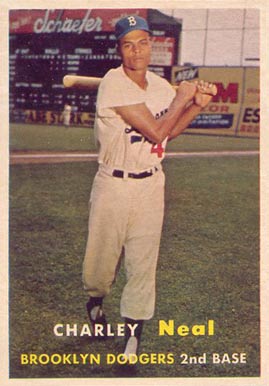
#427 Charlie Neal


The '59 Charlie Neal card was issued during his best season in the majors. Not only was he a member of the World Champion Dodgers, hitting .373 with two dingers, but he was an All Star, led the NL in triples, won a Gold Glove and scored 103 runs. Oh, yeah... his homer in Game Two of the '59 series was the shot that led to poor Al Smith getting a beer shower. We've looked at that before.

Neal's first pro baseball experience was as a member of the Negro Leagues. He signed with the Brooklyn Dodgers in 1950 and spent six seasons clawing his way up the talent-rich Dodger system. He debuted in 1956 as a second baseman hitting .287 in 62 games. He played with the Dodgers in the World Series that season.

In '57 he took over as the club's regular shortstop. He moved back to second when the team went west in 1958 and he made the All Star team that year. After that eventful 1959 season Neal's hitting and playing time diminished. A Sports Illustrated story that was published after his death mentioned that Neal was never the same after 1959. From that story:
But Neal never hit well again. Plagued by injuries and, perhaps, lethargy—"I quit on myself," he said after batting .235 in 1961—Neal was traded to New York in December 1961, where in his last hurrah he helped the Mets lose 120 games. 
As mentioned Neal was traded to the fledgling Mets and after '62 was passed on to the Reds where he finished his career after 1963.

As I read about Neal I didn't see his fielding prowess mentioned until I read that SI article.
Hall of Famer Billy Herman often said that one of his successors as second baseman for the Brooklyn Dodgers, Charlie Neal, made the double play better than any man who ever lived, and to be sure, Neal turned the pivot with a godsent grace.
That's pretty high praise.

Nothing special about this card, though. Looks like the LA Coliseum in the background. My copy has nice corners but is seriously off center. As far as Neal cards go I'd pick his '57 as my favorite. Love the Ebbets Field rightfield scoreboard and wall in the background.


Thursday, September 27, 2012

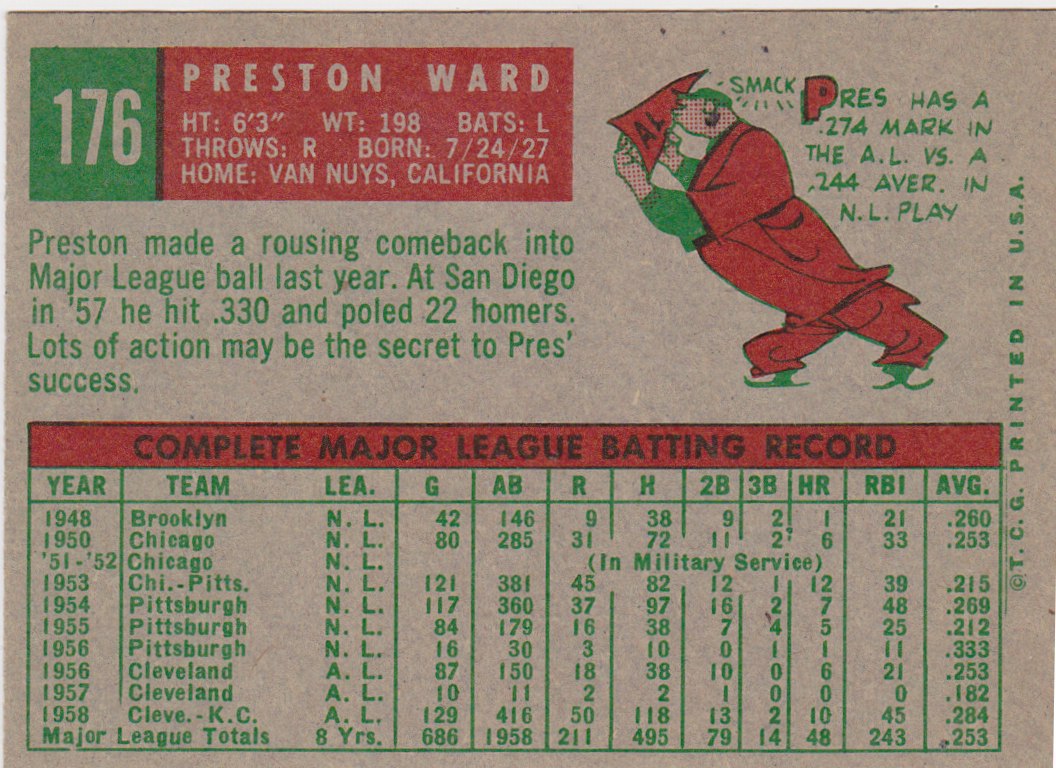
#176 Preston Ward


Handy but light hitting Preston Ward was signed by the Brooklyn Dodgers in 1944 and climbed through their loaded minor league system before getting a shot with them in 1948. He hit a respectable .260 in 62 games but was back in the minors the following year and then sold to the Cubs.

He was a semi-regular with Chicago in 1950 but his baseball career was put on hold with a military stint in '51/'52. When he returned the Cubs dealt him to the Pirates and, after a few years as a platoon 1B/outfielder he moved on to the Indians in '56 and Athletics in 1958. His numbers in 1958 reflect his best season as he hit .281 with 10 homers in 400+ at bats splitting tine between the Indians and A's. 1959 was his last shot in the majors.

Ward was another of the many ballplayers in the '59 set that left a basketball career in the dust to sign a major league contract. Ward was a captain and All-Conference selection at Missouri State in the late 40s.

Wednesday, September 5, 2012

#120 Chuck Coles The Sporting News Rookie Stars


Chuck Coles' major league career was over by the time this card was issued in 1959. A Pennsylvania schoolboy star, Coles was signee of the Brooklyn Dodgers in 1950 and when he made his pro debut with Valdosta that year he won the Gulf-Florida League batting title and was the All Star Game MVP. Coles was dealt to the Reds organization in 1958. After his long career in the minors during which he put up some good hitting numbers Coles made his major league debut late in September of '58.

He played in five games driving in a pair of runs. He never made it back to the bigs. He played in the minors in the Reds' and Twins' chains before hanging up his spikes after the 1963 season.

Coles went back to his hometown of Jefferson, Pa. and worked as a millwright. He died in 1996 at the age of 64.

This is one of the most mis-cut cards I have among my '59s. I've seen a lot of mis-cut Rookie Star cards from this set.


Saturday, August 18, 2012

#133 Bob Lillis The Sporting News Rookie Star


Bob Lillis might have been a "Rookie Star" in 1959 according to the Sporting News but he was no fresh faced kid. Lillis had been drafted by the Dodgers in 1951 and prior to that he'd been a multi-sport athlete at USC (where, if you are to believe the cartoon, the chicks really dug him). Lillis spent most of the decade in the Bums' minor league chain and serving in the military. That'll happen when you have Pee Wee Reese ahead of you in the organisation's food chain.

When he finally had a shot at starting in 1958 he got hurt and the job went to Maury Wills. Lillis was soon traded to St. Louis and then was drafted by the expansion Colt 45s. He was that club's MVP in their first season hitting .249. Lillis remained the team's infield anchor until the young duo of Joe Morgan and Sonny Jackson claimed the middle infield for Houston. Lillis retired as a player after the '67 campaign.

He went on to fill a number of front office roles for the Astros and served as a coach and finally manager in the mid 80s. He was runner-up in the Manager of the Year vote in 1983. He later coached on the San Francisco staff for more than a decade.

.


Wednesday, July 18, 2012

#495 Johnny Podres


Lefty Johnny Podres will forever own a spot in Dodger fans' hearts. Particularly those fans with an interest in the history of the franchise. In 1955 Podres had gone 9-10 in his third year as a Dodger starter. Podres won both the 3rd and 7th game of that '55 Series and was named Series MVP for pushing the Boys of Summer to their only title. 

Podres also pitched for four other Dodger World Series clubs, in '53 for the Brooklyn version and in '59, '63 and '65 (he didn't pitch in the 1965 Series) and was a combined 4-1 in postseason starts.

From his debut in 1953 through being dealt to the Tigers early in 1966 he won 136 games and lost 104 for the Dodgers with a 3.66 ERA. He added a dozen win for the Tigers and fledgling San Diego Padres before retiring after the 1969 season. 


Sidebar: Podres was born in upstate New York. I was there (and all over that state) recently and it's one of my favorite places. History plus natural beauty. Some day if I'm lucky I'll retire to a spot in the Adirondacks. 

Podres is also featured on one of my favorite cards ever, one I keep an eye peeled for online all the time. 1963 Topps #412 Dodgers' Big Three.


Read his NY Times obit for some nice Podres info. And check his website for additional pics.